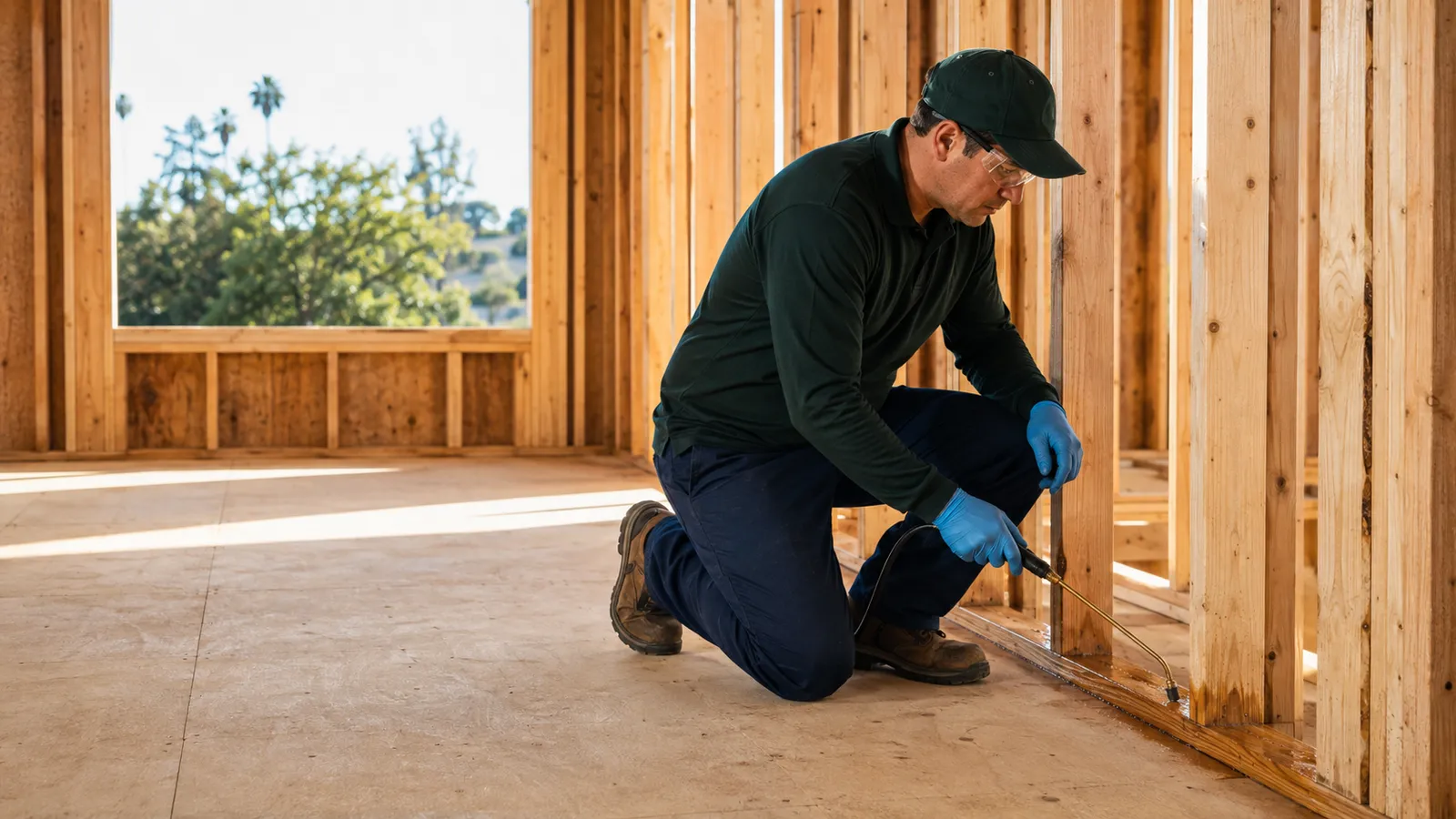
What is termite pretreatment for new construction?
It is termite protection applied during the build, before the structure is closed up. There are two distinct treatments and they happen at different moments. Pre-construction soil treatment goes down before the concrete is poured, creating a treated zone in the soil that subterranean termites cannot cross to reach the structure. Borate wood treatment is applied to the framing after it is up and sheathed but before insulation and drywall — the borate is absorbed into the wood and stays there, protecting against termites, carpenter ants, wood-boring beetles, and decay fungi for the life of the lumber. Both windows close permanently once the next trade starts work, which is why scheduling matters more here than on any other service we offer.
Service Overview
There is exactly one point in a building's life when every stud, joist, and rafter is exposed and reachable, and it lasts a few weeks. Treat the wood then and the protection is in the lumber for as long as the lumber is there. Miss the window and that same framing is sealed behind insulation, drywall, and finish work — after which protecting it means opening walls, drilling, or tenting the finished building. Pretreatment is the cheapest termite protection anyone will ever buy, and it is cheap only because of when it happens.
Key Takeaways
- Two separate treatments at two separate moments: soil before the pour, borate on open framing before insulation and drywall.
- The timing is the whole thing. Once drywall is up, that framing is unreachable without demolition.
- Borate is absorbed into the wood rather than coating it, so the protection stays in the lumber rather than wearing off a surface.
- Borate covers more than termites — carpenter ants, wood-boring beetles, and the decay fungi behind dry rot and mold.
- Soil pretreatment targets subterranean termites specifically, which reach a structure from the ground up.
- The two treatments do not last the same length of time. Borate stays in the framing; soil treatment generally holds 5 to 10 years depending on soil conditions.
- Give us your dates early. Crews are booked in advance, and a window that moves at the last minute may not be one we can re-slot the same week.
- Many building departments want pretreatment documentation in the permit file. We provide it.
- Retrofitting the same protection later costs multiples of what it costs now, because the access has to be manufactured.
Key Benefits
- ✓Protection built into the structure rather than applied to it later
- ✓Coverage against termites, carpenter ants, wood-boring beetles, and decay fungi
- ✓Scheduling coordinated to your build so the trade sequence is not held up
- ✓Documentation for the permit file and for the eventual buyer
Absorbed, Not Coated
Borate goes into the wood fiber rather than sitting on the surface, so it does not wear away and does not need reapplying later. The protection is a property of the lumber.
Booked Against Your Build
We work backward from your pour and insulation dates to hold a slot. Crews are scheduled in advance, so lead time is what makes this work — the earlier we have your dates, the better we can protect the window.
Paperwork Without Chasing
Documentation for the permit file and your records, provided as part of the job. It matters at inspection and again at resale.
Our Decisive Process
Plan Review & Scheduling
We look at the build schedule first, not the property. Both treatment windows are defined by other trades, so we work backward from your pour date and your insulation date.
Pre-Slab Soil Treatment
Applied to the soil and footings before concrete goes down, establishing a treated zone subterranean termites cannot pass through. Typically effective for 5 to 10 years depending on soil conditions.
Borate Application to Framing
Once framing and sheathing are up and before insulation, we treat the exposed wood. The borate absorbs into the lumber rather than sitting on it.
Documentation
You get the paperwork for your permit file and your records — useful at inspection, and useful again years later when the property sells.
Why the timing is non-negotiable
Every other pest service can be scheduled around your convenience. This one cannot, because the access does not belong to us — it belongs to the build sequence.
- ✓Soil treatment has to happen before the concrete pour. Afterwards the soil under the slab is permanently unreachable
- ✓Borate treatment needs open framing — after sheathing, before insulation and drywall
- ✓Once insulation is in, coverage drops sharply. Once drywall is up, the window is closed
- ✓Both are short windows on a busy site, so telling us your dates early is worth more than anything else you can do
- ✓On a remodel the same logic applies to whatever is opened up: treat while the wall is open, not after it is closed
What borate treatment actually protects against
Borate mineral salts are absorbed into the wood fiber, which is what separates this from a surface coating. It does not wear off, wash off, or need reapplying, and it addresses more than termites alone — a genuine advantage in coastal Southern California where moisture-driven decay does as much structural damage as insects do.
- ✓Drywood termites, which infest wood directly with no soil contact
- ✓Subterranean termites reaching framing from below
- ✓Carpenter ants, which excavate galleries in wood rather than eating it
- ✓Wood-boring beetles
- ✓Decay fungi — the organisms behind dry rot and wood-destroying mold
For builders and general contractors
What matters to you is that we show up in the window you gave us and do not become the reason a pour or an inspection slips, and we take that seriously. The trade-off is that we need real lead time. Pretreatment crews are scheduled in advance, so the earlier you give us your pour and insulation dates the better we can hold a slot for you. A date that moves at the last minute may not be one we can re-slot the same week — so if your schedule shifts, tell us the moment you know rather than the day before, and we will find the nearest window that works.
On a remodel or an addition
Homeowners rarely think about this, and it is the cheapest thing on the whole project. If a wall is open, a room is being added, or a subarea has been exposed, that framing is accessible right now for the only time in its life. Treating it while the contractor is already on site costs a fraction of what the same protection costs once everything is closed and finished.
Service FAQs
"When exactly do you need to be on site?"
Twice, at two different moments. Soil treatment goes in before the concrete pour. Borate treatment goes on after framing and sheathing are up and before insulation and drywall. Give us both dates as early as you have them — crews are booked in advance, so lead time is what lets us hold the window. Late notice is the one thing that genuinely puts a slot at risk.
"Our schedule slipped. Can you come a different day?"
Usually, but not always at short notice. Pretreatment crews are scheduled ahead, so a window that moves a day or two out may not be one we can refill the same week. Tell us as soon as you know a date is shifting rather than the day before, and we will get you into the nearest window that works. The earlier the call, the more options there are.
"We already poured and framed. Is it too late?"
For soil treatment under the slab, yes — that access is gone. For borate on the framing, not if the walls are still open. If insulation is in but drywall is not, tell us and we will look; coverage is reduced but often still worthwhile. Once drywall is up, the conversation shifts to conventional treatment of the finished structure.
"How long does each treatment last?"
They are genuinely different, and it is worth knowing which is which. Borate is absorbed into the wood rather than coating it, so it stays in protected interior framing and does not wear off or wash out. Soil treatment is not permanent — it generally holds for 5 to 10 years depending on soil conditions, drainage, and how much the soil is disturbed afterwards. That is meaningful protection through the years a new structure is most exposed, but it does eventually need revisiting, which is part of why periodic inspection still matters.
"Why does the soil treatment break down but the borate does not?"
Because of where each one lives. The borate is inside the wood fiber in a dry, protected interior space, so there is very little acting on it. The soil treatment is outdoors in the ground, exposed to moisture, drainage, microbial activity, and any digging or landscaping that disturbs the treated zone. Soil conditions vary a lot across Southern California, which is why the useful range is 5 to 10 years rather than a single number.
"Does pretreatment mean we never need termite service again?"
No, and we would rather say so plainly. Pretreatment protects the wood that was treated. It does not stop a colony arriving in soil that was never under the treated zone, it does not cover additions built later, and it does not cover wood the treatment never reached. It substantially reduces risk; it does not end the need for periodic inspection.
"Do you provide documentation for the building department?"
Yes, as part of the job rather than on request. Requirements vary between jurisdictions, so tell us which building department you are dealing with and what they are asking for, and confirm their current requirements with them directly — those change more often than anyone would like.
"Is it safe to have this done with other trades working?"
Coordination is the practical issue rather than a hazard. We would rather have the area to ourselves for the application and let it dry before the next trade is back in it, which is one more reason the schedule conversation happens first.
"Is this worth it on a small addition?"
Usually, because the marginal cost while the framing is already open is small and the alternative is treating that wood through a finished wall later. For a single-room addition it is one of the least expensive line items on the project.
Related Services
These often come up alongside this one, and each page goes deeper on what the work involves.
Identify What You're Dealing With
Treatment starts with correct identification. These pest library entries cover the species we target with this service.
Specialists you
can count on.
Xtermicon was founded in 2015 with one focus: protect Southern California homes and businesses from the pests that threaten them. The name says it all — eXterminate TERmites & pest CONtrol — and that's exactly what we do. We're a family-owned team specializing in termite control, pest control, and rodent exclusion. From West LA and East LA to the beach cities and Orange County, we're local neighbors who treat your property like our own.