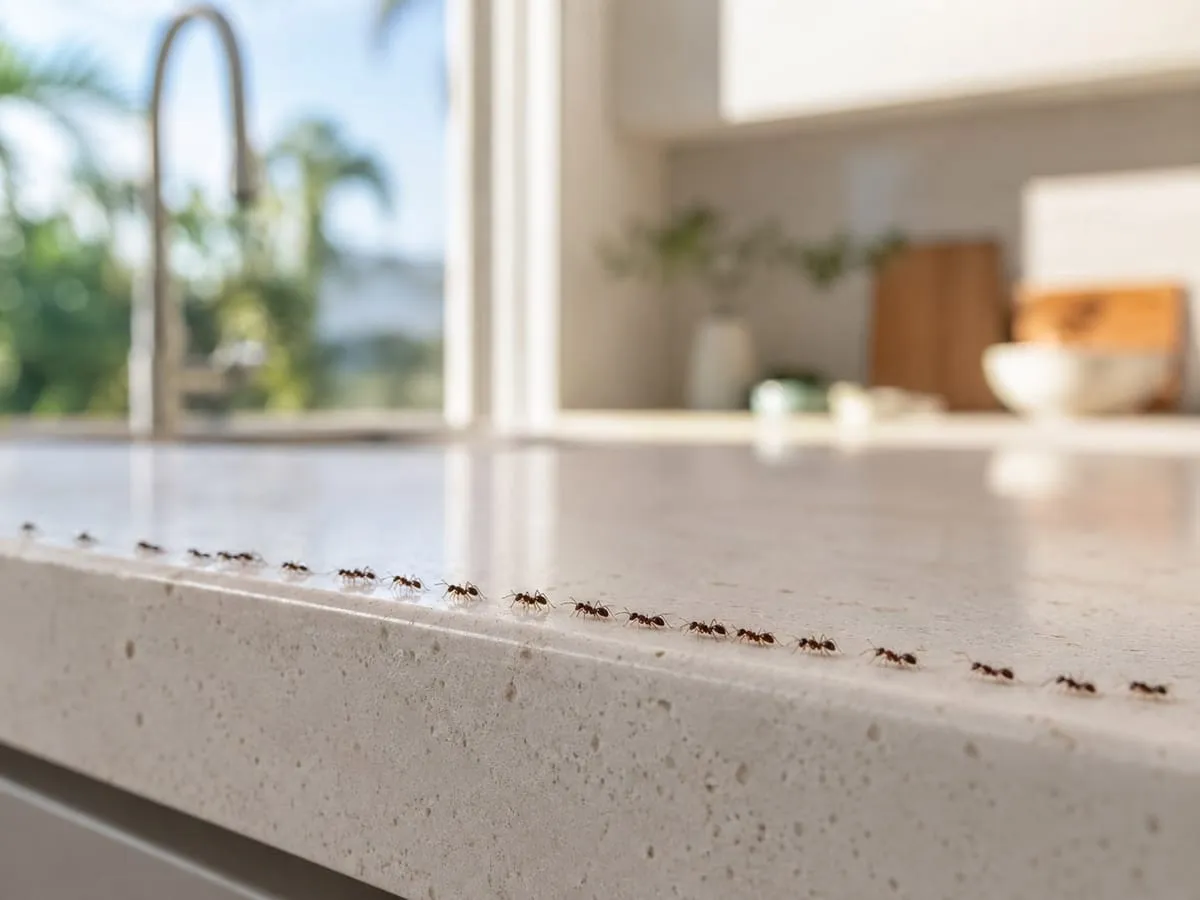
How do you treat an ant problem in a Southern California home?
It starts with an inspection: identifying the species, following the trails to entry points, and finding the moisture and food sources feeding them. What we apply follows from that — spray applications, baiting, or a combination, chosen for the ant we actually found rather than a fixed script. The part that matters most is that we treat both outside and inside. Treating only the exterior tends to push ants further into the structure, which is the single most common reason an ant problem comes back. And because Argentine ant supercolonies span entire neighborhoods, the realistic goal is ongoing control that keeps them out of your house, not permanent elimination.
Service Overview
Ants are the number one call we take. Southern California is dominated by Argentine ants, which do not behave like the textbook single-nest colony — they form vast interconnected supercolonies with many queens, spread across whole neighborhoods. That has two practical consequences. First, the right treatment depends entirely on what the inspection finds: for many situations a spray application is exactly the right tool, for others baiting is, and often it is both. Second, an ant colony on your block is not something anyone can eliminate. It is something we control, and keep on the outside of your house.
Key Takeaways
- Treatment depends on the inspection: species, trail routes, and conditions determine whether we spray, bait, or do both.
- We treat inside as well as outside. Exterior-only treatment tends to push ants deeper into the structure.
- Exterior-only service is the number one reason for ant call-backs — the ants stop appearing on the patio and start appearing in the kitchen.
- Argentine ants form multi-queen supercolonies spanning neighborhoods, so elimination is not a realistic goal. Control is.
- Think of it like recurring lawn service: the grass keeps growing, and recurring visits keep it managed.
- Carpenter ants are the exception that matters structurally — they excavate wood and warrant a different response.
- Pressure is year-round here, spiking when summer heat and irrigation changes push colonies toward indoor water.
Key Benefits
- ✓Inside and outside both treated, so the problem is not just relocated
- ✓Correct species identification before any product is chosen
- ✓Spray, bait, or both — matched to what the inspection actually found
- ✓Entry points and moisture drivers identified and documented
- ✓Free re-treatments between scheduled visits on a recurring plan
Treatment Matched to the Inspection
Spray applications, baiting, or both. Which is right depends on the species, where the trails run, and what the property is doing to attract them — so the diagnosis comes before the product, not the other way around.
Inside and Outside Together
Exterior-only treatment moves ants deeper into the structure. Treating both is what resolves the problem instead of relocating it.
Organic Options Available
For households that want to avoid conventional products, we offer essential-oil based treatments. They ask more of the maintenance schedule, and we will tell you honestly where they fit and where they do not.
Kid & Pet Aware Placement
Applications and bait stations are placed with children and pets in mind, and your technician walks you through precautions before starting.
Our Decisive Process
Species Identification
Argentine, odorous house, pharaoh, pavement, and carpenter ants each call for a different approach — so we confirm what we are dealing with before choosing a product.
Trail & Source Mapping
We follow trails back to entry points and locate the moisture, irrigation, and food sources feeding the colony.
Interior & Exterior Treatment
Spray applications, baiting, or both — applied outside and inside. Treating only the exterior drives ants further in, which is why we do both together.
Ongoing Control
A follow-up visit to confirm the treatment held, then recurring service to keep neighborhood colony pressure on the outside of your house.
Why we treat inside, not just the perimeter
This is the most important thing on this page. When an ant problem is identified, treating only the exterior or the subarea pushes the ants inward — they stop using the routes you were seeing outside and move further into the structure instead. The number one reason we get an ant call-back is a customer who asked for exterior-only service and then started finding ants in the kitchen. To actually address the problem rather than move it, we treat the outside and the inside together.
Control, not elimination — and why that is the honest answer
Argentine ant supercolonies are not confined to a property line. They stretch across yards, streets, and whole neighborhoods, with many queens and no single nest to destroy. Nobody can eliminate that, and anyone promising to is overselling. What works is the same logic as recurring lawn service: the grass keeps growing, so you keep mowing it. Recurring visits keep colony pressure managed and keep ants on the outside of your house, which is the outcome that actually matters day to day.
What to do — and not do — before we arrive
A couple of small things make the visit meaningfully more effective.
- ✓Leave the trail alone. It is a pheromone map to the entry point and often the nest, and wiping it with cleaner erases the best information we have
- ✓Do clean up the food source if there is one — a spill, pet food, or fallen fruit
- ✓Hold off on retail products. A store-bought spray applied before diagnosis can scatter a colony into new nesting sites and make the trail harder to follow
- ✓Note where and when you see activity, since timing and location are genuinely diagnostic
Carpenter ants are a different problem
Most ants here are a nuisance and a sanitation issue. Carpenter ants excavate galleries in wood to nest, and while they do not eat it the way termites do, they hollow it out — and they favor wood that is already damp. Finding them usually means finding a moisture problem too, which is why a carpenter ant call often turns into a conversation about a leak, a gutter, or a subarea.
Service FAQs
"Can you get rid of ants permanently?"
Not permanently, and we would rather say so than promise otherwise. Argentine ant supercolonies span whole neighborhoods with many queens, so there is no single nest to destroy and no point at which the surrounding population is gone. What we can do is control it — keep the pressure managed and keep ants out of your house. It works the same way recurring lawn service does: the grass keeps growing, so you keep mowing.
"Do you spray for ants, or use bait?"
Both, depending on what the inspection finds. Spray applications are often exactly the right tool, baiting is right in other situations, and frequently the answer is a combination. What decides it is the species we identify, where the trails run, and the conditions on the property — so the diagnosis comes first and the product follows.
"Can you just treat the outside of my house?"
We would strongly advise against it, and this is the most common mistake we see. Treating only the exterior or subarea pushes the ants inward — they abandon the outdoor routes and move further into the structure. Exterior-only service is the number one reason we get called back for ants: the patio clears up and the kitchen does not. Treating inside and outside together is what actually resolves it.
"How long does it take to see results?"
You should see trail activity drop within days. Where baiting is part of the plan, collapsing that portion of the colony typically takes two to three weeks because the bait has to circulate. A brief uptick in visible ants right after baiting is normal and means the bait is being found.
"Should I clean the ant trail before you come?"
Please do not. That trail is a pheromone map straight to the entry point and often to the nest. Clean up the food source if there is one, but leave the trail itself alone until we have seen it.
"Why do I get ants indoors when it gets hot?"
Summer heat dries out the soil moisture Argentine ants depend on, so colonies push toward reliable indoor water — kitchen sinks, dishwashers, bathrooms, and pet bowls. Irrigation changes have the same effect. This is why ant calls spike in the same weeks every year here.
"Are your ant treatments safe around pets?"
Yes, with normal precautions. Bait stations are placed out of pet reach, and your technician will tell you the specific timeframe to stay off treated areas until they are fully dry.
Identify What You're Dealing With
Treatment starts with correct identification. These pest library entries cover the species we target with this service.
Specialists you
can count on.
Xtermicon was founded in 2015 with one focus: protect Southern California homes and businesses from the pests that threaten them. The name says it all — eXterminate TERmites & pest CONtrol — and that's exactly what we do. We're a family-owned team specializing in termite control, pest control, and rodent exclusion. From West LA and East LA to the beach cities and Orange County, we're local neighbors who treat your property like our own.