End-of-Season Wasp Nests: Why September Removal Still Matters
The nest that was manageable in June is at its maximum size right now, and the colony is hungrier and shorter-tempered than it has been all year. Waiting it out is a worse plan than it sounds.
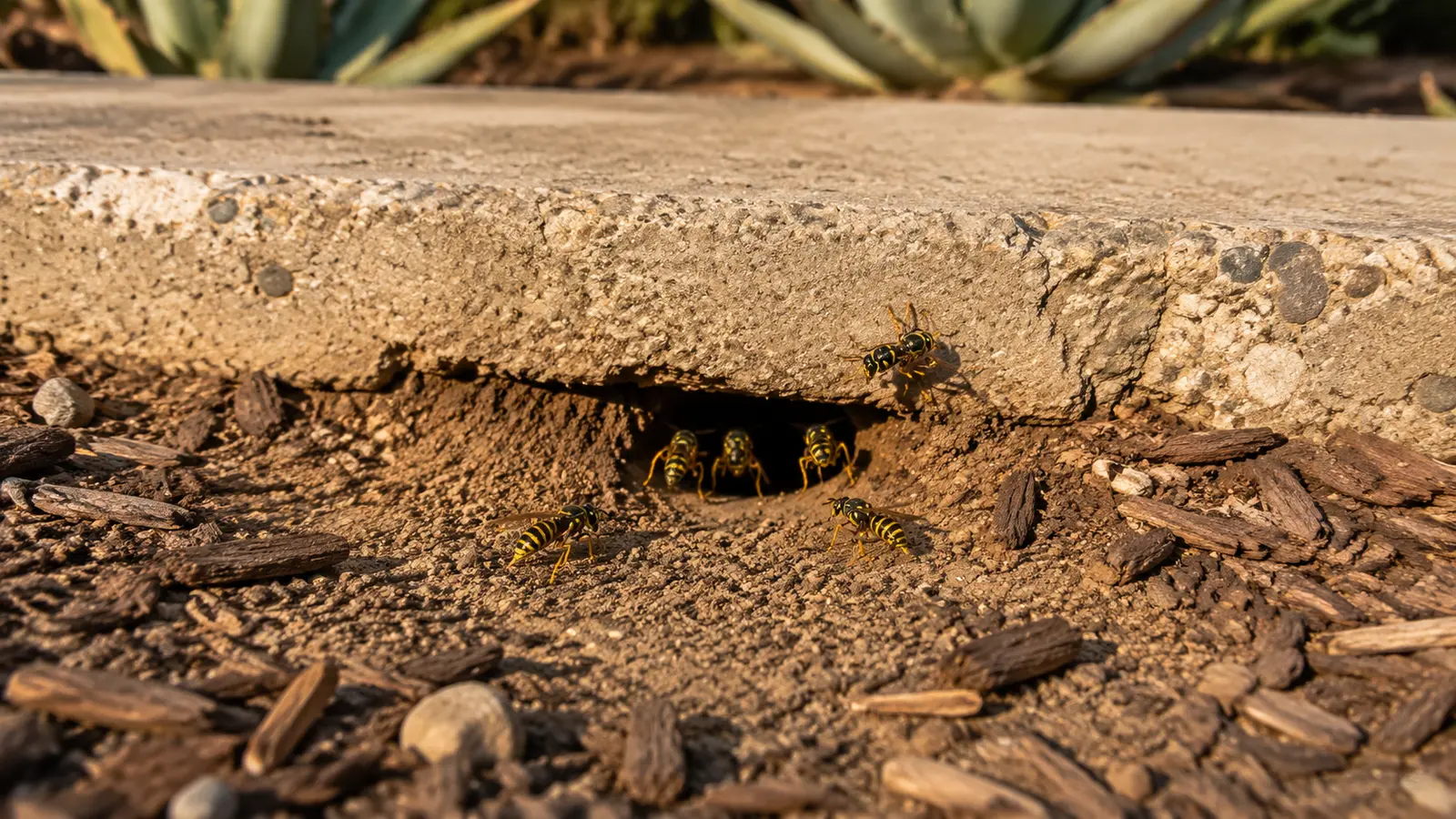
By the middle of September, the question we get about wasps changes. Through the summer it is "how do I get rid of this?" By now it has become "is it even worth dealing with at this point?" — usually from someone who has lived alongside a nest under an eave since June, has developed a working truce with it, and has read somewhere that wasps die off in the fall. The instinct is understandable and the underlying fact is roughly true. The timing, in coastal Southern California, is not what people think it is.
Is it worth removing a wasp nest in September?
Usually yes. A yellow jacket or paper wasp colony reaches its maximum size in late summer and early fall, so a September nest holds far more insects than the same nest did in June. At the same time, the natural food sources the colony has relied on start drying up, which pushes foragers toward human food and trash and makes encounters more likely and more defensive. And in coastal Southern California, the hard sustained cold that actually ends a colony often does not arrive until well into the year, so "waiting it out" can mean living with a peak-size nest for another two months or more rather than a couple of weeks.
The Short Version
- Colonies peak in size in late summer and early fall. A September nest is the largest it has been all year, not a declining one.
- Foraging behavior intensifies as natural food dries up, which is why wasps get noticeably more interested in picnics, trash cans, and outdoor dining in early fall.
- The "they will die off soon" logic assumes a hard freeze. Coastal Southern California often does not deliver one until well into the year, if at all.
- Sting risk is at its seasonal high right now, and it is highest for nests near doors, walkways, play areas, and anywhere yard work happens.
- An old nest from earlier in the season is usually inert, but it can attract other pests and occasionally be reused — worth a look rather than an assumption.
- Ground nests and in-wall nests are the two situations where do-it-yourself removal goes wrong most often.
The Nest Is Bigger Than It Has Ever Been
A social wasp colony follows a predictable annual arc. A single overwintered queen starts it in spring, alone, building a small nest and raising the first workers herself. Those workers take over the foraging and construction, and the colony grows through summer in a compounding way — more workers means more brood raised, which means more workers.
The result is that colony population peaks late in the season, not in the middle of it. The nest you noticed in June with a handful of wasps around it has spent three months compounding. That is the first thing worth understanding about a September nest: it is not winding down yet, it is at maximum.
The second shift is what the colony is doing. Through the growth phase, foragers are hunting protein — insects, spiders, caterpillars — to feed developing larvae. Late in the season the colony stops producing workers and switches to raising next year's queens and males, and the foragers switch to seeking carbohydrates and sugars for themselves. That change is why wasps that ignored you all summer suddenly want your soda, your fruit tree, your trash can, and your outdoor table.
Put those together and early fall is when a nest is simultaneously at its largest and at its most likely to bring wasps into contact with people. It is the worst combination of the year, and it happens to coincide with the point at which most homeowners have decided to stop worrying about it.
Late summer into early fall is the population maximum for the year, not the decline.
Foragers switch from hunting protein to seeking carbohydrates, which is what brings them to food, drinks, and trash.
A larger colony with a contested food supply defends more readily, and closer to the nest.
Why "Just Wait It Out" Does Not Work Here
The waiting-it-out advice is genuinely sound in a lot of the country. In a climate with a real winter, a hard sustained freeze kills the workers, the colony collapses, and only newly mated queens survive by overwintering in sheltered spots. The nest is not reused, and by spring the problem is over without anyone doing anything.
The mechanism that makes that work is the freeze. Coastal Southern California often does not get a hard, sustained cold snap until well into the year, and in many seasons never really gets one at all. Milder conditions mean colonies can stay functional considerably longer than the calendar suggests, and an active nest can remain a genuine presence for weeks past the point at which someone in a colder region would already be done with it.
So the honest framing is not that the advice is wrong, it is that the timeline attached to it is imported from somewhere else. Waiting out a nest in mid-September here is not waiting two weeks. It can be waiting well into the late season, at peak colony size, through the period when foragers are most interested in the places people actually are.
The question to ask yourself
Not "will this nest die eventually" — it will. Ask instead: where is it, and who walks past it? A nest high on a second-story eave at the back of a property is a genuinely reasonable thing to leave alone. A nest beside a front door, over a walkway, near where children play, in a shed you use, or in the ground where someone will mow is a different decision entirely, and the calendar does not change that.
Where the Nest Is Matters More Than the Date
If you are weighing whether to act, location and traffic should drive the decision more than the time of year.
Ground nests
Yellow jackets frequently nest in old rodent burrows, under railroad ties, in irrigation boxes, and at the base of shrubs. These are the ones that produce multiple-sting incidents, because they are invisible until a mower, a string trimmer, or a footstep sets them off. Vibration alone can trigger a defensive response. Treat any suspected ground nest as a job for someone with protective equipment.
Inside walls and voids
A nest reached through a gap in siding, a vent, or a soffit is inside a space you cannot see. Sealing the entrance is the classic mistake — it drives the colony to chew an exit, which surprisingly often means chewing inward into the living space. These need to be handled properly rather than closed off.
Near doors and walkways
Traffic is the risk multiplier. A nest above a front door or over a path gets disturbed several times a day and is the most common source of stings around a house.
Play areas, gardens, and work zones
Anywhere someone is going to be occupied and inattentive close to the nest. Kids, gardening, and yard maintenance are the three activities that turn a tolerable nest into an incident.
High and out of the way
A nest at the top of a tall eave at the back of the property, with nobody passing under it, is the one case where leaving it genuinely is reasonable — and it will not be reused next year.
What about old, empty nests?
A nest that has genuinely been abandoned is mostly inert, and paper wasps and yellow jackets do not reuse last year's nest — new queens build fresh in spring. Two caveats are worth knowing, though. An old nest is a structure full of organic material, and it can attract secondary pests such as carpet beetles and other scavengers, particularly if it is inside a void rather than out in the weather. And "abandoned" is harder to confirm than it looks: a nest with no visible activity on a cool morning can be quite active at midday. Confirming a nest is genuinely empty before you remove it is worth more than assuming, and removing it once confirmed is worthwhile if it is somewhere that matters.
The Short Version of Doing This Safely
The full safety discussion is in our peak-season piece from August, linked below, and it is worth reading before you do anything yourself. Compressed to the essentials:
Never seal a nest entrance
This is the one that produces the worst outcomes. A colony blocked in will chew its way out, and the direction is not up to you.
Ladders and wasps do not mix
Most serious wasp injuries are falls, not stings. If the nest requires a ladder, that is a reason to call someone.
Ground nests are not a DIY job
Numbers, invisibility, and a defensive response triggered by vibration make these categorically different from a visible aerial nest.
Know your household
Anyone with a known sting allergy in the house moves this out of the tolerable category immediately, regardless of nest location or time of year.
Do not swat or spray from close range
Both provoke a defensive response and put you inside it. Distance and timing matter more than product.
One note on scope, since we get asked: we handle wasps, yellow jackets, and hornets. We do not do honey bee work of any kind. If what you have turns out to be a honey bee colony rather than a wasp nest — and they are genuinely easy to confuse at a distance — that is a different trade and we are not the right call.
Nest somewhere you actually walk?
If it is by a door, over a path, in the ground, or inside a wall, that is worth handling rather than waiting out. Xtermicon works wasp and yellow jacket removal across the South Bay, Westside, and greater Los Angeles. Call (310) 370-0963 — quotes over the phone, no obligation.
Fall Wasp Nest FAQs
What homeowners ask about a nest they have already lived with all summer.
Will the nest just die off on its own?
The colony will eventually die and the nest will not be reused next year — that part of the folk wisdom is correct. What is imported from colder climates is the timeline. That die-off is driven by sustained cold, and coastal Southern California frequently does not deliver a hard freeze until well into the year, if at all. So waiting it out in September can mean living with a peak-size colony for a good while longer than the advice implies, during the stretch when foragers are most drawn to where people are.
Are wasps actually more aggressive in the fall?
Their behavior changes in ways that amount to that in practice. The colony stops raising workers and switches to producing next year's queens, and foragers shift from hunting insects to seeking sugars — which is what brings them to food, drinks, fruit, and trash cans where people are. Combine that with peak colony numbers and a food supply that is drying up, and encounters become both more frequent and more likely to go badly. Whether that is "more aggressive" or "more desperate and more numerous" is semantics from the receiving end.
I found a nest but it looks empty. Can I just knock it down?
Confirm it is genuinely empty first, and be careful how you confirm it — a nest can look completely inactive on a cool morning and be busy by mid-afternoon. Watch it at a warm point in the day, from a distance, for a few minutes. If it is truly abandoned, removal is low-risk and worth doing, since an old nest holds organic material that can draw secondary pests like carpet beetles, especially if it sits inside a void rather than out in the weather.
There is a nest in my wall. Can I just seal the hole?
No — this is the single worst thing to do with an in-wall nest. A colony sealed in will chew its way out, and it has no way of knowing which direction leads outdoors. A meaningful number of the in-wall wasp calls we get involve wasps that came through into a bedroom or a closet after somebody caulked the exterior entrance. The nest needs to be dealt with before the entry point is closed, in that order.
What if it is bees and not wasps?
That changes who you should call, because we do no honey bee work of any kind, including referrals for it. The quick distinction: honey bees are fuzzy, thicker-bodied, and generally amber and brown; wasps and yellow jackets are smooth, shiny, and more sharply marked, with a narrow waist. Yellow jackets are also far more interested in your food than a honey bee will ever be. If you are genuinely unsure, describe what you are seeing when you call and we will tell you honestly whether it is ours to handle.
Related Reading
The peak-season guide, species identification, and the service itself.
- Why late summer is peak wasp and yellow jacket seasonThe full safety guidance and why the season builds the way it does.
- Paper wasps vs. yellow jackets vs. hornetsWhich one you have, and why the nest shape tells you.
- Our wasp and hornet removal serviceWhat removal involves, including ground and in-wall nests.
- Wasps and hornets: species profileIdentification and behavior in the pest library.
- A pest-free patio in Southern CaliforniaOutdoor-living fixes, including what draws late-season foragers to a table.
- The Labor Day pest exclusion checklistClosing the gaps and voids that in-wall nests get established through.
Sydney Pardey is the owner of Xtermicon, a family-owned pest control company serving the South Bay and greater Los Angeles area since 2015. All content is written from direct operational experience and reviewed against current California Structural Pest Control Board standards.
Specialists you
can count on.
Xtermicon was founded in 2015 with one focus: protect Southern California homes and businesses from the pests that threaten them. The name says it all — eXterminate TERmites & pest CONtrol — and that's exactly what we do. We're a family-owned team specializing in termite control, pest control, and rodent exclusion. From West LA and East LA to the beach cities and Orange County, we're local neighbors who treat your property like our own.