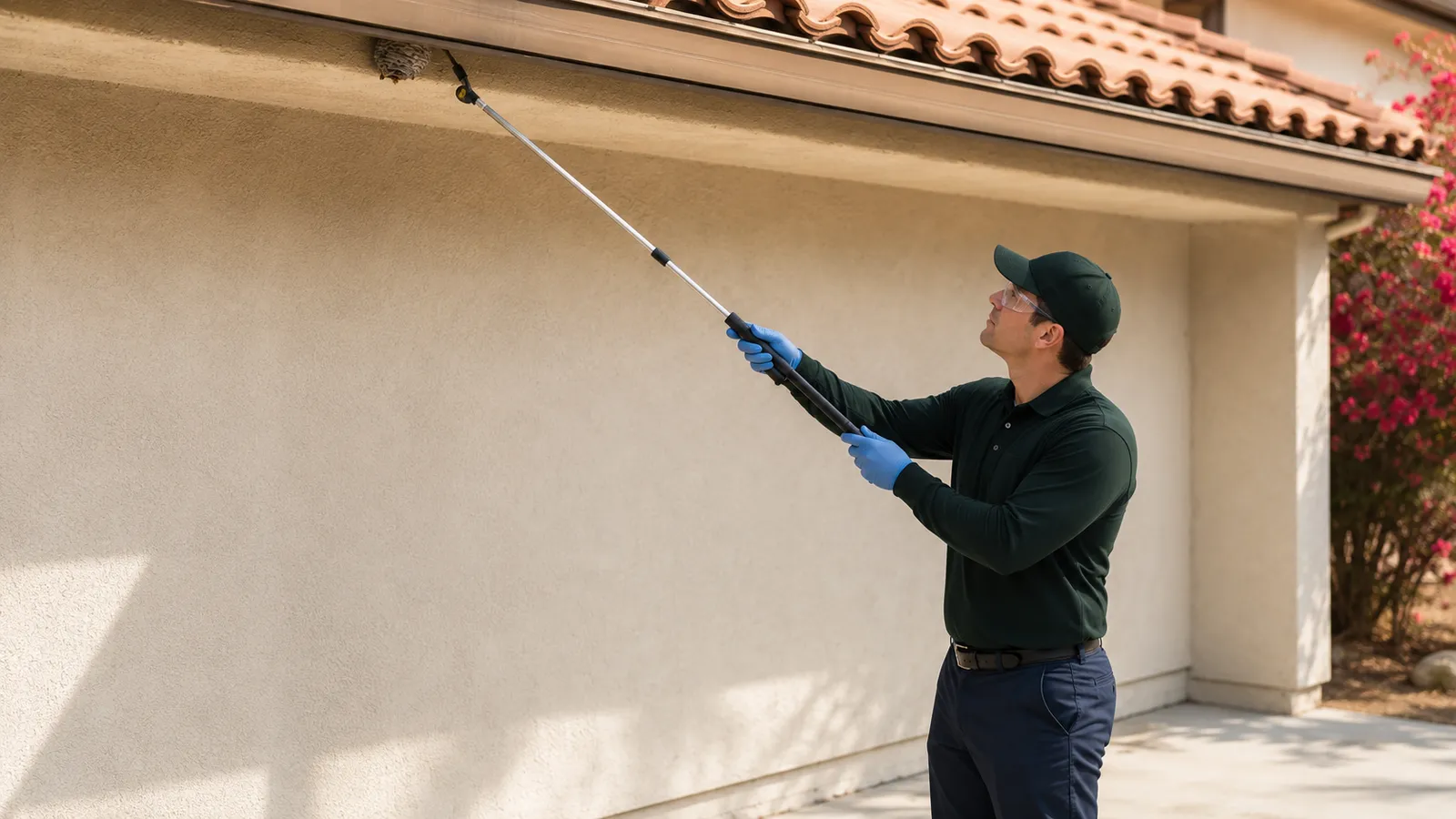
What should I do about a wasp nest at my house?
Keep people and pets away from it, note exactly where it is, and do not spray it — a store-bought can rarely reaches the whole nest and reliably provokes a defensive response from a colony that may hold thousands of insects. Identification matters: paper wasps under an eave are relatively docile and sometimes fine to leave if they are away from foot traffic, while yellowjackets in a ground or wall void are aggressive, grow all season, and are the ones that put people in urgent care. Once the nest is removed, the entry void needs sealing or the same location gets reused.
Service Overview
Stinging insects are the one pest category where the do-it-yourself attempt carries real physical risk. A can of spray on an established yellowjacket nest provokes a defensive response from a colony that can number in the thousands, and the person holding the can is standing right where the colony is looking. We handle removal with proper protective equipment, at the right time of day, and with the approach matched to where the nest actually sits — an exposed paper wasp nest under an eave and a yellowjacket colony inside a ground void are not the same job.
Key Takeaways
- Do not spray an established nest yourself — this is the pest category that sends people to urgent care, usually off a ladder.
- Yellowjacket colonies grow all season and are most populous and most defensive in late summer and early fall.
- Paper wasp nests under eaves are far less aggressive and are sometimes reasonable to leave if they are away from foot traffic.
- Ground and wall-void nests are the dangerous ones, because the entrance is easy to disturb without realizing it is there.
- Sealing the void after removal is what stops the same spot being reused next season.
Key Benefits
- ✓Removal performed with proper protective equipment and technique
- ✓Ground nests, eave nests, and wall voids all handled
- ✓The entry void sealed so the same location is not reused
- ✓Prompt scheduling for nests near doors, play areas, and walkways
Proper Protective Equipment
Established nests get approached with the right gear and the right timing. This is genuinely the wrong job to improvise on a ladder with a garden hose nearby.
Void and Ground Nests
The nests that matter are usually the ones you cannot see. We locate the actual entrance rather than treating where the activity was noticed.
Void Sealing After Removal
Removing the nest without sealing the entry point just opens the same address for next season. We close the cavity as part of the job.
Our Decisive Process
Identify & Assess
Yellowjacket, paper wasp, or hornet — plus where the nest sits and how much foot traffic passes it. That combination decides everything that follows.
Plan the Approach
Timing, access, and equipment set before anything is touched, and the area cleared of people and pets.
Removal
The nest is treated and removed at the appropriate time of day, when the colony is least active and most of it is home.
Void Sealing
The entry point gets sealed after removal, so the cavity that worked this year is not available next year.
Where yellowjackets actually nest
Most people picture a papery nest hanging from a branch. That is a paper wasp, and it is the easy version. Yellowjackets — the ones responsible for nearly every multiple-sting incident we get called about — usually nest out of sight, which is exactly why people disturb them by accident.
- ✓Ground voids: abandoned rodent burrows, irrigation valve boxes, gaps under stepping stones
- ✓Wall voids and attics, entered through a gap in stucco, trim, or a vent screen
- ✓Under decks and sheds, and inside block wall cavities
- ✓Behind fascia and in the space above a soffit
- ✓Compost bins, woodpiles, and dense ground cover
The seasonal pattern here
Yellowjacket colonies start small in spring and build all season, which is why the calls that involve someone actually getting stung cluster in late summer and early fall — the colony is at maximum size, foraging is competitive, and the insects are markedly more defensive around food and outdoor gatherings. Spring is the cheap, easy time to deal with a nest. September is not. If you noticed something in April and left it, now is the moment to call.
Service FAQs
"Do you remove honey bees?"
No — we do not service honey bees. For a hive or a swarm you will want a local beekeeper or a dedicated live bee removal specialist. Worth knowing, though: most "bees" people find nesting in the ground or inside a wall turn out to be yellowjackets, which we do handle. If you are not certain what you are looking at, describe it to us and we will tell you which call to make.
"How much does wasp nest removal cost?"
It depends mostly on access and location. An exposed paper wasp nest under an eave is straightforward. A yellowjacket colony in a ground void, inside a wall, or above a soffit is a materially bigger job. We will quote the specific nest rather than give you a number that changes when we arrive.
"Is it safe to knock down a wasp nest myself?"
We would strongly advise against it on anything established. Aerosol sprays often fail to reach the whole nest, the colony responds defensively toward whoever disturbed it, and most serious sting incidents we hear about involve a ladder. A small, new paper wasp nest is a different matter — but if you are unsure which you have, that uncertainty is the answer.
"Do I need to remove a paper wasp nest under my eave?"
Not always. Paper wasps are far less aggressive than yellowjackets and are beneficial predators. If the nest is well away from doorways, walkways, and play areas, leaving it is defensible. Remove it if it sits where people pass close, or if anyone in the household has a sting allergy.
"Why do yellowjackets get so aggressive in late summer?"
The colony has been building all season and peaks in size in late summer and early fall, right as natural food sources tighten. That combination makes them far more defensive and much more interested in your barbecue, trash cans, and sweet drinks than they were in June.
Identify What You're Dealing With
Treatment starts with correct identification. These pest library entries cover the species we target with this service.
Specialists you
can count on.
Xtermicon was founded in 2015 with one focus: protect Southern California homes and businesses from the pests that threaten them. The name says it all — eXterminate TERmites & pest CONtrol — and that's exactly what we do. We're a family-owned team specializing in termite control, pest control, and rodent exclusion. From West LA and East LA to the beach cities and Orange County, we're local neighbors who treat your property like our own.