Why Late Summer Is Peak Wasp and Yellow Jacket Season in Southern California
Nothing about your yard changed in August. The colony living in it has been growing since April, and this is the month it finishes growing. Here is the life-cycle reason it happens every year, and how to tell a nest you can leave alone from one you cannot.
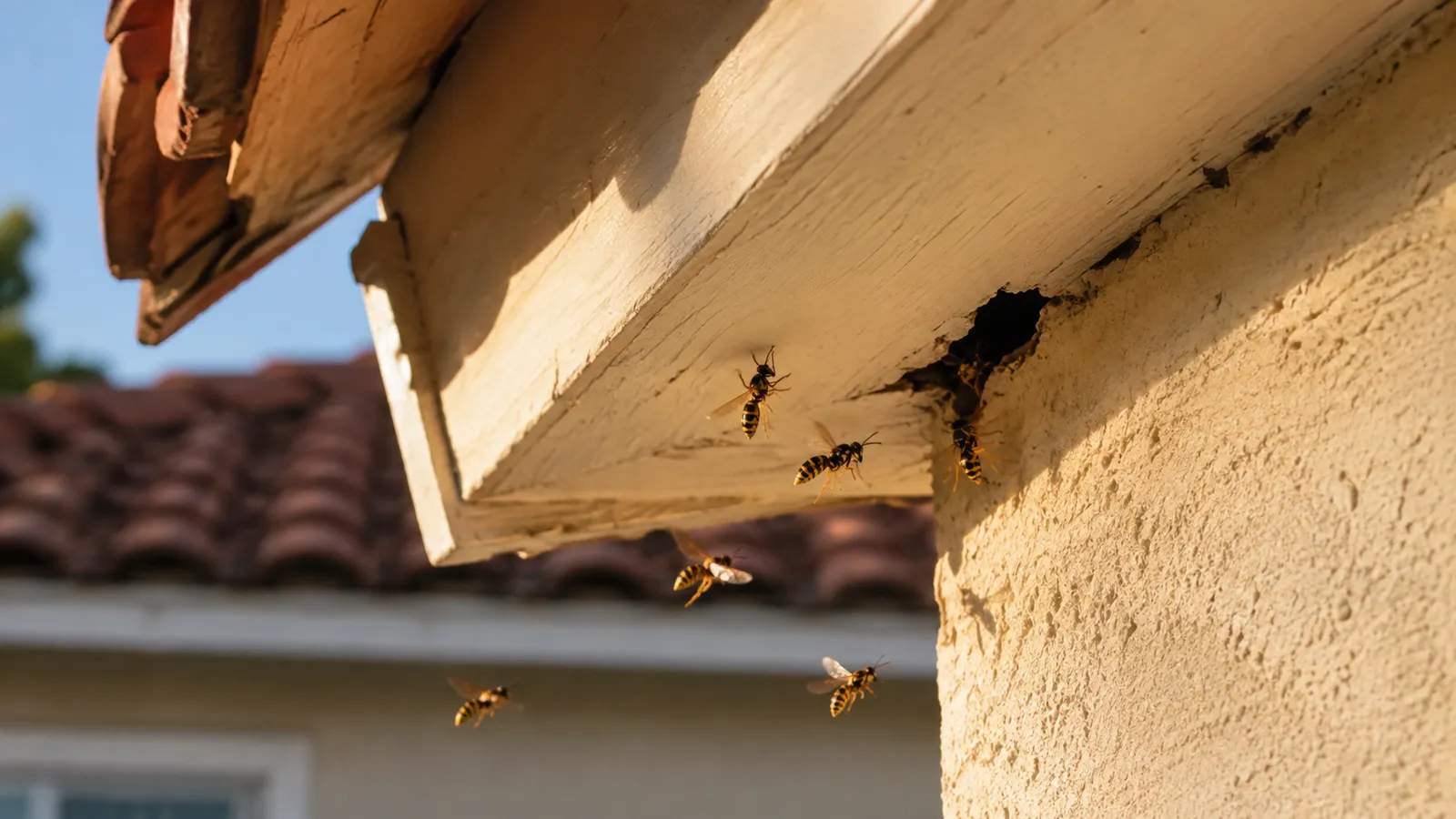
There is a specific stretch of August when the phone starts. Someone was pulling weeds along the side of the garage and got hit four times before they understood what was happening. Someone else has been watching what they assumed were bees drift in and out of a gap under the eave since June, and it is not a drift anymore — it is traffic. Nothing about either property changed. What changed is that the colony living there has been growing since April, and August is the month it finishes growing.
Why are there suddenly so many wasps and yellow jackets in late summer?
Because wasp and yellow jacket colonies are annual. Each one is founded by a single overwintered queen in early spring, adds workers all summer, and reaches its maximum size in August and September before dying off in late fall. A nest that held a few dozen workers in May can hold several thousand by late summer. At the same time, the colony stops raising workers and switches to raising next year's queens, which changes what the adults eat and sends them foraging for sugar around trash cans, patios, and outdoor meals. A bigger colony plus hungrier, more defensive foragers is why late summer feels like an invasion when it is really the same nest at full size.
The Short Version
- Wasp and yellow jacket colonies are annual — every nest you see in August started as one overwintered queen in spring and is now at its largest.
- Peak colony size and peak defensiveness land in August through October here, which is why late-summer sting incidents cluster.
- Late in the season the colony shifts from hunting protein to scavenging sugar, which is what puts wasps on your soda can, trash bin, and patio table.
- The nests that matter are the ones you cannot see — ground voids, wall voids, and attic vents — because they get disturbed by accident.
- Never seal a wall-void entry hole with a live colony inside. Trapped wasps chew toward light and can come through the drywall into the room.
- A small, new paper wasp nest away from foot traffic is often fine to leave. A yellow jacket nest in the ground or a wall near a door is not a DIY job.
The Colony Has Been Building Since April
Yellow jackets and paper wasps are annual insects, and that single fact explains almost everything about August. The colony bothering you right now did not move in. It was founded in early spring by one fertilized queen who survived the winter alone — under bark, in a woodpile, in the corner of a shed — and emerged to build a nest roughly the size of a golf ball. She laid the first eggs, hunted the first food, and fed the first larvae herself.
Once that first batch of workers matured, the queen stopped leaving the nest and did nothing but lay eggs. Every worker after that went into expanding the nest and feeding the next generation, and the growth compounds: more workers means more larvae raised, which means more workers. Through May and June the nest is small enough to go completely unnoticed. Through July it doubles, and doubles again. By August it is at or near the largest it will ever be. Then, once cool weather sets in for good, the entire colony dies except for the newly mated queens, who fly off to overwinter alone and start the cycle over next spring.
So the nest in your eave is not a permanent fixture, and it is not there because of anything you did. It is on a schedule. The problem is that its schedule peaks precisely when Southern California is spending the most time outdoors.
The colony at full size in August traces back to a single overwintered queen and a golf-ball-sized nest in spring.
An established yellow jacket colony can hold several thousand workers by August, up from a few dozen in May.
The colony is largest, hungriest, and least tolerant right as outdoor season peaks here.
Late Summer Also Changes What They Want From You
Size is only half of it. The other half is a shift in the colony's diet that most homeowners never hear about, and it is the reason wasps that ignored you in June are investigating your plate in August.
For most of the season, worker yellow jackets are hunters. They catch other insects, chew them up, and carry the protein back to feed the larvae. In exchange, the larvae produce a sugary secretion the adult workers feed on. It is a closed loop — the workers get their carbohydrates from the brood they are raising, and they have no particular interest in your kitchen.
Late in the season the queen stops producing worker eggs and the colony turns to raising next year's queens and males. Fewer larvae means far less of that sugary payoff, and thousands of adult workers with nothing feeding them start looking for carbohydrates somewhere else: fallen fruit under the citrus tree, hummingbird feeders, open trash cans, an unattended soda, the bin behind a patio restaurant. This is the point in the year when yellow jackets stop behaving like predators and start behaving like scavengers.
It also makes them harder to shoo off. A wasp working a trash can is not defending a nest, but it is far less inclined to leave when you wave a hand at it — and swatting at one near a nest entrance is how a single wasp becomes several.
The Nests You Can See, and the Ones That Matter
If you can point at the nest, you are in the easier version of this problem. Paper wasps build the open, downward-facing, umbrella-shaped combs you see under eaves, inside patio covers, in the corners of door frames, and inside a grill that has not been opened in a few weeks. You can count the cells. You can see the wasps sitting on it.
Yellow jackets are the ones responsible for nearly every multiple-sting incident we get called about, and they usually build where you cannot see them at all. These are the locations worth knowing:
Ground voids
Abandoned rodent burrows, irrigation valve boxes, gaps under stepping stones and planter edging. The entrance is often a hole no bigger than a quarter, and a lawnmower or string trimmer passing over it is the classic trigger.
Wall voids and attics
Entered through a gap in stucco, a failed trim joint, or a torn attic vent screen. From outside, all you see is traffic to one small spot. The nest itself may be a foot inside the wall.
Under decks, sheds, and block walls
Any dry, protected cavity with a small entrance qualifies. Block wall cavities and the underside of a low deck are both common and both easy to walk right past.
Behind fascia and above soffits
High, protected, and only reachable from a ladder — which is exactly the combination that makes do-it-yourself removal go badly.
Dense ground cover and compost
Ivy, thick shrubs, and compost bins conceal low nests well enough that the first contact is almost always accidental.
Do not seal the hole
This is the most common well-intentioned mistake we get called about. If wasps are going in and out of a gap in your siding, trim, or eave, plugging that gap with caulk or foam does not solve anything — it traps a live colony in a cavity and takes away its exit. Wasps sealed into a wall void chew toward light and air, and the thinnest material between them and open space is usually the drywall on the inside of your house. Remove the colony first. Seal second.
How to Tell You Have a Nest, Not Just Visitors
Wasps at a picnic tell you nothing about your property — foragers routinely travel hundreds of yards from the nest. What tells you there is a nest on your property is direction and repetition.
Two-way traffic to one fixed point
Wasps consistently arriving at and leaving from the same spot — a hole in the ground, a gap in trim, a vent — is the clearest sign there is. Watch it for a minute from a safe distance. A nest entrance looks like an airport.
Traffic that peaks at the ends of the day
Foraging is heaviest in the early morning and again before dusk. If a particular spot is busy at 7 a.m., it is an entrance, not a coincidence.
A visible paper comb
Grey, umbrella-shaped combs under eaves, in patio covers, or inside a rarely opened shed or grill. That is a paper wasp nest, and it is the easy case.
Sound inside a wall
A faint, continuous rustling or crinkling inside a wall or ceiling, strongest on warm afternoons, with wasps visible outside that same wall. That combination means the nest is in the void.
Repeated stings in the same corner of the yard
If one area produces a stinging incident more than once, treat it as a located nest until proven otherwise and keep people and pets out of it.
When It Is a DIY Job — and When It Genuinely Is Not
We are not going to tell you every wasp on your property requires a professional. That is not true, and you would know it is not true. Here is the honest line.
A small, new paper wasp nest — golf ball to ping-pong ball size, open comb, well away from doorways, walkways, and play areas, in a household with no sting allergies — is a reasonable thing to handle yourself early in the season, or to simply leave alone. Paper wasps are comparatively docile and are genuinely useful predators in a garden. If it is not in anyone's way, leaving it is a real option, and by late fall it will be empty on its own.
The picture changes when any of the following is true:
It is a yellow jacket nest in the ground or a wall
These are the colonies that produce multiple-sting incidents, and the entrance you can see is not the nest you need to reach.
Anyone in the household has a sting allergy
The calculus is different when the worst case is anaphylaxis. That is not the situation to improvise around.
The nest is near a door, walkway, play area, or pool equipment
Proximity to foot traffic turns a manageable nest into repeated accidental disturbance, which is where the incidents come from.
Reaching it requires a ladder
Most of the serious injuries we hear about in this category are not really sting injuries. They are falls.
It is late season and the nest is established
Spring is the cheap, easy time to deal with a nest. August is neither. An aerosol can rarely reaches an entire colony of several thousand, and it reliably provokes whatever it does not reach.
How we handle it
Identify and assess
Yellow jacket, paper wasp, or hornet; where the nest actually sits; and how much foot traffic passes it. That combination decides everything that follows, which is why we would rather look at it than quote it blind over the phone.
Plan the approach
Timing, access route, and equipment are set before anything is touched, and the area is cleared of people and pets. Nests get worked when the colony is least active and most of it is home — not in the middle of a warm afternoon.
Remove the nest
Treated and removed with proper protective equipment, matched to where it is. An exposed nest under an eave and a colony inside a ground void are not the same job and do not get the same approach.
Seal the void
The entry point gets closed once the colony is gone. Skipping this is why the same eave, the same valve box, and the same block wall get reused season after season — a cavity that worked once tends to work again.
One clarification worth making, because it comes up constantly this time of year: we do not service honey bees. A live hive or a swarm is a different trade entirely and not something we take on. But most of the "bees" people find nesting in the ground or inside a wall in Southern California turn out to be yellow jackets, which we do handle. If you are not sure which one you are looking at, describe it to us and we will tell you which call to make.
One SoCal Wrinkle: Colonies That Do Not Die Off
In most of the country the annual cycle is dependable — sustained freezing weather arrives, the colony dies, done. Southern California does not always cooperate. Our season runs weeks longer than the calendar suggests, and in the mildest coastal pockets a colony occasionally survives the winter rather than dying off. A nest that keeps its queen and keeps growing into a second year can get considerably larger than a normal annual nest.
This is uncommon, not the default, and not something to sit up at night about. It is simply the reason we treat an unusually large nest as a real problem rather than assuming the weather will resolve it, and the reason we would rather deal with a nest in October than tell you to wait for a cold snap that may not come.
Nest on your property right now?
Xtermicon has been working across the South Bay, the Beach Cities, and greater Los Angeles since 2015. If there is a nest near a door, a walkway, a play area, or anyone with a sting allergy, that is worth handling now rather than waiting for the weather to do it. Call (310) 370-0963 and we will identify what you have, tell you honestly whether it needs to be touched at all, and handle it if it does.
Wasp & Yellow Jacket Season FAQs
The questions we field most often between August and October.
When does wasp season end in Southern California?
Later than most people expect. Activity stays high through September and well into October, and it takes sustained cool weather — not one cool week — to shut a colony down. In a warm fall we are still removing active nests in November. The colony does die off, but the timing here runs weeks behind what it would be inland or in colder states, and in the mildest coastal areas a colony occasionally persists into a second year. If your plan is to wait it out, the wait is longer than the calendar suggests.
Are yellow jackets actually more aggressive in late summer, or does it just feel that way?
Genuinely more aggressive, for two separate reasons. The colony is at its largest, so there are simply more defenders and a bigger response to any disturbance. And the late-season shift away from raising brood pushes thousands of adult workers to forage for sugar, which brings them into direct contact with people at trash cans, patios, and outdoor meals. It is a real behavioral change on the colony's side, not a shift in your perception.
Can I just spray the nest myself with a can from the hardware store?
On a small, new, fully exposed paper wasp nest you can reach standing on the ground, sometimes. On an established late-summer nest, we would strongly advise against it. Aerosol rarely penetrates an entire nest inside a ground void or a wall cavity, and what it does reliably do is provoke a defensive response from a colony that may number in the thousands, directed at whoever is standing closest. Add a ladder and the risk changes character completely.
Wasps are going in and out of a gap in my stucco. Can I seal it?
No — this is the one thing not to do. Sealing the entrance traps a live colony inside the wall cavity. Wasps that lose their exit chew toward light and air, and the path of least resistance is very often the drywall on the inside of your house. The correct order is to eliminate the colony first, confirm it is done, and then seal the void so the same cavity is not reused next season. Sealing is the last step, not the first.
What is the difference between a wasp, a yellow jacket, and a hornet?
Yellow jackets are a type of wasp, and most of what people in Southern California call a hornet is actually a large yellow jacket or a paper wasp. In practical terms, the distinction that matters is nest type and temperament: open, umbrella-shaped combs under an eave are usually paper wasps and are comparatively docile, while a nest hidden in the ground or inside a wall is usually a yellow jacket colony and is the aggressive one. If you need to pin down exactly what you are looking at before deciding what to do, our companion guide to paper wasps, yellow jackets, and hornets walks through it — it is linked in the related reading below.
I got stung several times at once. Is that normal for a wasp?
Yes, and it is one of the real differences between wasps and honey bees. A yellow jacket has a smooth stinger rather than a barbed one, so it does not lose it and can sting repeatedly. Disturbing a nest also brings out many workers at once, which is how one moment becomes five or six stings in a few seconds. For most people that is painful rather than dangerous. For anyone with a known sting allergy, or if you have symptoms beyond the sting site — trouble breathing, swelling away from where you were stung, dizziness — that is a medical situation, not a pest control one. Get medical help first.
Do wasps come back to the same spot every year?
The same nest is not reused — the colony dies and next spring a new queen builds fresh. But the location very often is. A queen searching for a cavity in March is looking for exactly what made the site work last year: dry, protected, small entrance, undisturbed. That is why sealing the void after removal matters more for stopping the pattern than the removal itself does.
Related Reading
More on stinging insects, the wider summer surge, and the yard conditions behind both.
- Paper wasps vs. yellow jackets vs. hornetsThe companion identification guide — tell the three apart by nest type before you get close.
- Our wasp & hornet removal serviceHow ground nests, eave nests, and wall voids get removed — and sealed so they are not reused.
- Wasps & hornets pest libraryIdentification, nesting habits, and behavior at a glance.
- Summer pest season in Southern CaliforniaWhere wasps fit into the wider July-through-September pest surge.
- How to keep pests off your patioOutdoor-living fixes that cut down on wasp visits to the table.
- Landscaping habits that invite pestsFallen fruit, dense ground cover, and the yard conditions wasps use.
- Pest control in TorranceServing Torrance and the wider South Bay since 2015.
Sydney Pardey is the owner of Xtermicon, a family-owned pest control company serving the South Bay and greater Los Angeles area since 2015. All content is written from direct operational experience and reviewed against current California Structural Pest Control Board standards.
Specialists you
can count on.
Xtermicon was founded in 2015 with one focus: protect Southern California homes and businesses from the pests that threaten them. The name says it all — eXterminate TERmites & pest CONtrol — and that's exactly what we do. We're a family-owned team specializing in termite control, pest control, and rodent exclusion. From West LA and East LA to the beach cities and Orange County, we're local neighbors who treat your property like our own.