Paper Wasps vs. Yellow Jackets vs. Hornets: How to Tell Them Apart in Your Yard
Identify the nest before you identify the insect — it is safer, faster, and tells you almost everything you need to know about whether you can leave it alone.
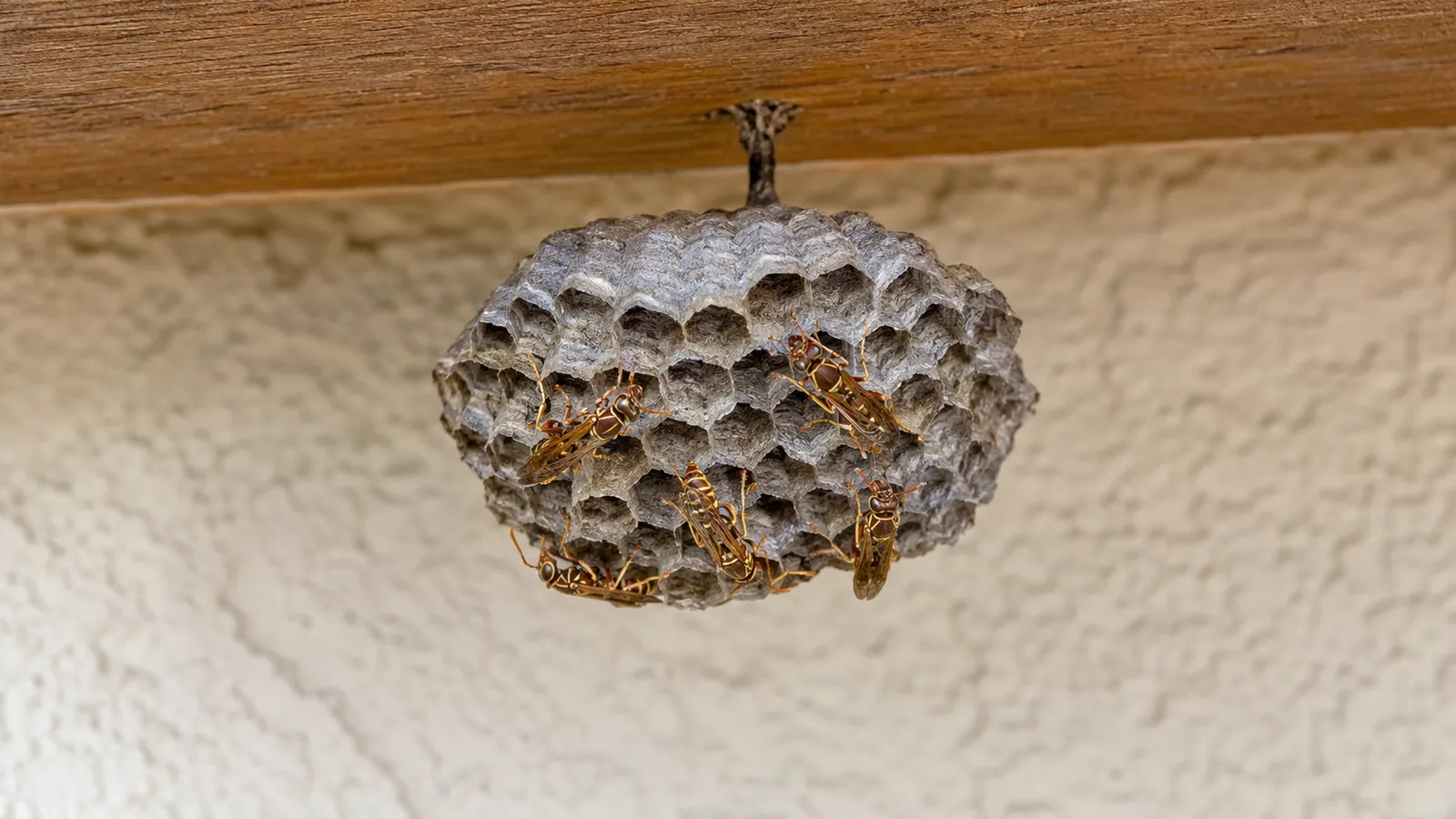
The photo always arrives slightly blurry, taken from farther away than the person wanted to be standing. Sometimes it is a grey papery thing under a soffit. Sometimes it is a hole in the lawn with insects streaming in and out of it like a tiny airport. The question is always the same, and it is exactly the right question: what is this, and how careful do I need to be? Because in Southern California the honest answer ranges from leave it, it is eating the caterpillars off your tomatoes all the way to do not go near that until someone in a suit gets here.
How do I tell a paper wasp from a yellow jacket from a hornet?
Identify the nest before the insect — it is safer and more reliable. An open, downward-facing, umbrella-shaped grey comb with visible cells, usually under an eave or patio cover, means paper wasps: slender body, legs dangling in flight, comparatively docile. A hole in the ground or a gap in a wall with steady two-way traffic and no nest in sight means yellow jackets: shorter and stockier, legs tucked in flight, and responsible for nearly every multiple-sting incident. A large enclosed football-shaped paper nest hanging out in the open is an aerial nest, which is what most people mean by hornet. True hornets are uncommon in Southern California, and most local "hornet" reports turn out to be large yellow jackets or paper wasps.
The Short Version
- Nest type is the fastest and safest identifier. You can read it from twenty feet away; you cannot read abdominal markings from twenty feet away.
- Open umbrella comb under an eave means paper wasp. A hidden ground or wall entrance means yellow jacket. An enclosed nest hanging in the open is an aerial nest.
- Paper wasps fly slowly with their back legs dangling below them. Yellow jackets tuck their legs up and fly fast and straight.
- Yellow jackets are the aggressive ones and the reason late summer sends people to urgent care. Paper wasps mostly sting when the nest itself is disturbed.
- True hornets are uncommon here. Most "hornet" sightings in Southern California are large yellow jackets or paper wasps.
- Honey bees, bumble bees, and mud daubers are the three things most often mistaken for wasps — and the first of those is not our work.
Identify the Nest First, Not the Insect
Every field guide starts with the insect. For a homeowner standing in their own yard, that is backwards — getting close enough to study the banding on a moving wasp is precisely the behavior that gets people stung. The nest tells you almost everything, and you can read it from a safe distance with no risk at all.
There are three nest patterns in a Southern California yard, and each maps cleanly onto one of the three groups.
Open comb, umbrella-shaped, hanging by a short stalk
Grey papery cells facing downward, fully exposed, no outer shell. Under an eave, inside a patio cover, in the corner of a door frame, under a railing, or inside a grill or mailbox that has not been opened in a while. Usually a few dozen cells with a handful of wasps sitting openly on it. This is a paper wasp nest.
No visible nest — just an entrance with traffic
A hole in the lawn, a gap under a stepping stone, an irrigation valve box, a crack in stucco, a seam in trim, a torn attic vent screen. Steady two-way traffic and nothing to see beyond the opening. The nest is below ground or inside the void, and this is a yellow jacket colony.
Enclosed nest hanging out in the open
A grey football or teardrop-shaped paper envelope with a single entrance hole near the bottom and no visible cells, hanging from a branch, a soffit, or a dense shrub. This is an aerial nest, and it is what people usually mean when they say hornet.
Use this rule before any other
If you cannot see a nest and there is steady traffic to a hole in the ground or a gap in the structure, treat it as a yellow jacket colony no matter what the insect looks like. That is the category that produces multiple-sting incidents, and the entrance you can see tells you nothing about the size of what is behind it.
Paper Wasps — The Ones Under Your Eave
Paper wasps are the most visible and the least dangerous of the three, and in Southern California they are what most people are actually looking at when they call.
Body
Slender and elongated with a sharply pinched waist. Commonly brown with yellow or reddish markings, though some local species are strongly yellow-and-black and get mistaken for yellow jackets at a glance.
In flight
The real giveaway. Paper wasps fly slowly with their long back legs hanging down beneath the body. Nothing else in the yard flies quite like that, and you can see it from a distance.
Nest
Open, downward-facing comb with visible hexagonal cells, attached by a short stalk, with no outer covering. Small — typically a few dozen cells.
Where you find it
Under eaves and patio covers, in the corners of door frames, under deck railings, and inside grills, mailboxes, and the hollow tubing of play structures.
Temperament
Comparatively docile. They defend the nest if it is disturbed or approached closely, but they are not interested in you otherwise, and they do not scavenge around your food the way yellow jackets do in late summer.
Sting risk
Real but situational. Painful, and they can sting more than once, but incidents are usually one or two stings from getting too close to a nest — not the coordinated response a yellow jacket colony produces.
The practical read: a paper wasp nest well away from doorways, walkways, and play areas is often reasonable to leave alone. They are genuinely useful predators, hunting caterpillars and other garden pests all season, and the colony dies off on its own by late fall. Remove it if it sits where people pass close by, or if anyone in the household has a sting allergy.
Yellow Jackets — The Ones That Cause the Problems
If someone in Southern California got stung several times at once, this is almost certainly what did it.
Body
Shorter, stockier, and more compact than a paper wasp — about half an inch — with crisp yellow-and-black banding and a smooth, almost polished look rather than a fuzzy one.
In flight
Fast and direct, with the legs tucked up against the body instead of dangling. If it looks like it is flying somewhere with purpose, it usually is.
Nest
Enclosed and hidden — a layered paper nest built inside a cavity. You almost never see the nest itself, only the entrance and the traffic.
Where you find it
Ground voids and abandoned rodent burrows, irrigation valve boxes, wall voids, attics through a torn vent screen, under low decks, inside block wall cavities, and in dense ground cover.
Temperament
The aggressive one. They defend the nest vigorously and in numbers, and late in the season they scavenge for sugar — which is why they turn up at trash cans, patios, and outdoor meals through August and September.
Sting risk
The highest of the three, mostly because of numbers rather than potency. The stinger is smooth rather than barbed, so each wasp can sting repeatedly, and a disturbed colony sends many at once.
The practical read: this is not a do-it-yourself nest. The entrance gives no indication of the colony size behind it, aerosol rarely reaches an entire nest inside a void, and the colony responds to a disturbance by defending toward whoever caused it. The reason all of this peaks in late summer is the colony's annual life cycle, which we cover in detail in the companion piece linked at the end.
Hornets — And Why You Probably Do Not Have One
This is where the vocabulary goes loose. In everyday use, "hornet" means "a large, alarming wasp," and in Southern California that is usually a big yellow jacket or a paper wasp rather than a true hornet.
True hornets are a specific group — larger than yellow jackets, and builders of the big enclosed aerial nests people picture hanging from a branch. The insect that best fits that popular image in the western United States is the bald-faced type: black and white rather than yellow, noticeably larger, and the builder of those exposed football nests. It is technically a close relative of the yellow jackets rather than a true hornet, a distinction that matters to entomologists and not at all to someone standing underneath one. Either way, aerial-nesting species are less common in Southern California yards than paper wasps and yellow jackets.
What matters practically is this: an enclosed aerial nest is defended aggressively, and it is usually high up, which means a ladder, which means it is not a DIY job either. And if someone tells you they have a hornet nest in the ground, they have a yellow jacket colony — aerial-nesting species do not nest underground.
Three Things People Mistake for Wasps
A meaningful share of "what kind of wasp is this" photos turn out not to be wasps at all. These are the three that come up.
Honey bees
Fuzzy, golden-brown, rounder in outline, and far less inclined to bother you. They nest in cavities — wall voids, hollow trees — which is exactly why they get confused with yellow jackets. The tell is texture: honey bees look furry, yellow jackets look smooth and polished. Worth stating plainly, we do not service honey bees; that is a different trade. But most "bees" people find nesting in the ground or inside a wall in Southern California turn out to be yellow jackets, which we do handle.
Bumble bees
Large, very fuzzy, black and yellow, and loud in flight. They sometimes nest in the ground, which triggers the yellow jacket comparison. They are docile, they are not scavengers, and they are very unlikely to be your problem.
Mud daubers
Very slender with a long thread-like waist, usually metallic blue-black or black and yellow. The nest is the giveaway: small tubular tubes of dried mud on walls, under eaves, and in garages — not grey paper. Solitary, essentially harmless, and they hunt spiders for a living. If it looks like dried mud pipes, leave it.
What the Identification Actually Changes
This is not trivia. The identification changes the decision in four specific ways.
Whether you can leave it
A small paper wasp nest away from foot traffic: often yes, and it will be empty by late fall. A yellow jacket colony in a wall or the ground near a walkway: no.
Whether it is safe to get close
Paper wasps tolerate people at a reasonable distance. A yellow jacket entrance can be disturbed by a lawnmower passing over it, and the response is immediate and in numbers.
Whether it comes back next year
No nest is reused — the colony dies and a new queen builds fresh in spring. But a good cavity gets claimed again, which is why sealing the void after removal matters more for stopping the pattern than the removal does.
Who to call
Honey bees are not our work, and not most pest control companies' work either. Paper wasps, yellow jackets, and aerial nests are.
How we handle each of them
Confirm the species and find the real nest
The insect and the location together decide the approach. With void and ground nests especially, we locate the actual entrance rather than treating where the activity happened to be noticed.
Match the method to where it sits
An exposed paper wasp nest under an eave and a yellow jacket colony inside a block wall are not the same job. Timing, access, and equipment get set before anything is touched, and the area is cleared of people and pets.
Seal the void afterward
Once the colony is gone, the entry point gets closed. Skip that and the same eave, valve box, or wall cavity is available to next spring's queen.
Not sure what you are looking at?
Describe it to us — nest shape, location, and how the insect flies is usually enough to settle it over the phone, and it saves you getting close enough to find out the hard way. Xtermicon has served the South Bay, the Beach Cities, and greater Los Angeles since 2015. Call (310) 370-0963 and we will tell you what you have, whether it needs to be touched at all, and if it is a honey bee, we will tell you that too.
Wasp Identification FAQs
The identification questions we get asked most, especially between July and October.
Is a yellow jacket a wasp or a bee?
A wasp. Yellow jackets are social wasps in the same family as paper wasps and hornets. The confusion comes from the yellow-and-black coloring and from the fact that both honey bees and yellow jackets will nest inside a wall void. The quickest visual separator is texture and outline: bees look fuzzy and rounded, yellow jackets look smooth, polished, and sharply waisted. Behavior separates them too — a bee working flowers is a bee, and an insect working your trash can in September is a yellow jacket.
What does a yellow jacket nest look like?
Usually like nothing at all, which is the problem. The nest is a layered paper structure built inside a cavity — a ground void, an old rodent burrow, an irrigation valve box, a wall void, or an attic — so what you actually see is a small entrance hole with steady two-way traffic. If you can see a papery nest hanging in the open with visible cells, you are looking at paper wasps instead. The invisible ones are the yellow jackets, and that is exactly why they get disturbed by accident.
Are there murder hornets in California?
No. The giant hornet that generated headlines a few years ago was found in Washington State, near the Canadian border, and never established a population in California. It is not what is in your yard. What people in Southern California are almost always looking at when they report an unusually large stinging insect is a large yellow jacket, a paper wasp, or occasionally a cicada killer — a big but essentially harmless solitary wasp.
Do we actually have hornets in Southern California?
Rarely, compared to paper wasps and yellow jackets. Aerial-nesting species that build the enclosed football-shaped paper nests do occur in California, but they are far less common in local yards than the other two groups, and the majority of "hornet" reports we take here turn out to be large yellow jackets or paper wasps. The practical implication does not change much: if there is an enclosed nest hanging in the open on your property, it is defended aggressively and it is usually high up, so it is not a DIY removal regardless of the species name.
How can I tell a wasp nest from a bee hive?
Material and structure. Wasp nests of every kind are made of chewed wood fiber and look like grey paper, whether that is an open comb under an eave or an enclosed envelope on a branch. A honey bee colony builds wax comb, which is yellowish-white and often shows honey. If a nest is inside a wall and you cannot see it at all, the insects tell you: fuzzy and round means bees, smooth and banded with a pinched waist means yellow jackets. Mud tubes on a wall are neither — those are mud daubers, and they are harmless.
Which of the three is most likely to sting me?
Yellow jackets, by a wide margin, and the gap widens in late summer. Two reasons: the colony is at maximum size so a disturbance draws many defenders at once, and the late-season shift to scavenging brings them into direct contact with people at trash cans and outdoor meals. Paper wasps sting defensively when their nest is disturbed but generally ignore you otherwise. All three can sting repeatedly, unlike a honey bee, because their stingers are smooth rather than barbed.
Can you identify it from a photo?
Often, yes — and a photo of the nest is more useful to us than a photo of the insect, which is usually blurry anyway. Nest shape, whether cells are visible, where it sits, and how the insect flies (legs dangling or tucked) will settle most cases without anyone getting close to it. If you have an active nest and you are unsure what it is, that uncertainty is itself a reason to keep your distance until it is identified.
Related Reading
The seasonal side of stinging insects, and what to do once you know what you have.
- Why late summer is peak wasp and yellow jacket seasonThe companion piece — the colony life cycle behind the August spike, and when to call.
- Our wasp & hornet removal serviceGround nests, eave nests, and wall voids removed — and the void sealed afterward.
- Wasps & hornets pest libraryIdentification, nesting habits, and prevention at a glance.
- Summer pest season in Southern CaliforniaWhere stinging insects sit in the wider summer pest surge.
- How to keep pests off your patioReducing what draws scavenging wasps to an outdoor table in the first place.
- Pest control in Redondo BeachServing Redondo Beach and the South Bay since 2015.
Sydney Pardey is the owner of Xtermicon, a family-owned pest control company serving the South Bay and greater Los Angeles area since 2015. All content is written from direct operational experience and reviewed against current California Structural Pest Control Board standards.
Specialists you
can count on.
Xtermicon was founded in 2015 with one focus: protect Southern California homes and businesses from the pests that threaten them. The name says it all — eXterminate TERmites & pest CONtrol — and that's exactly what we do. We're a family-owned team specializing in termite control, pest control, and rodent exclusion. From West LA and East LA to the beach cities and Orange County, we're local neighbors who treat your property like our own.