Why Clogged Gutters Become a Fall Pest Magnet
A gutter full of leaves is a small pond on your roofline now and a waterfall onto your foundation once the rain starts. Both are good news for pests.
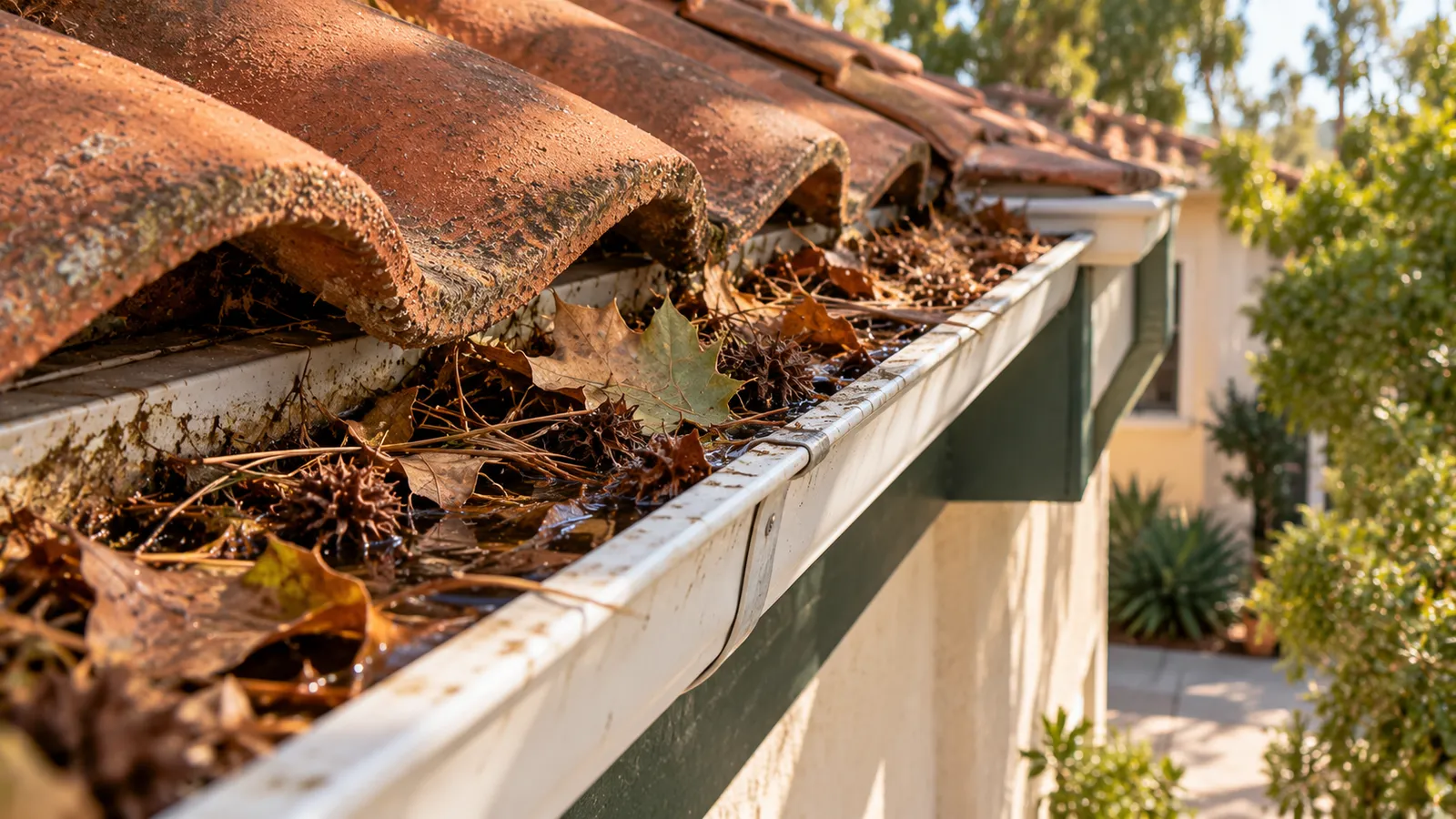
In Southern California you can go seven or eight months without meaningful rain, which is long enough to forget you own gutters at all. Meanwhile the sycamore next door, the neighbor's jacaranda and the pine across the street have been quietly filling them. By fall, a lot of gutters around here are less a drainage system than a long, narrow planter box. That matters to pests twice: once now, while the gutter holds a little standing water in the shade, and again when the first real storm hits and all that water goes over the edge instead of down the spout.
Can clogged gutters cause pest problems?
Yes, in two ways. A gutter packed with leaves holds standing water, and even a shallow pool that sits for more than a few days can be enough for mosquitoes to breed in, which stretches their season into fall. And when rain comes, a clogged gutter overflows and dumps water right at the foundation, soaking the soil that subterranean termites, Argentine ants and a long list of moisture-loving pests depend on. Clearing gutters and making sure downspouts carry water several feet away from the house is one of the simplest pest prevention jobs on the property.
The Short Version
- Clogged gutters hold water. Mosquitoes need only a small amount of standing water to breed, so a neglected gutter can keep them going into fall.
- Overflow soaks the soil along the foundation. Subterranean termites, ants, earwigs, pillbugs and millipedes all follow moisture.
- Repeated overflow can rot fascia boards and eaves, and damp, decaying wood draws wood-destroying pests.
- Clean gutters before the rain, check that downspouts drain away from the house, and read what the debris tells you about the roof.
- If water still collects against the house with clean gutters, the issue is drainage, and it is worth finding out what is taking advantage of it.
A Pond on the Roofline
A clean gutter drains in minutes. A clogged one doesn't drain at all. Leaves, pine needles, seed pods and roof grit settle into a dense mat that dams the water, and in the shade of an eave that water can sit for a long time. Even without rain, sprinkler overspray, a dripping AC condensate line or a neighbor washing a car can top it up.
For mosquitoes, that is a breeding site. The invasive day-biting species now common around Los Angeles, the ones people call ankle-biters, are especially good at using small, overlooked pockets of water: plant saucers, buckets, tarps, and yes, gutters. Southern California's warm falls keep them active well after people assume mosquito season is over, so a gutter holding water in October is still doing them a favor.
Our West Nile virus article covers what county health officials have been tracking this year, and we won't repeat it here. The point for this piece is simpler: standing water near your house is the part of the mosquito problem you actually control, and the gutter is one of the places people forget to look.
Clean gutters can hold water too
A gutter can be free of leaves and still hold water if it has lost its slope. Sagging sections, loose hangers and spots where the gutter has pulled away from the fascia all create low points. If you see a line of water sitting in a clean gutter a day after watering or rain, the gutter needs adjusting, not just emptying.
Water that stays put for more than a few days can be enough for mosquitoes to breed in.
A clog overflows at the same place each time it rains, soaking the same stretch of foundation over and over.
Repeated overflow rots the boards behind the gutter and invites wood-destroying pests.
Where the Water Lands
The second problem starts when it rains. Water hits the clog and spills over the front edge of the gutter in a sheet, landing in the same strip of soil along the foundation every storm. That strip gets saturated, the soil erodes, water splashes up onto the bottom of the stucco, and in some cases it finds its way under the slab edge or into a crawl space. If this winter turns out as wet as the El Niño forecast suggests, expect it to happen more often than usual.
Saturated soil against the house is about the most pest-friendly condition a property can have. Several of the pests that matter most follow moisture directly.
Subterranean termites
Subterranean termites live in the soil and need moisture to survive. Wet soil right against the foundation lets foraging workers work close to the house, and wood that stays damp is easier for them to attack. Our article on El Niño and termite swarms goes into how rain sets off their swarming season; this is the everyday version of the same problem.
Argentine ants
Argentine ants nest in shallow soil, mulch and leaf litter. They like moist ground, but when a nest floods they pick up their brood and move, often indoors. A soaked strip along the foundation is close to the house in both senses. Ant trails along the baseboard during a storm are a familiar rainy-season sight in this region.
The moisture crowd
Earwigs, pillbugs, sowbugs, millipedes, crickets and silverfish are not structural threats, but they all gather where it is damp. When you find them in numbers at a door threshold or in the garage, the overflow spot outside is often the reason.
The wood behind the gutter
Gutters hang on fascia boards, and fascia boards hold up badly to being soaked over and over. Overflow runs down the back of the gutter, stains and softens the wood, and eventually rots the fascia and rafter tails behind it. Damp, decaying wood is attractive to wood-destroying pests, and gaps where rotted fascia has pulled away from the roofline are exactly the kind of opening roof rats use to get into an attic.
Before the First Storm: Gutter and Drainage Checklist
Rain Barrels, Saucers and the Rest of the Roof Water
Rain barrels and other roof-water catchment have become popular around Los Angeles, and they are a good idea. Left unscreened, they are also a very large mosquito nursery fed directly by your downspout. Any barrel connected to a gutter should have a tight lid and fine mesh over every opening, including the overflow, and the water should get used rather than left to sit all winter.
The same downspout often feeds other water traps nobody intended: a plant saucer under the spout, a tarp folded over the woodpile, a toy in the side yard, the low corner of a patio cover. After the first storm, walk the drip line and the downspout outlets and tip out anything holding water. It takes five minutes and it is one of the more useful things a homeowner can do about mosquitoes.
Gutters as rodent highways
One more gutter detail, for anyone with roof rats in the neighborhood, which covers a good part of Los Angeles. Roof rats travel along rooflines, climb downspouts and overhanging branches to get up there, and look for gaps at the fascia and eaves to get in. A gutter pulling away from a rotted fascia board leaves exactly that kind of gap. While you are up on the ladder, notice whether anything along the roof edge has been chewed, and whether there are droppings mixed in with the gutter debris.
What Gutter Cleaning Won't Fix
Clean gutters solve the gutter part. They don't solve a yard that slopes toward the house, a patio poured with a slight tilt in the wrong direction, a planter built up against the stucco, or a sprinkler that has been soaking the same wall every morning for a decade. Often the gutters are just the most visible part of a broader water problem.
Plenty of Southern California houses also have no gutters at all. That is not automatically a problem, but it means the roof sheds water straight down along the drip line. Walk the house and look at what sits under that line. Wood fencing, mulch beds piled against the wall, firewood and stored lumber in the drip line all stay wetter than they should once the rain starts.
This piece is about water. The gaps pests use to get in, like door sweeps, garage seals and weatherstripping, are a separate job that our Labor Day exclusion checklist covers, and the two work best together: drainage makes the outside of the house less inviting, and exclusion makes the inside harder to reach.
The easiest test there is
The next time it rains, put on a jacket and walk around the house for five minutes. Watch where the water goes. Every spot where it sheets off the roof, pools against the wall or runs toward the foundation instead of away from it is a spot pests will find before you do.
When It's More Than a Gutter Problem
Gutter cleaning is a homeowner job, or a job for a gutter or roofing company. Where pest control comes in is when the moisture has already drawn something in, or when you aren't sure whether it has.
Mosquitoes that don't let up
If you have dumped every container you can find and are still being bitten in the yard, a mosquito program can help. Ours uses IGR trap systems: egg-laying mosquitoes are drawn to a station holding a growth regulator, pick it up, and carry it to other breeding spots they visit. The stations are refreshed on recurring visits, usually monthly. It reduces the mosquito population around the yard. It does not stop every bite, so personal precautions still matter.
Signs of termites near the overflow
Mud tubes on the foundation, damaged or hollow-sounding wood, or swarmers after a storm, especially near the spots where water lands.
Ants every time it rains
If storms reliably bring ants indoors, the nests are close to the house and the problem is ongoing. Ant control is about control, not elimination, and recurring service is usually the right fit.
Damp areas you can't see into
A crawl space that stays wet, a garage that floods at one corner, or a stretch of wall where something always seems to be living.
When we inspect a property, the exterior perimeter and the places where water collects are part of what we look at, since that's where a lot of pest activity starts. We can't regrade your yard or rehang your gutters, but we can tell you what the moisture is attracting and what it would take to deal with it.
Seeing pests where the water lands?
If the water landing against your foundation is drawing ants, termites or mosquitoes, that's worth a look. Xtermicon is a family-owned, licensed pest and termite company working across the South Bay, the Westside and greater Los Angeles. Call (310) 370-0963; quotes are free over the phone, with no obligation.
Gutter and Pest FAQs
How often should I clean my gutters in Southern California?
At minimum, once a year before the rainy season starts. Homes under trees that drop a lot of leaves, needles or seed pods may need a second cleaning partway through winter, especially in a wet year. It is also worth a quick look after any big wind event, which can fill a clean gutter in an afternoon.
Can mosquitoes really breed in gutters?
Yes. Any pocket of standing water that lasts more than a few days can work, and a clogged or sagging gutter in the shade can hold water for a long time. The invasive day-biting mosquitoes common around Los Angeles are particularly good at using small, hidden water sources like this.
Do gutter guards help with pests?
They help keep leaves and larger debris out, which reduces clogs and standing water. They are not maintenance-free, though. Fine debris and roof grit still get through, and leaves can pile up on top of the guard and block water from entering. Check guarded gutters at least once a year.
Where should my downspouts drain?
Away from the house, onto ground that slopes away from the foundation, ideally several feet out. A downspout that empties into a planter against the wall, or onto a patio that drains back toward the house, just moves the overflow problem a few feet.
My house has no gutters. Should I worry about pests?
Not automatically, since many homes here were built without them. What matters is where the roof water lands. Keep the drip line clear of wood, firewood and deep mulch, make sure the ground there slopes away from the house, and watch that strip during the first storm to see whether water is pooling against the foundation.
Related Reading
The rest of the getting-ready-for-rain picture.
- El Niño rains and termite swarmsWhat a wet winter means for subterranean termites once the storms arrive.
- The Labor Day exclusion checklistThe garage, shed and weatherstripping gaps that let pests in.
- West Nile virus in LA CountyWhat health officials have been tracking and what it means for your yard.
- Mosquito controlHow our IGR trap system works to reduce mosquitoes in the yard.
- Landscaping habits that invite pestsMulch, irrigation and planting choices that keep the foundation damp.
- Subterranean termite profileThe soil-dwelling termite that follows moisture to the house.
Sydney Pardey is the owner of Xtermicon, a family-owned pest control company serving the South Bay and greater Los Angeles area since 2015. All content is written from direct operational experience and reviewed against current California Structural Pest Control Board standards.
Specialists you
can count on.
Xtermicon was founded in 2015 with one focus: protect Southern California homes and businesses from the pests that threaten them. The name says it all — eXterminate TERmites & pest CONtrol — and that's exactly what we do. We're a family-owned team specializing in termite control, pest control, and rodent exclusion. From West LA and East LA to the beach cities and Orange County, we're local neighbors who treat your property like our own.