El Niño Rains Are Coming — What to Know About Termite Swarms Before They Start
For subterranean termites, a soaking rain is the starting signal. What to watch for once it falls, and why the dry weeks before it are worth using.
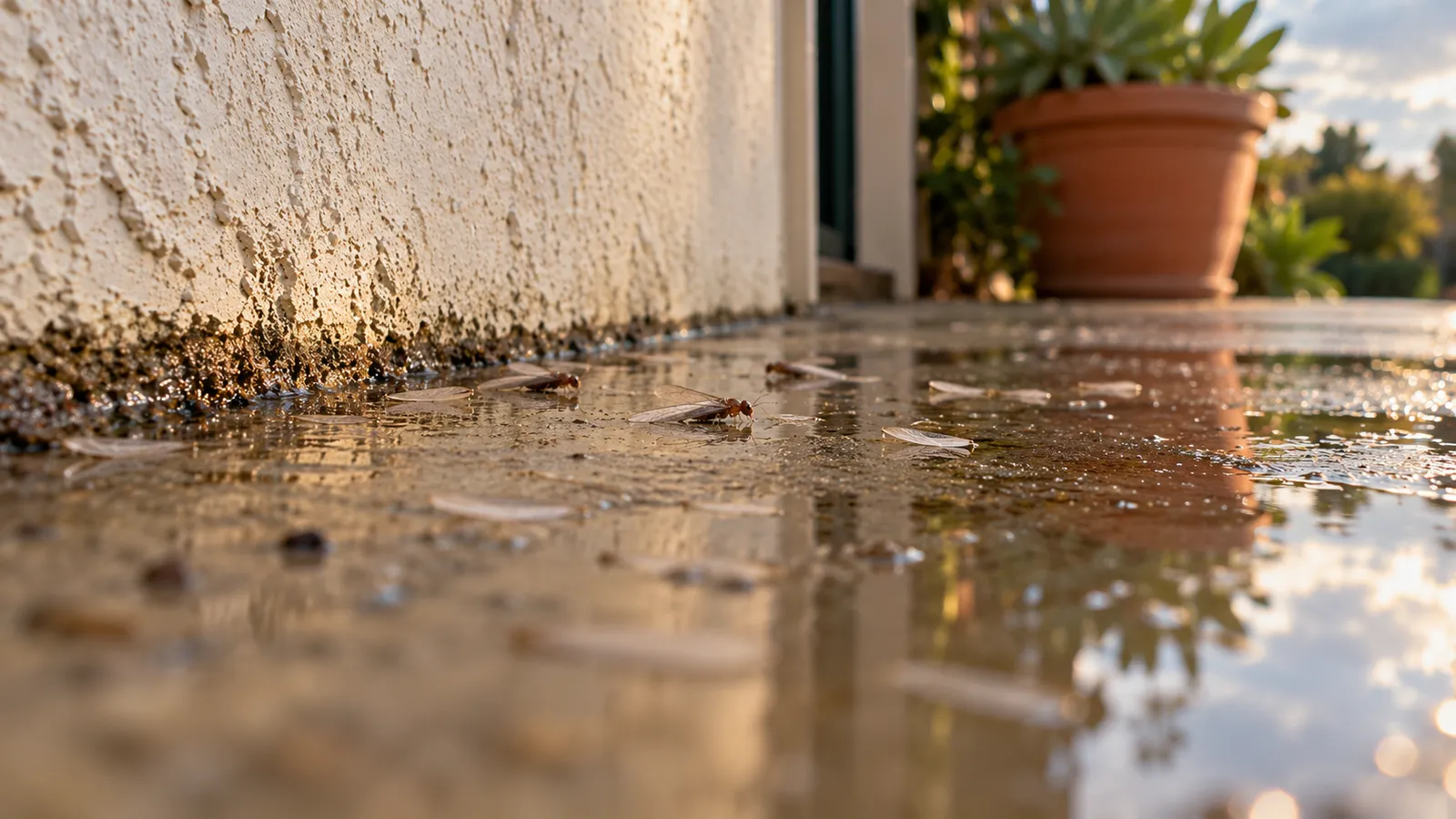
For most of the year, a subterranean termite colony under a Southern California house gives no sign that it exists. Then the first real storm of the season rolls through, the sun comes back out a day or so later, and a hairline crack in the garage slab lets go of a cloud of winged termites all at once. They flutter toward the nearest window, shed their wings, and are mostly dead by evening. If you were at work, the only evidence is a little drift of papery wings on the sill. This winter is forecast to be a wet one, and the rain hasn't started yet, which makes right now the most useful time to think about it.
Will a wet El Niño winter mean more termite swarms in Southern California?
It can. Subterranean termites, the species that live in the soil, time their swarms to rain: a soaking storm softens the ground, and the colony releases its winged reproductives, usually on a warm, calm day soon after. A wetter-than-normal winter means more of those trigger days and more moist soil, so swarms are likely to be more noticeable once the rain arrives than in a dry year. The swarm itself does no damage, but a swarm inside the house is a strong sign of an established colony in or under the structure. Since the rain has not started yet, the weeks before the first storm are a good time for an inspection.
The Short Version
- This winter is forecast to bring a super El Niño pattern, which tilts the odds toward a wetter-than-normal season. The rain has not started yet.
- Subterranean termites swarm in response to rain and soil moisture. More wet days generally means more swarm activity, and more of it noticed.
- Drywood termites swarm on their own schedule, not the rain's, so El Niño matters most for the subterranean species.
- Once storms start, check windowsills, glass doors, light fixtures and spiderwebs near windows for winged insects or piles of shed wings.
- A swarm indoors means the colony is close, usually in or under the house. The swarm is a symptom, not the infestation itself.
- An inspection before the first storm finds what is there while the house is quiet, instead of waiting for a swarm to tell you.
What a Super El Niño Does and Doesn't Promise
Seasonal forecasters expect a super El Niño to take shape this winter. In plain terms, that means unusually warm water in the tropical Pacific, which tends to push the winter storm track farther south than usual and tilts the odds toward a wetter season in Southern California.
"Tilts the odds" is the careful way to put it. El Niño doesn't lock in a soaking winter here, and strong El Niño years have underdelivered in Southern California before. Nobody can tell you today how many storms are coming, how much rain they'll bring, or when the first one will land. We certainly can't. We're a termite and pest control company, not a weather service.
What we can tell you is how subterranean termites behave when the rain does come, because that part is very consistent. If this winter turns out as wet as forecast, expect the pattern below to show up more often, and more visibly, than it does in a dry year.
Why Subterranean Termites Wait for Rain
Subterranean termites live in the soil. The colony sits underground and sends workers up through narrow mud tubes to reach the wood they feed on, which is why the first sign many people see is a pencil-width tube of dirt running up a foundation or a garage wall. Everything about this species depends on moisture. Workers dry out quickly in open air, and the colony needs damp soil to survive.
Swarmers are how a colony starts new colonies. Over the months before swarm season, an established colony raises a batch of winged reproductives, called alates, and holds them until conditions are right. For the western subterranean termite here, the right conditions usually mean a soaking rain followed by a warm, calm day. The rain softens the ground so a new pair can dig in and start a nest, and the humidity keeps the fragile swarmers from drying out during the few minutes they spend in the air.
So the colony waits. When conditions line up, the swarmers pour out of exit points in the soil, cracks in a slab, or gaps inside a wall, fly a short and clumsy distance, drop their wings, and pair off. Nearly all of them die within hours. The few pairs that land on damp soil near wood try to start over.
Why a wet year can look worse
More rain doesn't create termites. The colonies under your street are already there, and they took years to get established. What a wet winter changes is the number of days when conditions are right for swarming, and the number of chances you get to notice. In a dry year, a colony might swarm once on a weekday afternoon when nobody is home. In a wet one, repeated storms mean repeated opportunities, and the season can stretch from the first storms well into spring.
Wet soil also makes life easier for the workers. Saturated ground along the foundation, especially where a gutter overflows or a sprinkler soaks the stucco, is exactly the environment they need to forage close to the house.
Subterranean swarms follow a soaking rain, usually on a warm, still day soon after.
Most swarms are over quickly. Often all that is left by the time anyone looks is a drift of wings.
Underground, reaching the wood in your house through tunnels and mud tubes.
Drywood Termites Run on a Different Clock
This is mainly a subterranean termite story. Drywood termites, the other common species here, live entirely inside the wood they eat. They don't need contact with soil and get the moisture they need from the wood itself, so rain has little to do with their timing. Drywood colonies tend to swarm on warm days in late summer and fall, whatever the forecast says.
That has a practical side. If you find winged termites at a window during a dry, warm stretch in September or October, drywood termites are the more likely suspect. If they show up the day after a storm, think subterranean. The two need very different treatment, so it is worth getting a sample identified rather than guessing.
What to Watch For When the Storms Arrive
Swarms are short, and most people miss the actual event. What they find is the aftermath. Once the wet weather starts, these are the things worth a second look.
Winged insects at windows and glass doors
Swarmers head for light. Indoors, they gather at windows, sliding doors and skylights, and around light fixtures if it is getting dark. They are weak fliers and often look like they are crawling more than flying.
Little piles of wings
Swarmers drop their wings soon after they land. The wings are translucent, all about the same length, and tend to collect on windowsills, in window tracks, along baseboards, and in sinks and tubs.
Wings caught in spiderwebs
A web in a window corner or a garage makes a surprisingly good sample jar. Spiders catch swarmers whether anyone was home or not, so a web full of wings after a storm tells you something happened.
Where they came from
If you see them emerging, note the spot: a crack in the slab, an expansion joint, a gap at a baseboard, the base of a door frame, or around plumbing. That location is useful to an inspector.
Mud tubes
Pencil-width tubes of soil on the foundation, in the garage or in a crawl space are not new with the swarm, but people tend to find them once they start looking.
If you catch a swarm in progress, don't do anything dramatic. The swarmers are not damaging anything. Put a few in a zip-top bag or press them onto clear tape, take a photo of where they were coming from, and write down the date. Vacuum up the rest. Then call someone who can identify them properly.
Termite or flying ant?
Flying ants swarm at similar times of year and get mistaken for termites constantly. The quick version: termites have straight antennae, a thick waist with no pinch, and four wings of equal length that extend well past the body. Ants have bent, elbowed antennae, a narrow pinched waist, and front wings noticeably longer than the back pair. Our swarmers vs. flying ants guide has pictures, which help more than any description.
Please skip the spray can
Spraying swarmers on a windowsill kills the swarmers on the windowsill. They were already leaving and would have died on their own within hours. The colony that sent them is in the soil, under or beside the house, and no spray from the garage will reach it. What a swarm gives you is information, so save a few and call for an inspection.
Why the Dry Weeks Before the Rain Are the Best Time to Look
A swarm is a colony announcing itself, but it's a late announcement. By the time a colony is mature enough to produce swarmers, it has usually been feeding for years, so waiting for the swarm to tell you it's there means letting the rainy season set your schedule.
An inspection in a dry month looks at the same house without the urgency. A licensed Branch 3 inspector can check the foundation, the garage, the subarea where there is one, and the wood around the house for mud tubes, damage, and the conditions that invite termites in the first place. If something is active, treatment can be planned on your timetable instead of in the middle of a wet week. If nothing is, you have a baseline, and you know which spots to watch once the rain starts.
Some houses deserve a closer look than others. Slab homes with cracks or expansion joints, older raised-foundation homes with wood close to the soil in the crawl space, additions where a new slab meets an old one, and anywhere planters or soil are built up against the stucco all give subterranean termites an easier way in. Having any of these doesn't mean you have termites. They're just the places a good inspection spends the most time.
What you can do yourself before the first storm
Clear the gutters
And make sure the downspouts carry water several feet away from the foundation instead of dumping it at the base of the wall.
Look at the bottom of the stucco
Most stucco ends in a metal edge called a weep screed. Soil, mulch and planters should sit below it, not against it or over it.
Fix sprinklers that hit the house
A head that sprays the wall every morning keeps the soil next to the foundation wet all year, rain or no rain.
Get wood off the ground
Firewood, scrap lumber and old fence boards stacked against the house are an easy meal. Store them up off the soil and away from the walls.
Know your baseline
Walk the garage and the foundation now and photograph anything that looks like a mud tube or damaged wood, so you can tell later whether it is new.
What a Swarm Means for Your House
A swarm inside the house is a strong sign that a colony is close, usually in or under the structure. It is not a sign that the house is about to fail. Termite damage builds slowly, and a swarm is a reason to get an inspection soon, not a reason to panic tonight.
A swarm outside, from a fence post, an old stump or a pile of lumber in the yard, is less direct. It tells you colonies are active nearby, which in most Southern California neighborhoods is true anyway. That doesn't by itself mean they're in your house, but the house does deserve a look, since the conditions that suit a colony in the fence often suit one in the framing.
The part that trips people up comes afterward, when things go quiet. The wings get vacuumed up, no new swarmers appear for weeks, and it's easy to decide the problem went away. It didn't. The colony that swarmed is the same colony it was the day before, and it keeps feeding whether anyone sees it or not. Our article on the seven signs of termites walks through the other evidence to look for.
Want a look before the first storm?
A dry house is the easiest kind to inspect. Xtermicon is family-owned and licensed, our termite inspections are done by a licensed Branch 3 operator, and we work across the South Bay, the Westside and greater Los Angeles. Call (310) 370-0963 to talk it through; quotes are free over the phone, with no obligation.
El Niño and Termite Swarm FAQs
What people tend to ask once they hear the forecast.
When do termites swarm after rain in Southern California?
Subterranean swarms usually follow a soaking rain, often on the first warm, calm day afterward. In Southern California that typically starts with the first real storms of the season and can continue into spring; our month-by-month swarm calendar has the detail. Drywood termites are different and tend to swarm on warm days in late summer and fall without waiting for rain.
Are termite swarmers dangerous?
No. Swarmers don't bite, sting or carry disease, and they don't eat wood. They are short-lived reproductives whose only job is to pair off and try to start a new colony. What matters is what they tell you: a colony mature enough to produce them is nearby, and if they appeared inside, it is probably in or under the house.
If I see swarmers in the yard, do I have termites in my house?
Not necessarily. Swarmers coming from a fence, a stump or a woodpile mean there is an active colony on the property, which is common. They don't prove the house is infested. They are a good reason to have the house inspected, because conditions that support one colony usually support others.
Will the swarmers start a new colony in my house?
It is possible but uncommon. Nearly all swarmers die within hours. A pair has to land near damp soil and wood, dig in, and survive long enough to raise a colony, which takes years to amount to anything. The real concern is the established colony that produced the swarm, not the swarmers themselves.
Does El Niño affect drywood termites too?
Not much. Drywood termites live inside the wood and don't need contact with soil, so rain has little to do with when they swarm. A wet winter mainly matters for subterranean termites. If you're not sure which kind you have, a few saved swarmers, or a sample of the tiny pellets drywood termites push out of the wood, will settle it.
Should I schedule a termite inspection before the rain starts?
If it has been a while since your last one, before the rain is a good time. The house is dry, nothing is swarming yet, and any treatment that turns out to be needed can be planned rather than rushed. It also gives you a sense of what was there beforehand, so a mud tube or a pile of wings in January is easier to read.
Related Reading
Our other termite reading, for the parts this article skips.
- Termite swarms are already showing up this fallWhat the fall swarm season has looked like so far, before any rain.
- When do termites swarm in Southern California?The month-by-month swarm calendar for both species.
- 7 signs you have termitesThe other evidence to look for besides a swarm.
- Termite swarmers vs. flying antsA visual guide to telling the two apart.
- Termite inspectionHow our licensed inspectors look at a home.
- Subterranean termite profileIdentification and habits of the soil-dwelling species.
Sydney Pardey is the owner of Xtermicon, a family-owned pest control company serving the South Bay and greater Los Angeles area since 2015. All content is written from direct operational experience and reviewed against current California Structural Pest Control Board standards.
Specialists you
can count on.
Xtermicon was founded in 2015 with one focus: protect Southern California homes and businesses from the pests that threaten them. The name says it all — eXterminate TERmites & pest CONtrol — and that's exactly what we do. We're a family-owned team specializing in termite control, pest control, and rodent exclusion. From West LA and East LA to the beach cities and Orange County, we're local neighbors who treat your property like our own.