Termite Swarms Are Already Showing Up in Southern California This Fall
Winged insects on a windowsill, or a small pile of shed wings by a sliding door. Here is how to tell what you are looking at in the next sixty seconds, and what it does and does not mean.
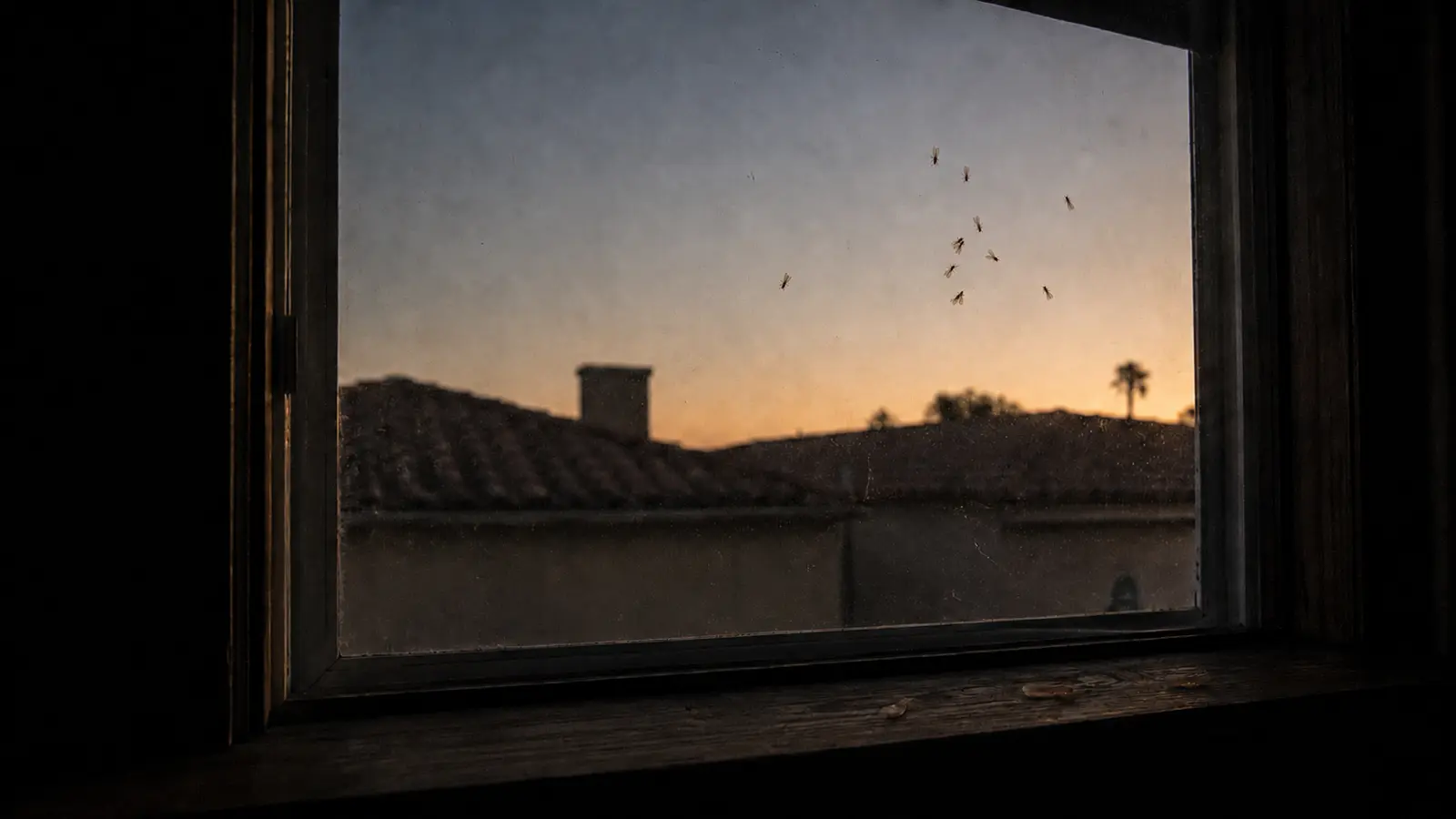
The phone calls have a recognizable shape this time of year. Someone opens a blind in the late afternoon and there are two dozen winged insects working at the glass. Or they find a scatter of small translucent wings on a windowsill, in a sink, or caught in a cobweb near a sliding door — no insects at all, just the wings, which is somehow more unsettling. Swarm activity is picking up across Southern California right now, consistent with the wetter-than-average fall pattern, and it is arriving noticeably earlier than people expect. Here is how to read what you are looking at.
What does it mean if I see termite swarmers in my house?
A swarm is a mature colony sending out winged reproductives to start new colonies — it is a sign of an established colony rather than a new arrival. The critical distinction is where you found them. Swarmers outdoors are not necessarily about your house; they fly, and they can land anywhere from a colony down the street. Swarmers emerging inside your home, or a pile of discarded wings found indoors, is a much stronger signal that a mature colony is in or immediately against the structure, and it warrants an inspection. Swarmers themselves cause no damage and spraying them accomplishes nothing, because the colony that produced them is somewhere you cannot reach with a can.
The Short Version
- Swarm activity is running early this season, consistent with the wetter-than-average fall pattern already underway.
- Three features separate termite swarmers from flying ants: straight versus elbowed antennae, four equal wings versus unequal pairs, and a thick straight waist versus a pinched one.
- Discarded wings are the more common find, and they are the more useful clue — termites shed them readily, ants rarely do.
- Outdoors is ambiguous; indoors is a signal. A swarm emerging inside means a mature colony in or against the structure.
- Swarmers do no damage themselves. They are the reproductive stage — evidence of a colony, not the thing eating your house.
- Do not spray them. It kills the visible insects, destroys the evidence an inspector needs, and does nothing to the colony.
Why You Are Seeing This in September
Termite swarms are triggered by a combination of colony maturity, temperature, and moisture. A colony has to reach a certain size and age before it produces reproductives at all, and then it waits for conditions — typically warmth followed by moisture, which is why swarms so often follow rain and why they cluster in the hours after a warm, humid afternoon.
This fall has been wetter than average, and that is the relevant variable. Rain earlier in the season, combined with the warmth still in the ground, produces conditions that bring swarms out sooner and make them more visible than a dry September would. We are not going to put a number on how much earlier or quote a sighting count, because nobody has a reliable regional figure and inventing one would not help you. What we can say is that the calls started earlier this year than they usually do, and that the pattern is consistent with what the weather has been doing.
The seasonal mechanics — which species swarms when, and the full month-by-month picture across the year — are covered in a separate piece linked at the end. This one is about what to do in the next hour.
Termite Swarmer or Flying Ant? Three Features
This is the single most useful thing to know, because both swarm in the same conditions and get mistaken for each other constantly. If you can get a look at one — on a windowsill, in a web, on the floor — three features settle it.
The waist
A termite swarmer has a broad, straight-sided body with no narrowing between its sections — the outline is essentially a uniform tube. A flying ant has a dramatically pinched waist, the classic wasp-like nip. This is the fastest tell and usually visible without magnification.
The antennae
Termite antennae are straight and look like a string of tiny beads. Ant antennae have a distinct elbow — a clear bend partway along. Once you have seen the difference it is unmistakable.
The wings
A termite has four wings of roughly equal length, all noticeably longer than its body, and they detach very easily. An ant's front pair is clearly longer than its rear pair, and the wings stay attached.
The shed wings deserve special mention because they are what most people actually find. Termite wings come off readily once the insect has landed and is looking for a place to start a colony, so a small pile of identical translucent wings on a sill, in a sink or bathtub, along a sill plate, or caught in a spider web is close to a signature. Ants very rarely leave that evidence. If you find wings and no insects, that is still a finding worth acting on.
Beaded and straight. Ant antennae have a distinct elbow bend — the clearest close-up difference.
All four roughly the same length and longer than the body. Ants have a longer front pair and shorter rear pair.
Broad and uniform from front to back. Ants are sharply pinched in the middle.
Save one, do not spray it
If you can, trap one under a glass or collect a few of the shed wings into a plastic bag or an envelope. That single step makes an inspection substantially more useful, because species identification changes what the treatment should be. Spraying the swarm destroys exactly the evidence that would have told us what we are dealing with.
Where You Found Them Changes Everything
This is the distinction that determines whether you should be concerned, and it gets flattened in most coverage into a blanket "termites means panic," which is neither accurate nor useful.
Outdoors: probably not about your house
Swarmers are fliers. A colony in a neighbor's fence, a utility pole, a tree stump, a woodpile, or a landscape timber can put reproductives into the air that land on your patio furniture, your driveway, your car, or the outside of your windows. Finding them outdoors tells you there is a mature colony somewhere in the vicinity, which in Southern California is close to a given, and it does not by itself mean anything about your structure.
It is still worth noting rather than ignoring. If you are seeing them outdoors repeatedly and in the same place each time, that is worth mentioning at your next inspection, because it may point at a source close to the building.
Indoors: a genuine signal
Swarmers emerging inside the house is a different finding, and this is the one that warrants a call. Reproductives that come out inside a structure came from a colony in or immediately against that structure — they did not fly in through a closed window. The same goes for shed wings found indoors on sills, in sinks and tubs, or along baseboards.
What it means practically: a colony has reached maturity, which takes years. It does not mean your house is about to collapse — termite damage accumulates slowly, and a swarm is not a sudden emergency. But it does mean the situation has been developing for a while without being noticed, and the useful response is an inspection rather than a product.
One more location worth knowing: swarmers appearing around a slab edge, an expansion joint, a bath trap, or a plumbing penetration point toward subterranean termites coming up through soil contact. Swarmers concentrated near eaves, window frames, attic access, or exterior trim point more toward drywood termites, which need no ground contact at all. Both are common here; they call for different treatment, which is another reason identification matters.
The Next Steps, In Order
Do not reach for a spray can
Store-bought aerosol kills the swarmers you can see and does nothing whatsoever to the colony, which is inside wood or below the slab. It also removes the evidence. This is the single most common wasted step.
Collect a sample
A few insects under a glass, or shed wings in a bag or envelope. Photograph where you found them before you clear anything up — location is part of the finding.
Note exactly where and when
Which room, which window, what time of day, whether it followed rain. Repeat sightings in the same spot are meaningful. An inspector uses this to decide where to open things up.
Vacuum up the rest
Once you have a sample and a photo, the remaining swarmers can simply be vacuumed. They will die on their own regardless — they are poor fliers and most never establish anything.
Schedule an inspection
For an indoor swarm, promptly. For an outdoor one, at your next routine interval unless it is recurring in one spot. A wood-destroying organism inspection is done by a licensed Branch 3 operator and covers the accessible structure rather than only the room where you saw them.
On timing: there is no need to treat this as a same-day emergency, and any company that tells you otherwise on the phone is worth a second look. Colonies that produce swarms have been there for years. What matters is that the inspection actually happens rather than getting deferred until the swarm is forgotten in November — which is the genuinely common failure mode, because swarms stop being visible long before the colony stops being active.
Found swarmers or wings indoors?
That is worth an inspection. Xtermicon has worked termite pressure across coastal Southern California housing stock since 2015, and holds California Structural Pest Control Board Company License No. 10100. Call (310) 370-0963 — we can talk through what you found over the phone first, and there is no obligation.
Termite Swarm FAQs
What people ask in the hour after they find a swarm.
I found wings but no insects. Does that still count?
Yes, and it is actually the more common find. Termite swarmers shed their wings shortly after landing, so a small pile of identical translucent wings on a windowsill, in a sink or bathtub, along a baseboard, or caught in a spider web is characteristic evidence. Ants rarely leave shed wings behind. Collect a few in an envelope and note where they were — that is a usable finding even with no insect to look at.
Is a swarm an emergency? Do I need someone today?
No. A swarm indicates a colony that has been maturing for years, not damage happening this week. Termite damage accumulates slowly and a few days makes no practical difference. What does matter is that the inspection actually gets scheduled — swarms are visible for a short window and easy to forget once they stop, while the colony carries on regardless. Prompt is right; panicked same-day is not necessary, and pressure to treat it that way is worth questioning.
Should I spray the swarmers?
No, on two counts. It does nothing to the colony, which is inside structural wood or below the slab where an aerosol cannot reach — you are killing the reproductive stage, which was leaving anyway and does no damage. And it destroys the specimens that would let someone identify the species, which determines whether you are dealing with drywood or subterranean termites and therefore what the treatment should be. Collect a sample, then vacuum the rest.
They were outside on the patio. Do I still need an inspection?
Not urgently. Swarmers fly, and one landing on your patio furniture may have come from a fence, a stump, a woodpile, or a neighbor's structure. Outdoors is ambiguous by nature. Worth mentioning at your next routine inspection, and worth taking more seriously if you are seeing them repeatedly in the same spot, since that can indicate a source close to the building.
How can termites have been there for years without me noticing?
Because almost everything they do happens inside wood or below ground. Termites avoid open air and eat wood from the inside out, so a piece of framing can be substantially hollowed while its painted surface looks untouched. There is often no smell, no visible hole, and no sound audible to a person. The swarm is frequently the first thing a colony does that is visible from the outside, which is exactly why it matters as a signal even though the insects themselves are harmless.
Does a swarm mean I need fumigation?
Not necessarily, and it is too early to know from a swarm alone. What treatment is appropriate depends on the species, how widespread the activity is, and where it is located — local or spot treatments handle a contained drywood infestation, while subterranean termites are addressed a different way entirely, and whole-structure fumigation is for widespread drywood activity. Any of that is a conclusion an inspection reaches, not something a swarm establishes on its own.
Related Reading
The full seasonal picture, the identification detail, and what an inspection covers.
- When do termites swarm in Southern California?The month-by-month picture across the whole year, by species.
- 7 signs you have termitesThe evidence that is present between swarms, which is most of the year.
- Termite swarmers vs. flying antsThe full identification guide, with the three features in detail.
- Drywood vs. subterranean termitesWhich one you have changes the treatment entirely.
- Termite inspection when buying or selling a homeWhat a Section 1 and Section 2 report actually says.
- Our termite control serviceInspection and treatment options for both termite types.
Sydney Pardey is the owner of Xtermicon, a family-owned pest control company serving the South Bay and greater Los Angeles area since 2015. All content is written from direct operational experience and reviewed against current California Structural Pest Control Board standards.
Specialists you
can count on.
Xtermicon was founded in 2015 with one focus: protect Southern California homes and businesses from the pests that threaten them. The name says it all — eXterminate TERmites & pest CONtrol — and that's exactly what we do. We're a family-owned team specializing in termite control, pest control, and rodent exclusion. From West LA and East LA to the beach cities and Orange County, we're local neighbors who treat your property like our own.