When Do Termites Swarm in Southern California? A Month-by-Month Guide
Two species, two completely different schedules — one keyed to summer heat, the other to the first real rain. Here is the calendar, and what finding swarmers actually tells you about your house.
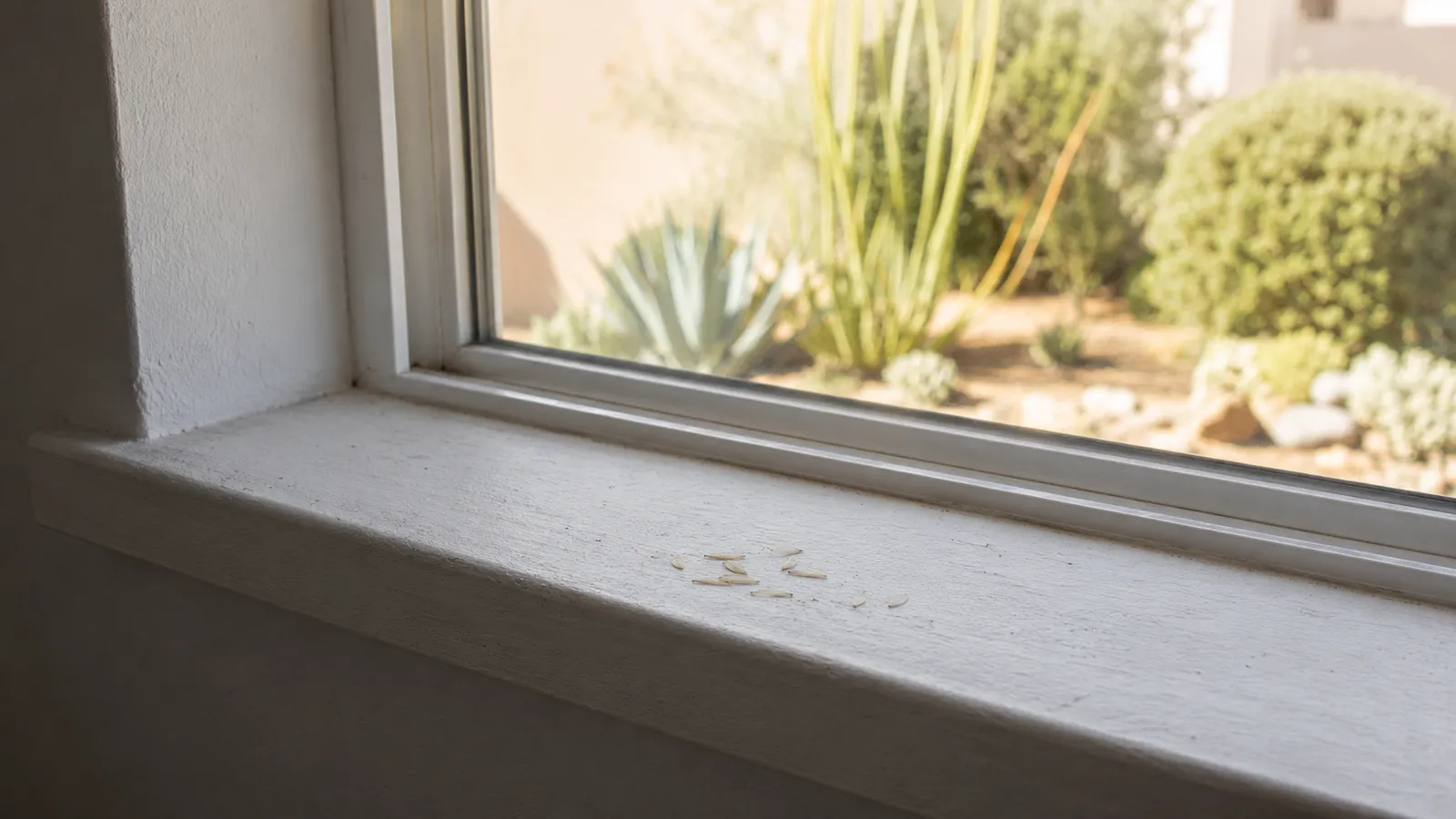
Almost nobody sees the swarm. What people see is what it leaves behind: a scatter of small translucent wings on an interior windowsill, all roughly the same size, collected along the edge where the glass meets the frame. Sometimes it is a few dozen. Sometimes it is one, and you only notice because it is an odd thing to find indoors in September. That pile of wings is the single most useful piece of evidence a Southern California homeowner ever gets about termites, and almost everyone sweeps it up before understanding what it was telling them.
When do termites swarm in Southern California?
It depends on the species, and the two on our schedule are on opposite calendars. Drywood termites swarm mainly from midsummer into fall — roughly July through October — on warm evenings, often in the day or two after a heat spell. Subterranean termites swarm after the first significant rainfall of the season, which here usually means September through December, and they sometimes produce a second, smaller flight in spring. Exact timing shifts year to year with temperature and rain, so treat these as windows rather than dates. The more important point: seeing swarmers does not mean your house was just infested. It means a mature colony is nearby and has been established for years.
The Short Version
- Drywood termites swarm on warm evenings from roughly July into October, often right after a hot stretch.
- Subterranean termites swarm after the first meaningful rain of the season — typically September through December in Southern California, occasionally again in spring.
- Both windows shift year to year. Temperature and rainfall drive the trigger, so a warm dry fall pushes flights later and a wet one pulls them forward.
- Swarmers mean an established colony, not a new one. A colony generally has to mature for years before it produces winged reproductives at all.
- Swarmers found inside are the finding that matters most — they point to a colony in or immediately against the structure rather than somewhere in the neighborhood.
- Do not panic and do not spray the wings. Collect a few in a bag, note where you found them, and get an inspection scheduled.
A Swarm Is a Colony Reproducing, Not a Colony Arriving
This is the part that changes how people react, so it is worth getting straight before the calendar.
A termite colony spends most of its life invisible. Workers feed, soldiers defend, and the colony grows inside wood or underground with no outward sign at all. Only once it reaches a certain maturity does it start producing a different caste: winged reproductives, called alates or swarmers. On the right day, those alates leave in a mass flight, pair off, drop their wings, and try to start colonies of their own. The overwhelming majority die within hours. A handful succeed.
The consequence for you is straightforward. Swarmers are not an invasion arriving — they are an established colony exporting. A colony has to be several years old before it produces them. So the wings on your windowsill are not evidence that termites showed up last week. They are evidence that a mature colony has been working somewhere nearby, quite possibly in your structure, long enough to start reproducing.
Colonies mature for several years before producing winged reproductives — which is why a swarm signals a long-running problem, not a new one.
Drywood termites fly on heat. Subterranean termites fly on rain. Knowing which you saw narrows the search enormously.
Most swarms are over quickly, often within the hour — which is why the discarded wings are usually the only thing anyone sees.
Why the Two Species Fly at Different Times
Southern California has both drywood and subterranean termites, and they live completely differently. This article is about timing rather than identification — if you want the full breakdown of how the two species differ, where they live, and how treatment differs, that is covered in a separate piece linked at the end. For the calendar, only the trigger matters.
Drywood termites live entirely inside the wood they eat, with no soil contact and no need for external moisture. Their swarm trigger is heat. Flights come on warm evenings through the back half of summer and into fall, and they cluster in the day or two following a hot stretch. In a coastal city with a mild marine layer, a drywood swarm often arrives the evening after the first genuinely hot day in a while.
Subterranean termites live in the soil and travel up into a structure through mud tubes, which means their whole existence depends on moisture. Their swarm trigger is rain — specifically the first significant rainfall of the season, often on the warm, still, humid day right after. In Southern California that lands most often between September and December, and a secondary spring flight is not unusual after a late rain.
Swarm Season, Month by Month
A working calendar for the South Bay and greater Los Angeles. Treat these as windows, not dates — a dry warm fall pushes everything later, and an early storm pulls the subterranean flights forward.
Little swarm activity. Colonies are active but not flying. This is the best window of the year for an unhurried inspection, because you are not competing with everyone who just found wings on a sill.
Subterranean termites sometimes produce a second, smaller flight following a late-season rain, particularly on a warm humid morning after a storm. Smaller and less reliable than the fall flights, but real — and easy to write off as flying ants.
Few flights, but colonies are growing fast in the warm months and drywood alates are developing. Nothing to see yet. This is the cheap month to deal with a problem you already know about.
Drywood swarm season opens. Warm evenings are the trigger, and flights cluster in the day or two after a heat spell. Attic and roof-adjacent wood, fascia, eaves, window and door frames, and furniture are the usual sources.
The busiest stretch of the year. Drywood flights continue through the warm evenings, and if the first real rain lands in this window, subterranean flights begin on top of them. Two species swarming in the same month is normal here.
Drywood activity tapers. Subterranean flights follow the season's rainfall, and in a wet year the largest flights of the year happen now — typically on the still, humid day right after a storm passes.
One piece of context for this particular season, offered as a general pattern rather than a forecast: the outlook for fall 2026 has been trending wetter than average along the Southern California coast. If that holds, subterranean flights could arrive earlier and be more noticeable than in the last few dry autumns. That is a reason to know what a swarmer looks like before you see one, not a reason to do anything differently today.
Indoors versus outdoors is the distinction that matters
Swarmers outside — around a porch light, over the lawn at dusk, along a fence line — tell you there is a mature colony in the neighborhood. That is worth knowing and not worth losing sleep over. Swarmers found inside the house, or wings piled on an interior windowsill or in a light fixture, are a different finding entirely: they point to a colony in or immediately against the structure. Alates fly toward light, so an interior sill is exactly where they collect when they emerge indoors. That is the one that earns a same-week inspection.
You Found Swarmers. Now What?
The instinct is to reach for a spray can. Resist it — killing the visible alates does nothing to the colony that produced them, and it destroys the evidence that would tell an inspector what they are dealing with.
Collect a few, do not sweep them all
Put several intact insects or a pinch of the discarded wings in a sealed bag or a small container. Species matters enormously for what happens next, and an intact specimen settles it in seconds.
Note exactly where you found them
Which room, which window, which side of the house, and whether they were inside or outside. If it is a light fixture, note that too. This is genuinely the most useful information you can hand an inspector, because it narrows where to look.
Photograph the source if you can find it
Sometimes there is a small hole in trim, a bulge or blister in paint, or a scatter of tiny pellets beneath a beam. Photograph it rather than probing at it.
Leave the wood alone
Do not drill it, do not open it up, and do not treat it with a hardware-store product. Both of those complicate a proper inspection, and neither reaches a colony living inside a structural member.
Schedule an inspection
Not an emergency, but not a next-spring item either. Termite damage is slow and cumulative rather than sudden, so the cost of a few weeks is low and the cost of a few years is not.
Swarmer or flying ant?
Plenty of swarms get dismissed as ants, which is how a real finding gets lost. Three differences settle it, and you can check all three on a single specimen with the naked eye.
Waist
A termite alate has a straight, uniform body with no pinch. An ant has an obvious narrow waist between thorax and abdomen. This is the fastest tell.
Wings
A termite has four wings of equal length, all noticeably longer than its body, and they shed easily. An ant has front wings clearly longer than the back pair, and they do not drop off in a pile.
Antennae
A termite's antennae are straight and beaded. An ant's are elbowed, with a distinct bend partway along.
If you are looking at a pile of shed wings with no insects attached, that alone points to termites. Ants generally do not leave a windowsill covered in discarded wings.
What an Inspection Actually Sorts Out
The reason species identification matters so much is that the two problems live in different places and get handled differently. A drywood colony is inside the wood, which means the work is about locating and treating the infested members — local or spot treatments where the extent is limited and contained, and fumigation where it is widespread through a structure. A subterranean colony is in the soil, which means the work is about the soil-to-structure connection: where the mud tubes run, what conducive conditions are feeding them, and treating the ground rather than just the wood.
An inspection sorts out which of those you have, how far it has gone, and whether what you are seeing is active or old damage from something already resolved. That last one comes up more than people expect, particularly in an older home that has been treated before.
Found wings on a windowsill?
Bag a few, note the room, and give us a call. Xtermicon has been working on termites across the South Bay, the Beach Cities, and greater Los Angeles since 2015, and a swarm finding is one of the clearest reasons to get a look at a house. Call (310) 370-0963 and we will tell you what you found and what it means before anyone talks about treatment.
Termite Swarm Season FAQs
What homeowners ask most in the weeks after they find their first swarm.
Does seeing swarmers mean my house has termites?
Not necessarily, and the location is what separates the two cases. Alates fly, and a swarm outdoors may well have come from a neighbor's fence, a tree stump, a woodpile, or a structure down the street — it tells you a mature colony is in the area. Swarmers or shed wings found inside the house are a much stronger signal, because it means alates emerged within or immediately against the structure. Either way, a swarm is the reason to get an inspection rather than the conclusion of one.
I killed the swarmers. Is the problem solved?
No, and this is the most common misunderstanding about swarms. The alates you can see are a tiny reproductive fraction of the colony, and almost all of them were going to die within hours regardless. The colony that produced them — the workers actually eating the wood — is unaffected. Killing swarmers changes nothing about the infestation; it only removes the evidence.
How do I know if it was drywood or subterranean termites?
Timing is a strong first clue: a warm evening flight in August is almost certainly drywood, while a flight on a humid day right after the season's first storm is almost certainly subterranean. Beyond that, drywood termites push out distinctive small hard pellets from kick-out holes, while subterranean termites build mud tubes running from soil to wood. An intact specimen settles it definitively, which is why collecting a few matters more than it seems at the time.
Is there a best time of year to get a termite inspection?
Any time is a reasonable time, but late winter and early spring — roughly January through March — is the easiest window. Swarm season has passed, the evidence from fall flights is still visible, and it is the quietest stretch of the year for scheduling. That said, if you have just found swarmers, do not wait for a convenient month. The finding is more useful while you still remember exactly where it was.
Do the swarm dates change from year to year?
Yes, and meaningfully. Both triggers are weather-driven rather than calendar-driven. Drywood flights follow heat, so a cool coastal summer delays them and a run of hot days pulls a flight forward. Subterranean flights follow the season's first real rainfall, which in Southern California can land anywhere from September to well into December depending on the year. Treat the windows in this guide as the pattern and the weather as the actual schedule.
Can I prevent a swarm?
You cannot prevent alates from flying in your neighborhood, and you would not want to try. What you can do is make your structure a poor destination and catch an existing colony before it matures enough to swarm: keep soil and mulch below the level of any wood, fix the leaks and drainage that keep wood damp, keep firewood and lumber off the ground and away from the foundation, screen attic and subarea vents, and have the structure looked at periodically rather than only when something appears. Prevention here is really early detection.
Related Reading
The identification, evidence, and inspection side of termites — the pieces this timing guide deliberately does not repeat.
- Drywood vs. subterranean termitesThe full species breakdown — where each lives, what the damage looks like, and why treatment differs.
- 7 signs you have termitesThe evidence to look for between swarms, from mud tubes to hollow-sounding wood.
- Termite inspection when buying or selling a homeHow the escrow inspection works and what a Section 1 finding actually means.
- Our termite control serviceLocal and spot treatments through to fumigation, matched to what the inspection finds.
- Drywood termite pest libraryIdentification, biology, and the evidence they leave behind.
- Pest control in TorranceTermite work across Torrance and the wider South Bay since 2015.
Sydney Pardey is the owner of Xtermicon, a family-owned pest control company serving the South Bay and greater Los Angeles area since 2015. All content is written from direct operational experience and reviewed against current California Structural Pest Control Board standards.
Specialists you
can count on.
Xtermicon was founded in 2015 with one focus: protect Southern California homes and businesses from the pests that threaten them. The name says it all — eXterminate TERmites & pest CONtrol — and that's exactly what we do. We're a family-owned team specializing in termite control, pest control, and rodent exclusion. From West LA and East LA to the beach cities and Orange County, we're local neighbors who treat your property like our own.