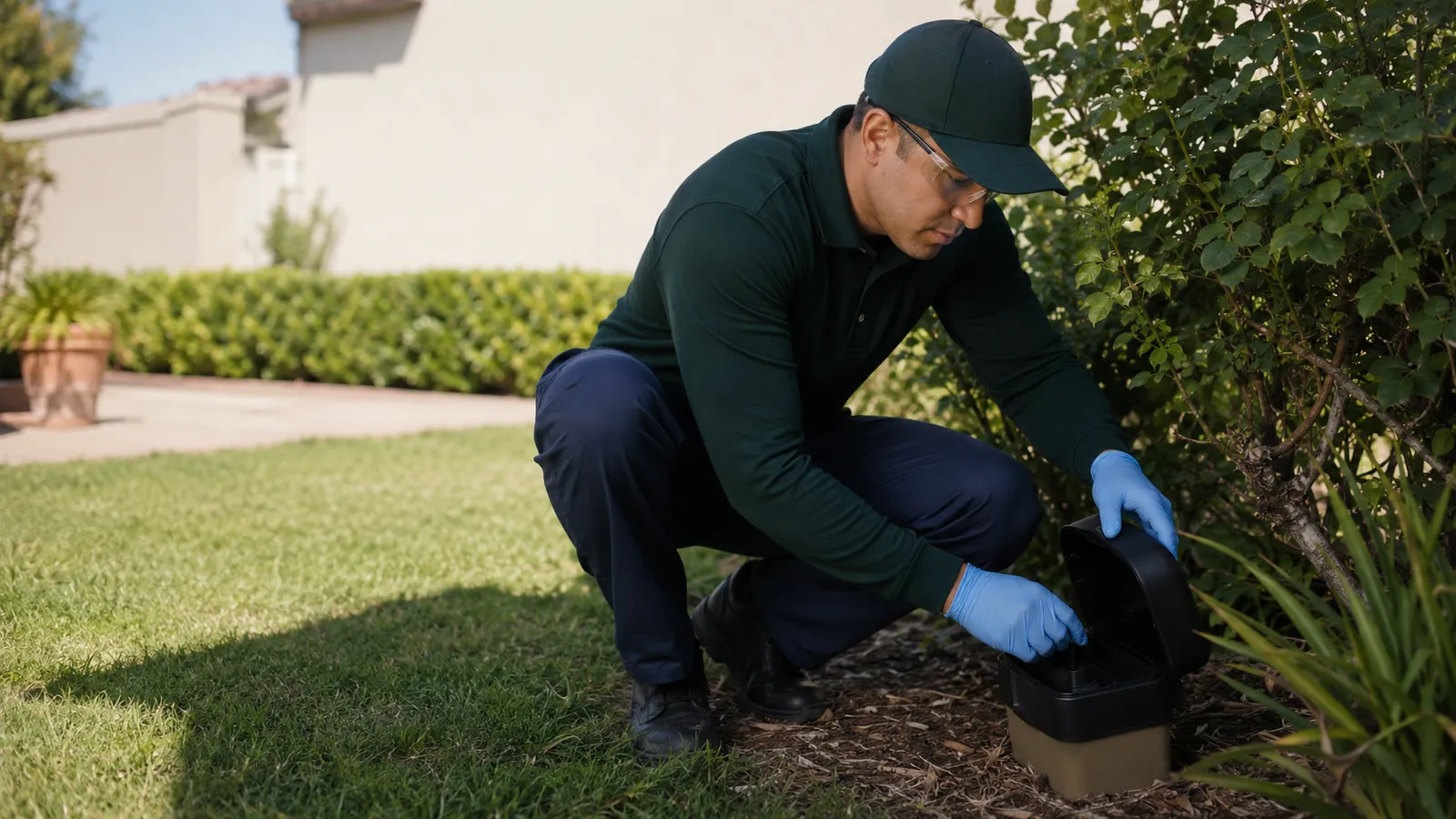
Why do mosquitoes keep coming back after treatment?
Because killing the adults that are flying at that moment leaves the breeding containers untouched, and the invasive Aedes mosquitoes established in Southern California can complete a generation in about a week in as little water as a bottle cap holds. Unless the standing water is reduced — plant saucers, bromeliads, drain lines, tarps, toys, clogged gutters, pet bowls — the population reloads. Our approach is to survey the property and show you what we find, set out growth-regulator trap systems that interrupt the larval stage, and return on a schedule to refresh the product in them.
Service Overview
Mosquito control here changed when Aedes aegypti and Aedes albopictus became established. These are not the dusk-active mosquitoes people grew up swatting — they bite in daylight, they go for ankles, they rarely travel far from where they hatched, and they breed in astonishingly small amounts of water. A bottle cap is enough. That last detail is why killing the adults currently flying does so little on its own: it leaves the containers producing the next batch untouched. Our program sets out IGR trap systems that turn standing water against the population, and we return on a recurring basis to refresh the product so the traps keep working.
Key Takeaways
- Aedes aegypti and Aedes albopictus are now established across Southern California — they bite during the day, target ankles, and are the reason mosquito complaints rose sharply.
- These mosquitoes breed in tiny volumes of water and typically stay within roughly 150 feet of where they hatched, so the source is almost always on the property or next door.
- Killing adults alone is the least durable approach; reducing the water they breed in is what lowers bite pressure.
- We survey the property and present our findings — the containers we locate, and what we recommend doing about them.
- We set out IGR trap systems, which use the mosquito's own egg-laying behavior against it: females deposit eggs in treated water where larvae cannot mature.
- The traps need refreshing, so recurring visits to change the product are part of how the service works.
- Because flight range is short, coordinating with immediate neighbors dramatically improves results.
Key Benefits
- ✓A survey of the property with our findings presented to you clearly
- ✓IGR trap systems that break the larval stage rather than only killing adults
- ✓Recurring visits to refresh the product in the traps
- ✓Practical, specific source-reduction guidance you can maintain between visits
IGR Trap Systems
Rather than relying on adult knockdown, these traps recruit egg-laying females into treated water where an insect growth regulator prevents larvae from ever reaching adulthood.
Source-First Diagnosis
We find and document the containers producing your mosquitoes. Any service that skips this step is selling you a temporary afternoon, not control.
Seasonal Adjustment
Pressure shifts with heat, irrigation, and rainfall. Placements and frequency get adjusted through the season instead of running the same plan in October as in July.
Our Decisive Process
Property Survey
We walk the property looking for what holds water — saucers, bromeliads, drains, tarps, gutters, toys, meter boxes — and present our findings to you, since Aedes need almost nothing to breed.
Source Reduction
Dumping and draining what can be dealt with on the day, plus a specific list of what needs ongoing attention from you between visits.
IGR Trap Placement
We set out growth-regulator trap systems in shaded locations, so water that cannot be removed becomes a dead end for larvae instead of a nursery.
Recurring Product Refresh
We return on a recurring basis to change and refresh the product in the traps, and adjust placement as pressure shifts through the season.
The ankle-biters changed the playbook
If you are being bitten in the middle of the afternoon, on the ankles, in your own backyard, that is almost certainly an invasive Aedes mosquito rather than the native species. It matters practically, not just academically. Aedes are container breeders, weak fliers, daytime feeders, and persistent — a single female will bite several times to complete one blood meal, which is why a handful of mosquitoes feels like an infestation.
- ✓Daytime biting, concentrated around ankles and lower legs
- ✓Breeds in containers, not ponds or marshes — bottle caps, saucers, bromeliad axils, corrugated drain pipe
- ✓Short flight range, usually within about 150 feet of the hatch site
- ✓Bites repeatedly and approaches low and quietly, so people rarely see them land
What we need from you between visits
This is the one service where the homeowner genuinely determines the outcome. We can eliminate the sites we find and place traps for the water we cannot remove, but new containers fill every time you water or it rains. A weekly five-minute walk — tip anything holding water, scrub plant saucers rather than just dumping them, flush bromeliads, check the corrugated drain pipe behind the planter — does more for bite pressure than any additional product we could apply.
A note on your local vector control district
Southern California is covered by public mosquito and vector control districts, and they are a real resource: most will investigate a persistent source, and several offer free mosquito fish for ornamental ponds and neglected pools. If your problem traces to a neighboring property, a green pool, or a public storm drain, that is squarely their remit and worth a call alongside ours.
Service FAQs
"Can you get rid of mosquitoes completely?"
Honestly, no — not permanently, and anyone promising it is overselling. Mosquitoes fly in from neighboring properties and public spaces. What we can do is substantially reduce bite pressure by eliminating the breeding sites on your property and interrupting the larval stage, which is where the population you are actually experiencing comes from.
"Why am I getting bitten during the day?"
Because the mosquitoes biting you are almost certainly invasive Aedes species, which are daytime feeders — unlike the native mosquitoes most people picture. They also bite low, around the ankles, and approach quietly, so you feel the bite before you ever see the mosquito.
"How small a puddle can mosquitoes actually breed in?"
Smaller than most people believe. A bottle cap of water is enough for Aedes. In practice the culprits we find most often are plant saucers, bromeliad leaf axils, corrugated drain pipe, pet bowls, tarps and pool covers, kids' toys, clogged gutters, and water meter boxes.
"Do mosquito treatments harm bees?"
It is a fair concern with any outdoor application. Our mosquito program is built around trap systems and the larval stage rather than broad spraying, and traps are placed in shaded locations away from blooming plants. If you keep bees or maintain a pollinator garden, tell us and we will plan placement around it.
"Will treating my yard help if my neighbor has a green pool?"
Partly. Because Aedes rarely travel more than about 150 feet, a neglected pool next door can supply your whole block, and treating only your side is fighting the current. We will identify it, and your local vector control district can act on the property directly — that combination works far better than either alone.
Identify What You're Dealing With
Treatment starts with correct identification. These pest library entries cover the species we target with this service.
Specialists you
can count on.
Xtermicon was founded in 2015 with one focus: protect Southern California homes and businesses from the pests that threaten them. The name says it all — eXterminate TERmites & pest CONtrol — and that's exactly what we do. We're a family-owned team specializing in termite control, pest control, and rodent exclusion. From West LA and East LA to the beach cities and Orange County, we're local neighbors who treat your property like our own.