Sowbugs, Pillbugs, and Millipedes: The Harmless Bugs You'll See After It Rains
A patio full of little gray armored bugs the morning after a storm looks like the start of something. It almost never is.
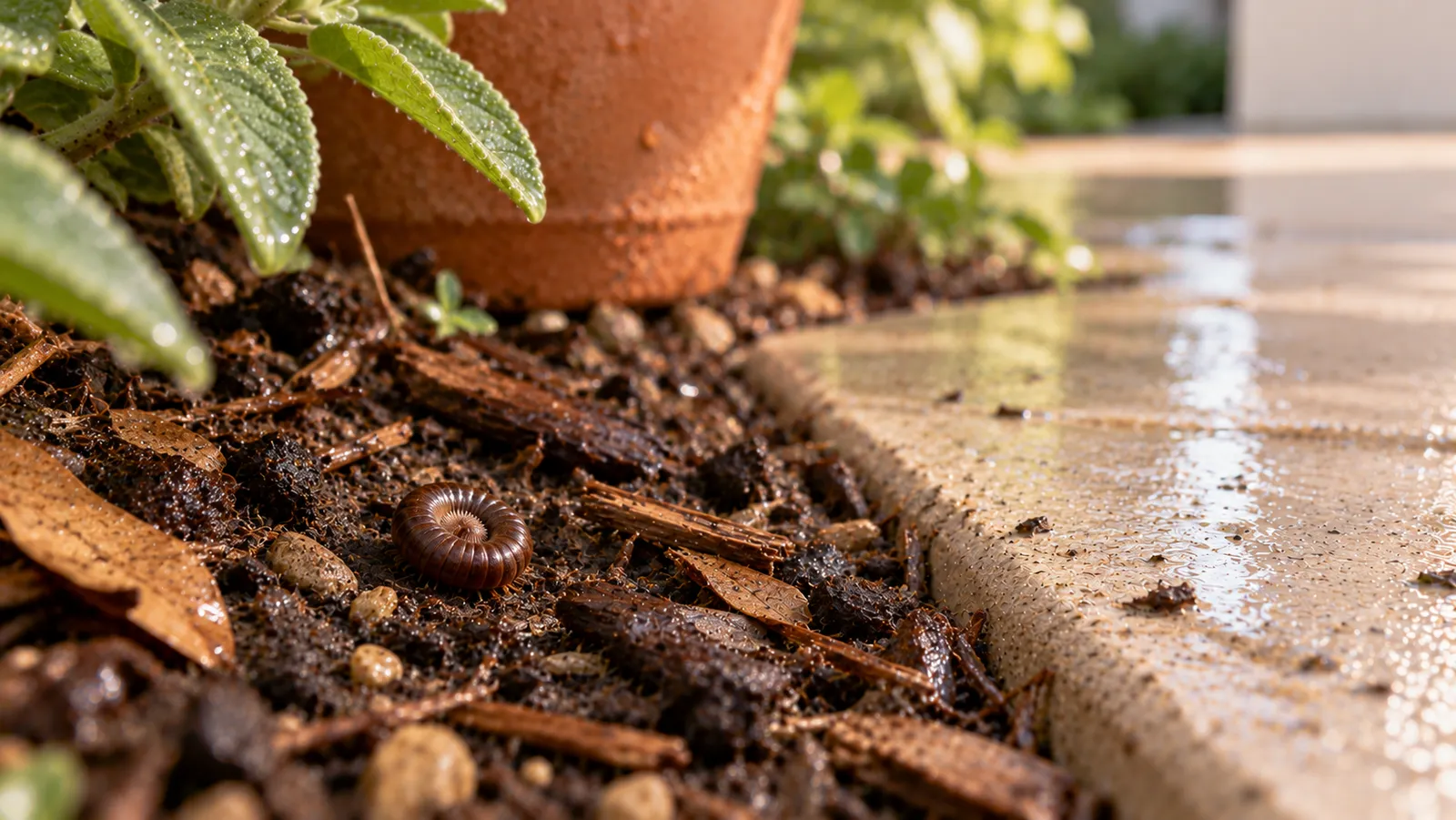
The morning after the first real rain of the season, you slide open the patio door and there they are: a scatter of little gray armored bugs across the concrete, a few rolled up tight like ball bearings, and something long, brown and segmented curled into a neat spiral on the doormat. By the second storm, some of them have made it into the garage. By the third, someone in the house has found one in the bathtub and wants to know whether this is the beginning of something.
Why are there so many roly-poly bugs and millipedes around my house after it rains?
Rain floods them out. Pillbugs, sowbugs and millipedes live in damp soil, mulch and leaf litter, and when heavy rain saturates the ground they move toward higher, drier surfaces, which often means patios, foundations, garages and door thresholds. None of them bite, sting or damage your house. They eat decaying plant material, and most die quickly indoors because the air is too dry for them. A sudden crowd after a storm is normal; steady numbers inside week after week usually point to a moisture or drainage problem worth fixing.
The Short Version
- Pillbugs roll into a ball; sowbugs can't, and have two small tail points. Both are land-living crustaceans, closer kin to shrimp than to insects.
- Millipedes are long, slow and curl into a flat spiral, with two pairs of legs on most body segments.
- All three eat decaying plant matter. They don't bite, sting, or damage wood, wiring or foundations.
- Rain drives them out of saturated soil and mulch toward the house. Indoors, most dry out and die quickly.
- The fix is moisture: pull mulch back from the foundation, sort out drainage and irrigation, and close gaps at doors. A broom handles the stragglers.
- If live ones turn up inside every week, the bugs aren't the problem. The damp spot is.
Three Bugs, One Reason
These three get lumped together because they show up together, in the same places, for the same reason. They're quite different animals, and only two of them are closely related.
Pillbugs (the roly-polies)
Pillbugs are the ones kids pick up. They are small, gray to slate-blue, oval and armored, with a body made of overlapping plates, seven pairs of legs and short antennae. Touch one and it rolls into a near-perfect ball, which is where the names roly-poly and pill bug come from. They aren't insects at all. They are crustaceans, land-living relatives of shrimp and crabs, and like their relatives they breathe through gill-like structures that have to stay moist.
Sowbugs
Sowbugs look almost the same at first glance, and most people never realize there are two different animals. The difference is that a sowbug can't roll into a ball. It is a little flatter, often more brownish or mottled, and has two small tail-like points sticking out from its back end. Disturb one and it runs instead of rolling. Biologically it belongs to the same group as the pillbug, with the same need for moisture and the same harmless habits.
Millipedes
Millipedes are long, slow and cylindrical, brown to nearly black, with a hard, shiny, segmented body and a fringe of tiny legs underneath. Look closely and you will see two pairs of legs on most body segments, one of the quickest ways to tell them from centipedes. When threatened, they curl into a tight, flat spiral and stay put. Many species also release a defensive fluid that smells unpleasant and can stain or irritate skin, so move them with a paper towel or a dustpan, and wash your hands if you do handle one.
The look-alike that does bite: centipedes
Centipedes get confused with millipedes, but they are a different animal with a different temperament. They are flattened, fast and long-legged, with one pair of legs per segment, and they are predators that hunt other small creatures. Larger ones can give a painful bite if handled. They like damp places too, so you may see them in the same spots, but they move very differently: a millipede trundles, a centipede sprints.
They breathe through gill-like structures and need moisture to survive.
On most body segments. Centipedes have one pair per segment and move much faster.
None of the three chew wood, wiring, drywall or foundations.
Why Rain Sends Them Toward Your House
All three live in the top layer of soil and in the damp material on top of it: mulch, leaf litter, compost, and the undersides of stones, boards, pots and pavers. They need moisture, but they need air too, and fully saturated ground is more water than they can handle. When a storm soaks the soil, they move up and out, looking for somewhere damp but not drowned.
In practice, that often means toward your house. A slab foundation, a concrete patio, a garage floor and a door threshold are all a little higher and drier than the soaked bed beside them, and they are the first hard surfaces a pillbug crawling out of the mulch is likely to reach. Humid nights after rain also let all three travel farther than usual without drying out, which is why you tend to find them in the morning rather than watching them arrive.
Millipedes add a twist. In some years they move in large numbers in the fall, occasionally in the hundreds, and those wanderings often get going with the first rains. Nobody has a tidy explanation for why some years are so much bigger than others, but heavy moisture after a long dry spell seems to be part of it.
Rain isn't the only trigger
In Southern California, irrigation does the same job for most of the year. An overwatered bed against the house, a sprinkler head that soaks the wall, a drip line that runs too long or a leaky hose bib can keep a strip of soil wet enough that these three never leave it. If you see them in numbers in the middle of a dry summer, go looking for the water source.
Where they gather around a house
Doorways and sliders
Under doormats, along sliding door tracks and at the gap beneath a door without a sweep.
The garage door
Along the bottom seal, especially at the corners, and in the dust and leaves that collect just inside.
Equipment pads
Around the AC condenser, the pool equipment and the water heater, where condensation and leaks keep the ground damp.
Hose bibs and planters
Anywhere a faucet drips or a planter drains against the wall.
Under pots and pavers
Lift any pot, stepping stone or bag of soil that sits on the ground near the house and you will usually find a few.
Do They Cause Any Damage?
To your house, no. None of these three chew wood, eat insulation, damage wiring, undermine foundations or harm drywall. They have no interest in the structure at all. They eat decaying plant material, which is why they live in mulch and leaf litter and why gardeners tend to think of them as part of the cleanup crew.
To your garden, occasionally, a little. Pillbugs and sowbugs will nibble seedlings, tender new growth and soft fruit lying on damp soil, like strawberries or squash resting on the ground. Millipedes can do the same in large numbers. It is usually minor and limited to things in direct contact with moist soil.
To your health, not a concern. They don't bite, sting or carry disease. The only practical issue is the millipede's defensive fluid, which is unpleasant to touch.
Indoors is a dead end for them
These are moisture animals in a dry house. Most pillbugs, sowbugs and millipedes that wander indoors dry out and die within a short time, which is why you often find them curled up and lifeless on a garage floor or in a corner. They can't set up home indoors unless something is keeping an area damp, like a slow leak, a wet crawl space or a bathroom with a moisture problem. If you keep finding live ones in the same room, look for the water.
What to Do About Them (Mostly, Not Much)
For a handful after a storm
Sweep them up, vacuum them, or carry them back outside. That's all there is to it. There is no reason to spray a pillbug. A retail spray doesn't fix the damp soil that sent them your way, the next storm will send more, and you would be adding pesticide to your house for an animal that was going to dry out on its own.
To cut down how many come to the door
Pull mulch back from the foundation
Leave a few inches of bare ground or gravel between the mulch and the wall, and keep soil and mulch below the weep screed at the bottom of the stucco.
Fix irrigation near the house
Adjust sprinkler heads that hit the walls, shorten drip run times next to the foundation, and water in the morning so the surface can dry by evening.
Clear what sits against the house
Boards, stones, stacked pots, bags of soil and leaf piles along the foundation are exactly where these animals spend the day.
Deal with roof water
Clean gutters and extend downspouts so water lands well away from the foundation. Our clogged gutters article has the full checklist.
Close the gaps at ground level
Door sweeps, intact garage door seals and sealed gaps at thresholds keep wanderers outside.
Keep firewood up and away
Stack it off the ground and away from the walls, where it can dry out between storms.
None of this needs to be perfect. The goal isn't a yard without pillbugs, which would be neither possible nor desirable. It is a dry buffer around the house, so the ones flushed out by the next storm stop at the edge of the patio instead of the kitchen.
When a Bug Problem Is Really a Moisture Problem
A burst of pillbugs and millipedes after the first storm, and a trickle after the next few, is normal, and not something you need a pest control company for. What deserves a closer look is a pattern: live ones turning up indoors week after week, in the same room every time, or numbers that don't drop off once the weather dries out.
In those cases, the bugs are pointing at something. It could be a leak under a sink or behind a shower, a slab that wicks moisture, a crawl space that never dries out, or drainage that sends water toward the house instead of away from it. Older raised-foundation homes in particular can have damp subareas nobody has looked at in years.
The same damp conditions attract the pests that do matter: subterranean termites need moist soil, Argentine ants nest in it, and earwigs, silverfish and crickets all gather where it's wet. So when pillbugs are the only thing you've noticed so far, think of them as the early warning. A general pest inspection looks at the exterior perimeter and the places water collects, and recurring perimeter service, usually quarterly, is how we keep the moisture-loving insects that come along with it in check.
Finding them inside every week?
That usually means there is a damp spot worth finding. Xtermicon is a family-owned pest control company serving the South Bay, the Westside and greater Los Angeles. Call (310) 370-0963 for a quote; quotes are free over the phone, with no obligation.
Pillbug, Sowbug and Millipede FAQs
Are roly-polies insects?
No. Pillbugs and sowbugs are crustaceans, more closely related to shrimp, crabs and lobsters than to any insect. They are among the few crustaceans that live entirely on land, and they still need moisture to breathe, which is why they stick to damp soil and mulch.
Do millipedes bite or sting?
No. Millipedes don't bite or sting. Many species do release a defensive fluid when handled or threatened, which can smell unpleasant and may stain or irritate skin, so use a paper towel to move them and wash your hands afterward. Centipedes, which are faster and flatter, can bite, which is one reason it helps to tell the two apart.
Why do I find dead millipedes in my garage?
Because a garage is too dry for them. Millipedes wander in from wet soil outside, especially after rain, and dry out quickly on a concrete floor. Finding dead ones is common, and it usually just means they are getting in under the garage door or through gaps at the base of the walls.
Should I spray for pillbugs and sowbugs?
For an occasional sighting, no. Sweep or vacuum them and focus on the moisture drawing them in: mulch against the foundation, sprinklers hitting the walls, and roof water landing near the house. If they are showing up indoors in numbers week after week, that is worth an inspection to find the damp spot behind it.
Can pillbugs or millipedes live in my houseplants?
Sometimes, for a while. Potted plants that live outdoors or sit in saucers of water can pick up pillbugs, sowbugs and millipedes in the soil, and they come inside with the pot. Let the soil dry out between waterings, empty the saucers, and check the bottom of the pot before bringing a plant in for the winter. In a dry house they rarely last long.
Are pillbugs good for the garden?
Mostly, yes. They help break down dead leaves and other decaying plant material, which returns nutrients to the soil, and they are a normal part of a healthy compost pile. They can nibble seedlings and soft fruit touching damp soil, so keep ripening fruit off the ground and give young plants a bit of a dry buffer.
Related Reading
The other moisture-driven pests, and the drainage fixes that help with all of them.
- Why clogged gutters become a pest magnetThe drainage checklist that keeps the foundation dry, and these three away from the door.
- Centipedes and millipedesIdentification notes for both, and how to tell them apart.
- Earwigs in Southern California gardensAnother moisture-loving garden visitor that wanders toward the house.
- Silverfish in Southern CaliforniaThe indoor pest that tells you about humidity inside the walls.
- Landscaping habits that invite pestsMulch, irrigation and planting choices that keep the foundation damp.
- General pest controlRecurring perimeter service for the pests that follow moisture.
Sydney Pardey is the owner of Xtermicon, a family-owned pest control company serving the South Bay and greater Los Angeles area since 2015. All content is written from direct operational experience and reviewed against current California Structural Pest Control Board standards.
Specialists you
can count on.
Xtermicon was founded in 2015 with one focus: protect Southern California homes and businesses from the pests that threaten them. The name says it all — eXterminate TERmites & pest CONtrol — and that's exactly what we do. We're a family-owned team specializing in termite control, pest control, and rodent exclusion. From West LA and East LA to the beach cities and Orange County, we're local neighbors who treat your property like our own.