Silverfish: The Bug You Only Notice After It Is Too Late
They are nocturnal, they hide in the places you open twice a year, and the first evidence most people find is damage to something they cared about. Here is how to identify them and what their presence is actually telling you.
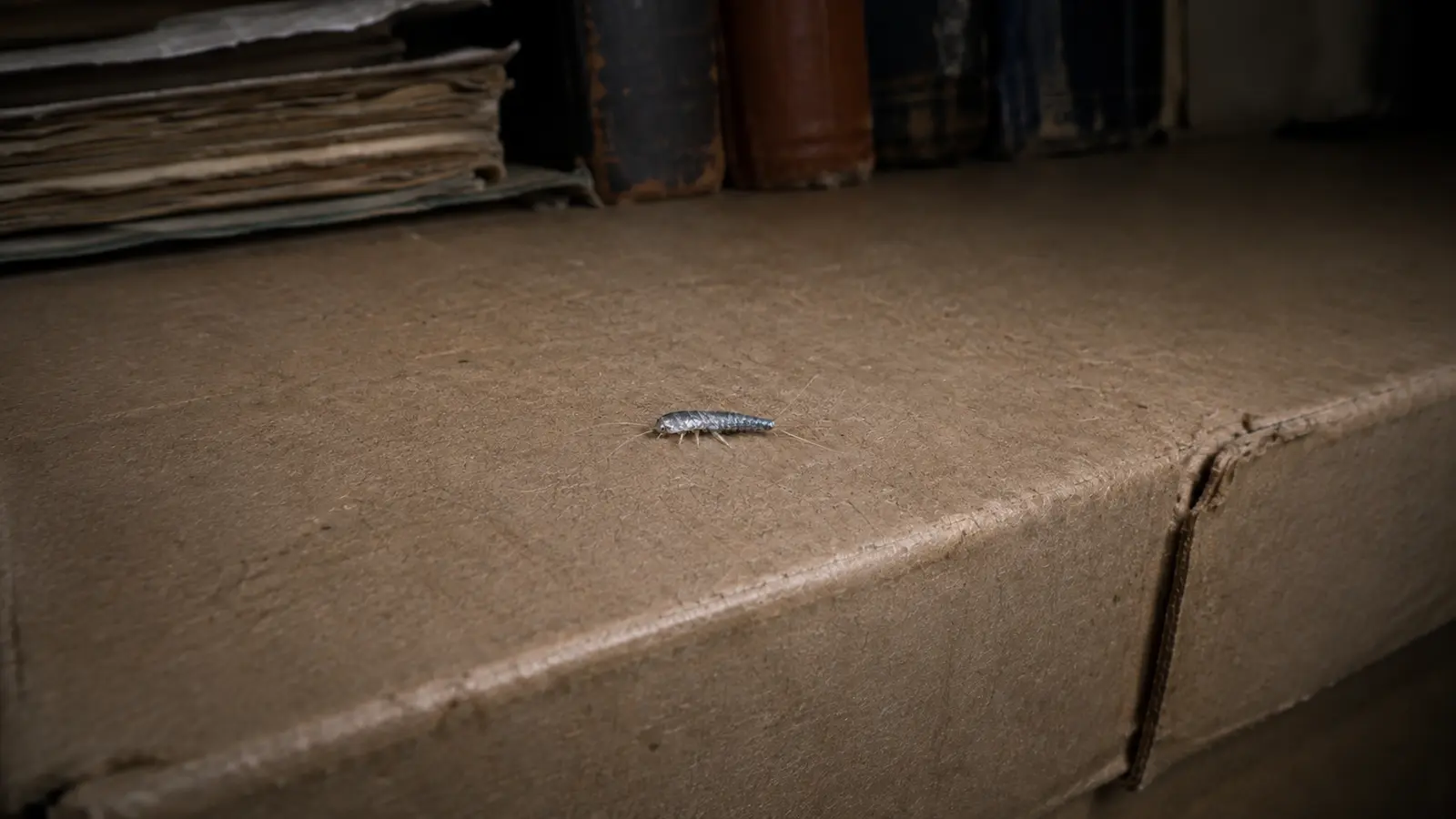
Most people meet their first silverfish by accident, at night, when a light goes on in a bathroom and something the color of tarnished metal darts for the gap behind the baseboard faster than seems reasonable for an insect that size. The second meeting is usually worse and comes later: a box of photographs pulled out of a closet with the edges grazed away, or a book whose spine has been scraped clean of its glue. That delay between the sighting and the discovery is the whole problem with this insect. By the time silverfish have caused damage you notice, they have been established long enough to breed.
What are silverfish and should I be worried about them?
Silverfish are small, wingless, silvery-grey insects with a flat teardrop-shaped body, long antennae, and three distinctive bristles at the tail end. They move in a quick side-to-side wriggle that looks like a swimming motion, which is where the name comes from. They do not bite, sting, or transmit disease, so they are not a health concern — they are a property concern. They feed on starches and cellulose, which means paper, book bindings, wallpaper paste, cardboard, photographs, and natural fabrics. Their presence is nearly always a signal of excess humidity, so finding them indoors is more a moisture diagnosis than a sanitation one.
The Short Version
- Identify by three tail bristles, long antennae, a tapered silver body, and a distinctive wriggling run. Nothing else in a Southern California home looks quite like it.
- They are harmless to people — no bite, no sting, no disease. The damage is to paper, books, photographs, wallpaper, and natural fibers.
- Silverfish are a humidity indicator. They need consistently damp conditions, which is why they concentrate in bathrooms, laundry rooms, garages, and closets on exterior walls.
- Coastal Southern California suits them well. The marine layer keeps relative humidity elevated year-round on the Westside and in the South Bay.
- They are slow to build and long-lived, so a visible population usually means an established one rather than a recent arrival.
- Drying the space is the actual fix. Treatment without addressing moisture handles the insects present and not the reason they were there.
What You Are Actually Looking At
Silverfish are distinctive enough that once you have seen one properly, you will not misidentify the next one. The problem is that most sightings last under two seconds in poor light.
An adult runs roughly half an inch to three quarters of an inch long, not counting the appendages. The body is flattened top to bottom and tapers steadily from the head toward the rear, giving it a carrot or teardrop outline that is genuinely unlike other household insects. The colour is a metallic silver-grey that comes from fine scales covering the body — those scales rub off easily, which is why one found in a sticky trap often looks duller and browner than the live insect.
The two features that settle identification are at the ends. At the front, a pair of long, thin antennae that sweep forward and are nearly as long as the body. At the rear, three bristles — two angling outward and one pointing straight back — which is the single most reliable field mark. And then the movement: they do not walk so much as wriggle, throwing the body side to side in a motion that reads as swimming across the floor.
The defining feature. Three filaments at the rear, one central and two angled out — visible without magnification if the insect holds still.
Exceptionally long for a household insect, which is why populations build slowly and then persist.
Active in darkness and strongly light-avoidant, so the population is almost always larger than the number of sightings suggests.
What it is not
Two look-alikes come up regularly. Firebrats are close relatives with the same body plan and tail bristles, but they are mottled brown and grey rather than silver, and they prefer genuinely hot locations — around water heaters, furnaces, and boiler rooms — where silverfish prefer cool and damp. The control approach is the same, so the distinction matters less than it sounds. The other confusion is with small centipedes, which have obvious legs down both sides of a segmented body; a silverfish has six legs, all tucked close under the front half.
Silverfish Are a Humidity Reading
This is the part worth internalising, because it changes what you do about them. Silverfish are exceptionally dependent on ambient moisture. They do not have the water-conserving abilities that let other household insects tolerate dry interiors, and in a genuinely dry environment they simply do not persist. So when they appear, they are not telling you the house is dirty. They are telling you some part of it is damp.
Coastal Southern California is more accommodating to them than people expect. The marine layer holds relative humidity elevated across the Westside and the South Bay for much of the year, and homes here are frequently built and lived in without much active dehumidification because the temperature is comfortable. A closet on an exterior wall, a bathroom with a weak or unused exhaust fan, a garage with a slab that sweats, a subarea with poor ventilation under a raised foundation — all of these hold enough moisture to support a population indefinitely, and none of them feel obviously wet to a person walking past.
Add the second half of the equation and you have an infestation: the damp places in a house are also the places where people store paper. Boxes of documents in a garage. Books against an exterior wall. Photo albums in a hall closet. Stored cardboard in a subarea. The food and the humidity are in the same room, and the room is opened twice a year.
Bathrooms
Daily moisture, warm air, and plumbing chases connecting into the wall structure. Under the vanity and behind the toilet are the two spots to check first.
Laundry rooms
Humidity plus lint plus the starch in stored fabric. Often also the room with the weakest ventilation in the house.
Closets on exterior walls
Poor air circulation, temperature differential against the outside wall, and typically full of stored paper and natural fabric. A silverfish ideal.
Garages and storage areas
Cardboard is both food and harborage, and a concrete slab in contact with soil moves moisture upward continuously.
Attics and subareas
Especially where ventilation is blocked. Cellulose insulation and stored boxes make an attic a food source as well as a shelter.
Kitchens
Less common than the others but real — under the sink, behind the dishwasher, and in the back of pantry shelving where flour and starch residue collect.
What They Actually Eat
Silverfish target carbohydrates, specifically starches and cellulose, and their feeding pattern is characteristic once you know it. They graze the surface rather than boring through, leaving irregular etched patches, notched edges, and areas scraped thin rather than clean round holes. On paper it looks like the surface has been sanded in patches.
The list of what qualifies is longer than most people expect: book bindings and the glue in them, wallpaper and the paste behind it, cardboard, envelopes, photographs, documents, dry pet food, flour and cereal residue, cotton and linen, silk, and the starch in laundry-stiffened fabric. Anything sized or coated with starch is a target, which is why old books and archival material are so consistently affected.
The practical consequence is that the losses tend to be things without replacements. Nobody keeps a spare of their grandparents' photographs. That is really the case for treating a silverfish problem promptly rather than tolerating it — not risk to the household, but that the items they favour are the ones you cannot re-buy.
A slow build, not a sudden arrival
Silverfish develop slowly and adults can live for several years, which is unusual for a household insect. That means a population you are now noticing has very likely been present for a long time, and it also means results take patience — there is no life-cycle bottleneck that collapses the population quickly. It is also why sealing and drying matter more here than they do for faster-cycling pests.
Dry the Space, Then Deal With the Insects
Because the underlying driver is moisture, the order of operations matters. Treating a damp room for silverfish without changing the moisture is treating a symptom on a schedule.
Lower the humidity in the specific rooms
A dehumidifier in the affected room is the single most effective intervention available to a homeowner. Run the bathroom exhaust fan during and well after showers — most people turn it off too early — and confirm it actually vents outside rather than into the attic, which is a surprisingly common installation fault.
Fix the water before the bugs
Slow leaks under sinks, sweating supply lines, poor drainage against the foundation, and blocked subarea or attic ventilation are the underlying causes. Any of these will reproduce the problem after treatment, and they are also feeding conditions for pests considerably worse than silverfish.
Get stored paper off the floor and into sealed containers
Move documents, books, and photographs out of cardboard and into sealed plastic bins, and get them off concrete onto shelving. This removes food and harborage in one move — cardboard is both.
Reduce damp clutter
Stacked cardboard, old newspaper, fabric stored in contact with a concrete slab, and undisturbed piles in a garage or subarea are exactly the conditions they need. Thinning that out does more than most products.
Seal the routes between damp and dry
Caulk gaps around plumbing penetrations, baseboards, and the junctions where a bathroom or laundry wall meets the rest of the house. This limits movement out of the wet room into the closets where the valuable material is.
Then treat, if the population warrants it
Where activity is established, targeted application into cracks, voids, and harborage points is what works — this is a crack-and-crevice problem, not a broadcast one. Monitoring traps in the affected rooms are genuinely useful here, because a nocturnal insect gives you very little other evidence of whether numbers are actually falling.
When it is worth calling someone: when you are seeing them in multiple rooms rather than one, when they persist through a season of dehumidifying, when the damage is to items that matter, or when the moisture source is somewhere you cannot inspect — a subarea, a wall cavity, an attic. That last case is worth acting on for its own sake, because sustained moisture in an unventilated space is the precondition for subterranean termites and wood-decay fungus, and both of those are considerably more expensive problems than silverfish.
Finding them in more than one room?
A silverfish problem that spans rooms is usually a building moisture problem rather than a housekeeping one, and the useful visit is one that inspects the subarea, the attic, and the plumbing runs rather than just treating baseboards. Xtermicon has worked coastal Southern California housing stock since 2015. Call (310) 370-0963 — quotes are free, over the phone, with no obligation.
Silverfish FAQs
What people ask after the first sighting in the bathroom.
Are silverfish dangerous or do they bite?
No. Silverfish do not bite people or pets, they do not sting, and they are not known to transmit disease. Their mouthparts are built for scraping at starchy surfaces and cannot break skin. The concern with them is entirely about property — paper, books, photographs, wallpaper, and natural fabrics. Some people do develop an allergic response to the scales they shed in a heavy long-term infestation, but that is uncommon and requires substantial numbers.
Does having silverfish mean my house is dirty?
No, and this is the most common misconception about them. Silverfish are responding to humidity, not to housekeeping. A meticulously clean bathroom with a weak exhaust fan is a better silverfish habitat than a cluttered but dry room. What their presence genuinely indicates is that some part of the house is holding more moisture than it should — which is worth knowing for reasons well beyond this insect.
Where are they coming from?
Usually from within the structure rather than from outside. Established populations live in wall voids, subareas, attics, and the undisturbed backs of storage spaces, and emerge at night to feed. They also arrive in things you bring in — cardboard boxes that sat in a damp garage or storage unit, second-hand books, and stored paper are all common introductions. If they are appearing in a bathtub or sink, that is not where they came in; smooth ceramic is just a place they cannot climb out of.
Will a dehumidifier alone get rid of them?
It is the most effective single thing you can do, and in a mild, localised case it can be enough on its own over time. Silverfish cannot maintain a population in genuinely dry conditions. What it will not do is act quickly — adults are long-lived and will persist for a while in a drying environment — and it will not reach a population living in a wall void or subarea whose moisture source you have not changed. Treat it as the necessary foundation rather than the complete answer.
How long does it take to get rid of silverfish?
Longer than most household pests, and the biology is the reason. They develop slowly, adults can live for years, and there is no rapid life-cycle turnover to exploit. Expect meaningful reduction over weeks rather than days, with the durability of the result depending almost entirely on whether the moisture condition actually changed. Monitoring traps are worth using throughout, because a nocturnal insect otherwise gives you no way to tell whether numbers are dropping.
How do I protect books and photographs specifically?
Get them out of cardboard and off the floor. Sealed plastic bins on shelving in the driest room available removes food, harborage, and ground moisture contact in one step. Avoid storing paper against exterior walls or on a concrete slab, since both move moisture. For genuinely irreplaceable material, the driest interior space in the house is worth more than any product you could apply around it.
Related Reading
Other moisture-driven pests, and the storage problems that overlap with this one.
- Silverfish: species profileQuick-reference identification and behavior in the pest library.
- The Labor Day pest exclusion checklistSealing the routes between damp spaces and the rest of the house.
- Landscaping habits that invite pestsDrainage and irrigation against the foundation — a common source of the moisture underneath all this.
- Pests in your pet foodThe other stored-goods problem, and why sealed containers matter.
- Residential pest controlRecurring service across the South Bay, Westside, and greater Los Angeles.
- Subterranean termitesWhy sustained moisture in a subarea is worth taking seriously beyond the silverfish.
Sydney Pardey is the owner of Xtermicon, a family-owned pest control company serving the South Bay and greater Los Angeles area since 2015. All content is written from direct operational experience and reviewed against current California Structural Pest Control Board standards.
Specialists you
can count on.
Xtermicon was founded in 2015 with one focus: protect Southern California homes and businesses from the pests that threaten them. The name says it all — eXterminate TERmites & pest CONtrol — and that's exactly what we do. We're a family-owned team specializing in termite control, pest control, and rodent exclusion. From West LA and East LA to the beach cities and Orange County, we're local neighbors who treat your property like our own.