Roof Rats and Backyard Fruit: Why Winter Citrus and Avocados Bring Rats to Your Yard
An orange that is hollow but still hanging on the branch is one of the clearest roof rat signs there is. What it tells you, what to change in the yard, and how to tell whether the rats have already moved from the tree to the attic.
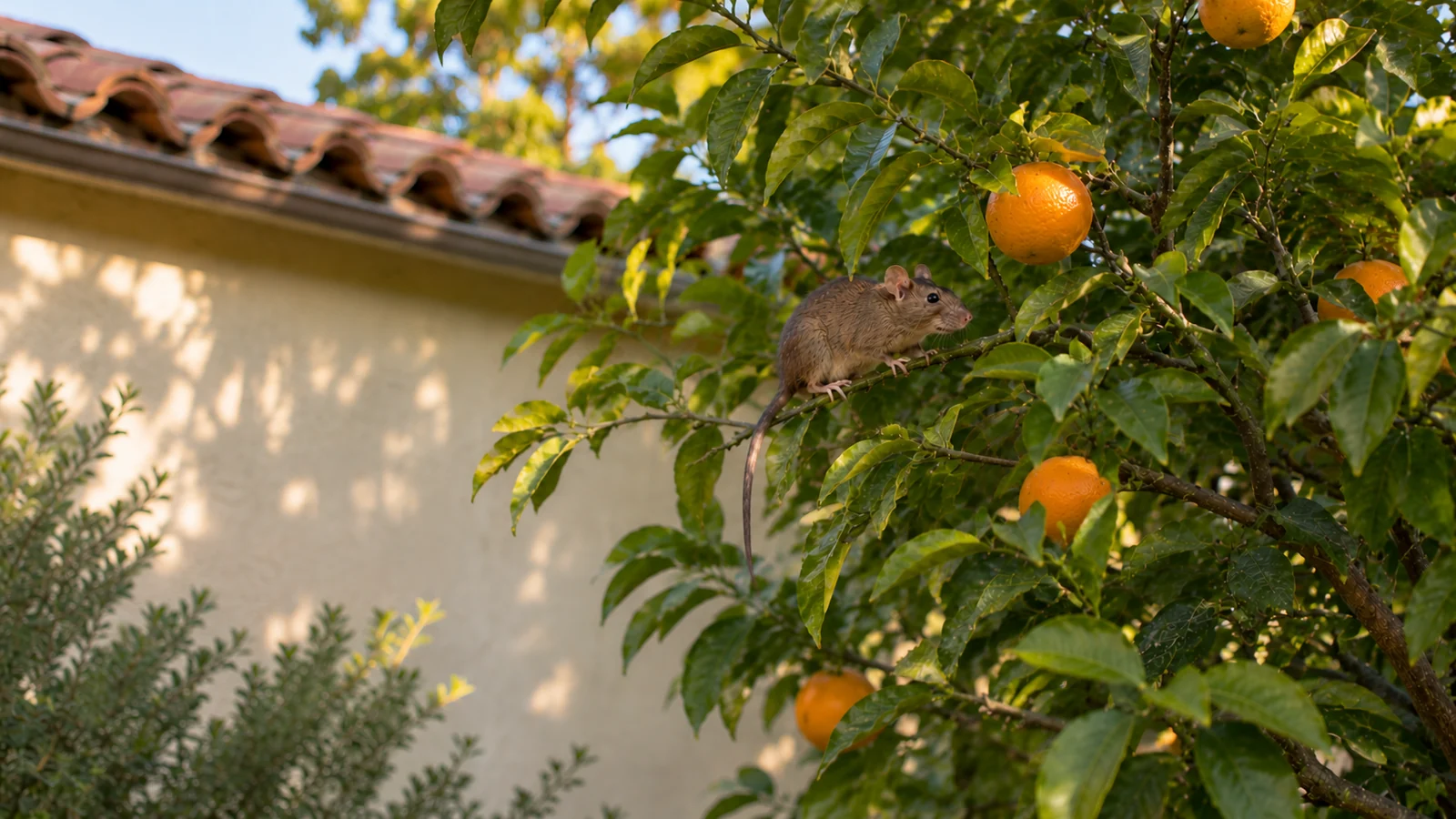
It usually starts with an orange that looks fine from the patio. You reach up to pick it and it weighs almost nothing. There's a small, neat hole in the side, and inside, where the fruit should be, there's only pith and rind, scraped clean. Nothing fell. Nothing rolled under the hedge. Whatever ate it did the work while hanging from the branch in the dark, then went somewhere else to sleep. In a lot of Southern California yards, that somewhere else is closer to the house than anyone would like.
Why are rats eating the fruit on my trees?
In most Southern California yards, the animal eating fruit on the tree at night is the roof rat. Roof rats are climbers that nest in trees, dense shrubs, ivy and attics, and fruit is one of their favorite foods, so a citrus or avocado tree that holds fruit through the winter is a meal that lasts for months. The giveaway is fruit eaten while it is still on the branch: oranges hollowed out through a small hole with the empty rind left hanging, and lemons with the rind chewed away and the flesh left behind. Picking ripe fruit, clearing fallen fruit and cutting branches back from the roof take away the food and the route to your attic. If you find the damage, check the attic and garage too, because the rats eating your fruit are often nesting nearby, sometimes in the house itself.
The Short Version
- Hollow oranges still hanging on the tree, and lemons with the rind eaten off, are classic roof rat damage.
- Roof rats feed at night and climb well. They can eat in your tree and nest in the neighbor's yard, or in your attic.
- Citrus and avocado trees can hold fruit for months, which turns one backyard tree into a food supply that lasts the winter.
- The yard fixes are simple: pick ripe fruit, clear fallen fruit every day or two, and get branches away from the roof.
- A tree touching the house is a bridge. If the fruit is being eaten, check the attic and the garage before assuming the rats live outside.
What the Damage on the Tree Tells You
Roof rats eat a long list of things. University of California pest management guidance names fruit, tree nuts, berries, snails and slugs among their favorites, along with whatever pet food is left out. But fruit trees are where they leave the most readable evidence, because they tend to eat the fruit right where it hangs.
Oranges
On a ripe orange, a roof rat chews a small hole and eats the inside out, leaving the rind on the branch like an empty cup. From the ground the fruit can look untouched for days. The shell is often the first thing a homeowner notices, usually when they go to pick it. If you find one, look around the tree for more. A single hollow orange might be a one-off. Five or six in a week means the tree is part of somebody's nightly route.
Lemons
Lemons get the opposite treatment. Rats often eat the rind and leave the sour flesh behind, so the fruit looks half peeled while it's still attached. People sometimes blame birds or a passing squirrel, but peeled lemons on the branch, especially when they show up overnight, are a strong pointer toward rats.
Avocados
Avocados get the same attention, often while the fruit is still on the tree. Look for gnawed fruit hanging from the branches or lying underneath, with tooth marks through the skin. Because avocado trees are big and dense, the damage is easy to miss until a lot of fruit has been eaten.
Under the tree and along the fence
The ground under the canopy tells the rest of the story. Look for rinds and half-eaten fruit, droppings, and any well-worn path along the top of a block wall or wooden fence. Roof rats are often seen at dusk or soon after, running along fence tops and overhead utility lines and using the tail for balance. If you've ever seen something sprint along the cable line at twilight and wondered what it was, now you know.
UC pest guidance says roof rats routinely travel 300 feet or more for food, so the rats in your tree may be nesting next door.
UC guidance is to seal openings larger than a quarter inch, and young rats can squeeze under a door with a half-inch gap.
The average for roof rats according to UC, with up to eight young in each.
Why a Fruit Tree Matters More in Winter
Summer is easy for a rat. Gardens are producing, fruit is everywhere, and there's water in the irrigation. As the year turns, a lot of that dries up or dies back. Citrus goes the other way. In much of Southern California, navel oranges ripen through the winter, and lemons and many other citrus trees carry fruit for months at a stretch. A backyard tree loaded with fruit becomes one of the most dependable food sources on the block during the months when food is otherwise harder to find.
That steady supply is the problem. A rat that finds a reliable meal has little reason to move on, and roof rats breed several times a year. One tree that feeds a few rats in November can be feeding a good many more by spring if nothing changes.
The weather adds a second push. Cooler nights already send rodents looking for shelter, and if this winter turns out as wet as forecasters expect, soaked foliage makes a dry attic even more attractive. We covered that side of it in our article on why rain sends rodents looking for higher, drier ground. A fruit tree beside the house puts the food and the shelter a few feet apart.
From the Branches to the Attic
Roof rats nest above the ground. Outdoors that means dense trees, overgrown shrubs, ivy on walls and fences, and old palm fronds. Indoors it means attics, wall and ceiling voids, and the back of a cluttered garage. UC guidance also notes that roof rats return to the same nest sites, so a nest that isn't dealt with tends to stay in use.
Now picture the usual backyard layout. The orange or avocado tree was planted close to the house years ago and has grown up and over the eaves. A branch rests on the roof or hangs a foot above it. A rat that spends the night in that tree doesn't need to climb a wall to reach the roofline. It walks along the branch, steps onto the shingles, and finds the gap where the fascia has pulled away or the vent screen has rusted through.
Not every rat in a fruit tree lives in the house. Because they forage so far, the rats emptying your oranges may sleep in a neighbor's ivy two doors down. But a tree full of fruit, a branch on the roof and an attic with a gap at the eaves put everything a roof rat needs in one place, and that is the combination that turns a garden nuisance into a rodent problem inside.
Signs the rats have moved in
Noises overhead
Scratching, running or gnawing in the attic or ceiling, usually in the evening and early morning.
Droppings
In the attic, along garage walls, near pet food, or in cabinets. Our droppings identification guide shows how rat droppings compare with mouse droppings.
Nests in storage
Shredded paper, fabric or insulation behind boxes, in garage drawers, or in a stack of firewood.
Smudge marks
Dark, greasy marks along rafters, beams and pipes where rats rub as they travel the same route night after night.
Chewed belongings
Gnawed edges on stored boxes, bags of pet food, plastic bins, or wiring in the attic or garage.
Why the attic matters more than the oranges
Losing fruit is an annoyance. Rats in the ceiling are a different problem. UC guidance notes that gnawing and nest-building in attics can cause electrical sparks and fires, and that roof rats can carry diseases that affect people and pets, including typhus and leptospirosis. If you have health questions, your doctor or county public health department is the right place to ask.
What to Change in the Yard
None of this means pulling out the orange tree. Most of what helps is ordinary yard work, done a little more often than usual through the winter.
Pick fruit as it ripens
Ripe fruit left hanging for weeks is an open buffet. If you have more than you can eat, pick it anyway and give it away.
Clear fallen fruit every day or two
UC guidance specifically calls out removing fallen fruit and nuts. Windfall fruit under the tree feeds the rats that can't be bothered to climb.
Get branches off the roof
UC's guidance puts the distance at 3 to 6 feet between limbs and the roof. Any branch touching the eaves or hanging just above them is a walkway.
Thin the climbing plants
Ivy, star jasmine and honeysuckle on walls and fences give roof rats cover and a highway. Thin them out, and keep shrubs about 2 feet from each other and from the house.
Feed pets on a schedule
Put out only what your pets will eat at one feeding, store the bag in a sealed, rodent-proof container, and clean up pet waste in the yard.
Lid the bins and stack the wood
Keep trash and green waste in bins with tight lids, and move firewood off the ground and away from the house walls.
What about the neighbor's tree?
You can only pick your own fruit. Because roof rats travel, a neighbor's loaded tree can feed the same rats that are running across your fence, and a neighbor's branch that reaches your roof is just as much a bridge as your own. A friendly conversation usually does more than anything else here. Plenty of people don't know their fruit is being hollowed out until someone mentions it, and most are glad to hear it before the rats find their attic too.
Before you seal anything
Trimming the tree and clearing fruit only change what's outside. If rats are already in the attic, sealing the gaps first can trap them inside, and a trapped rat either chews a new way out, often into the living space, or dies somewhere you can't reach. Check for the signs above before closing anything up. If you find them, deal with what's inside first and seal last.
How We Handle Roof Rats Around Fruit Trees
When a call starts with "something is eating our oranges," we look at the yard as well as the house. The tree tells us what the rats are eating and the fence line tells us how they travel. The attic and garage tell us whether they've come inside.
Inspection
We check the trees and the yard, the roofline and foundation, and the attic, garage and other areas of concern, to learn where the rats are feeding, how they're moving and whether there's activity inside.
Inside, if they're in
We set traps and come back three times to check them, re-bait them and clean them. We don't put poison inside the house, because rodents that eat it often die in walls and ceilings.
Outside, around the yard
Locked, tamper-resistant bait stations go outside, and a technician checks and services them once a month for as long as you keep the service. Most customers keep them in place long term.
Exclusion and clean-up
We check the house for the gaps rats are using and give you a separate bid to seal them, along with a separate bid for clean-up and sanitizing if the attic needs it.
Inside, outside, or both depends on what the inspection finds. A yard with fruit damage and no sign of rats in the house is a different job from an attic that's already busy. Either way, the inspection is a good time to look at the branches, vines and fence lines giving rats a route to the roof, because the yard changes are what keep the problem from coming straight back.
Finding empty oranges on the tree?
If the fruit is disappearing, now is a good time to find out where the rats are sleeping. Xtermicon is a family-owned, licensed pest control company working across the South Bay, the Westside and greater Los Angeles. Call (310) 370-0963; quotes are free over the phone, with no obligation.
Roof Rats and Fruit Trees FAQs
Is it rats or squirrels eating my oranges?
Timing is the best clue. Roof rats feed at night, while tree squirrels are out during the day. If fruit is being hollowed out overnight and you never see anything in daylight, rats are the likely answer. Droppings under the tree, peeled lemons and activity along fence tops at dusk point the same way.
Can I eat fruit from a tree that rats have been in?
Throw away any fruit with gnaw marks or holes, and fruit that has been lying on the ground where rats have been. For anything else, your county public health department is the best source of guidance, since rats can carry diseases that spread through contaminated food.
If I pick all the fruit, will the rats leave?
It takes away an easy meal, which helps, but it rarely solves the problem on its own. Roof rats also eat snails, garden produce and pet food, and they travel a long way to find it. If they are nesting in your trees, your ivy or your attic, they will usually stay until the shelter is dealt with too.
Do I need to cut down my fruit tree?
Usually not. Keeping branches well back from the roof, picking fruit as it ripens and clearing fallen fruit take away most of what draws roof rats to a backyard tree. Removing a tree is a bigger decision, and it won't help much if the rats are already living in the attic.
How can I tell whether the rats in my tree are also in my attic?
Listen in the evening and early morning for scratching or running overhead, and take a flashlight into the attic and the garage. Look for droppings, shredded insulation or paper, and dark rub marks along rafters and pipes. A branch that touches the roof makes it more likely. If you find any of those signs, deal with the rats inside before sealing the gaps.
Related Reading
For the rest of the rodent picture.
- Rats in the atticThe signs you have them, and what to do about it.
- Why wet weather sends rodents looking for drier groundHow rain changes where rats and mice nest, and how to get ahead of it.
- Landscaping habits that invite pestsThe plantings and yard habits that give pests cover, and what to do instead.
- Flea-borne typhus in Los AngelesWhy rats and their fleas matter for public health in LA County.
- Roof ratHow to recognize Southern California's climbing rat.
- Rodent controlHow we handle rats and mice, inside and out.
Sydney Pardey is the owner of Xtermicon, a family-owned pest control company serving the South Bay and greater Los Angeles area since 2015. All content is written from direct operational experience and reviewed against current California Structural Pest Control Board standards.
Specialists you
can count on.
Xtermicon was founded in 2015 with one focus: protect Southern California homes and businesses from the pests that threaten them. The name says it all — eXterminate TERmites & pest CONtrol — and that's exactly what we do. We're a family-owned team specializing in termite control, pest control, and rodent exclusion. From West LA and East LA to the beach cities and Orange County, we're local neighbors who treat your property like our own.