Ahead of the Rain: Why Wet Weather Sends Rodents Looking for Higher, Drier Ground
Flooded burrows and soaked ivy send rats and mice looking for shelter, and your attic has been waiting there all along. What to do while it is still dry.
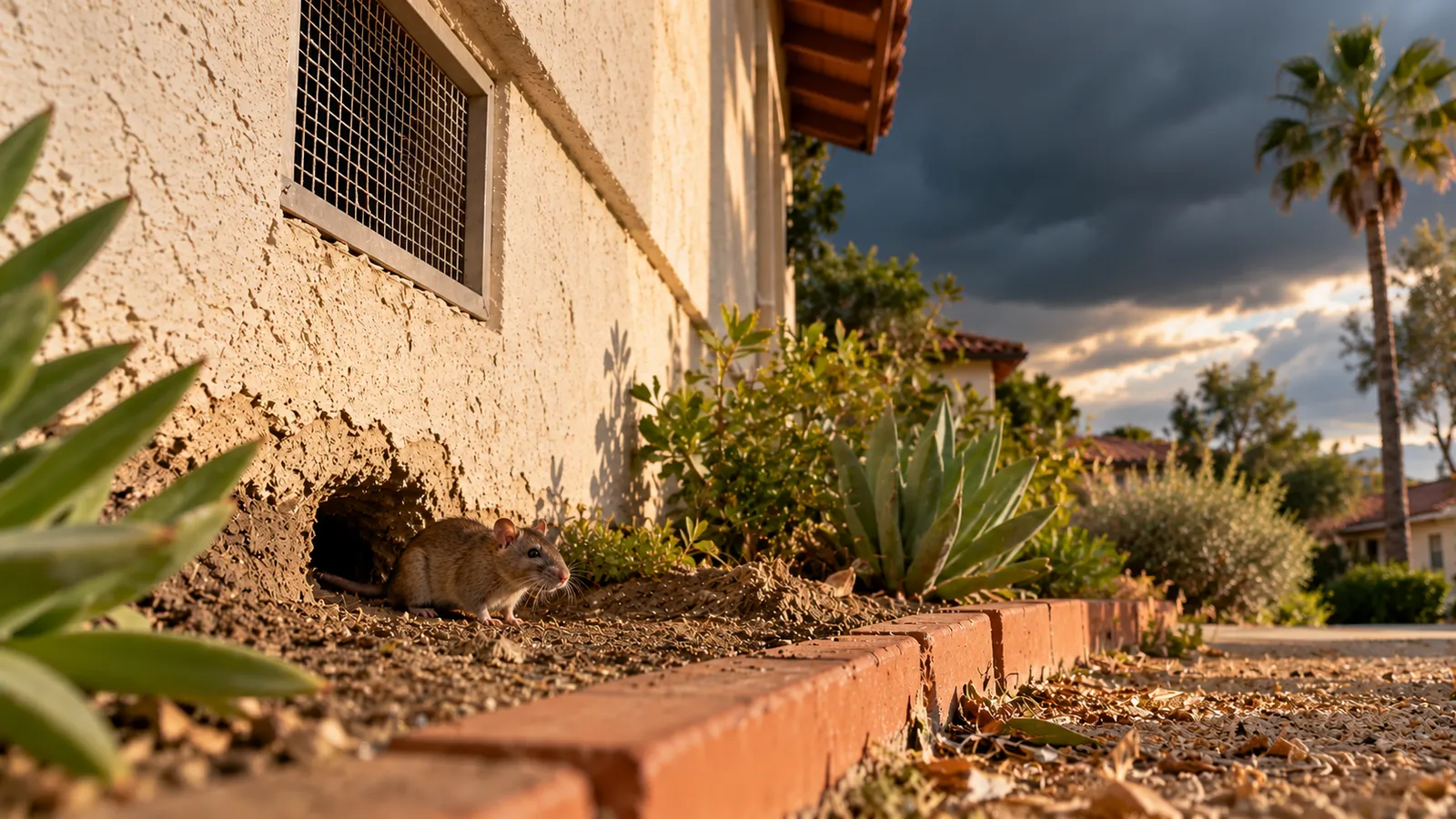
For most of the year, a rat living outdoors in Southern California has it pretty good. There is ivy on the back wall, fruit on the neighbor's tree, a burrow under the shed, and a dry season that lasts the better part of eight months. Then the rain comes. Burrows fill. Ivy stays soaked for days. And somewhere above your ceiling is a dry, insulated, perfectly sheltered attic that has been there the whole time, with a gap at the eave just wide enough to fit through.
Do rats and mice come inside when it rains?
Often, yes. Heavy rain floods ground burrows and soaks the dense vegetation where rats and mice nest outdoors, and cold, wet nights make a dry structure far more appealing. That sends them toward higher, drier shelter: attics, wall voids, garages, crawl spaces and the clutter in storage areas. Norway rats and mice tend to move up from flooded burrows, while roof rats, which already nest above ground, move from wet trees and ivy into attics. The most effective step is sealing entry points before the rain arrives, after making sure nothing is already living inside.
The Short Version
- Wet weather floods burrows and soaks outdoor nesting spots, and rodents go looking for dry shelter in attics, walls and garages.
- Norway rats and house mice nest low and get flooded out. Roof rats nest high and move from wet foliage into the roofline.
- Sealing gaps before the rain works far better than reacting once rodents have settled in.
- Never seal a structure without checking what is already inside. Trapping a rodent in the walls makes things worse.
- Woodpiles, clutter and vegetation touching the house give rodents cover and a route in. Deal with them before the storms.
- This winter's wetter-than-normal forecast could make the pattern show up earlier or more noticeably than usual.
What Rain Does to a Rodent's Housing
The rodents around Southern California homes split roughly into two groups by where they nest, and rain affects them differently.
The ground floor: Norway rats and mice
Norway rats are burrowers. They dig along foundations, under slabs and sheds, beneath woodpiles and into garden beds and slopes, and they line the burrow with whatever soft material is handy. House mice nest close to the ground too, in dense ground cover, under debris and in the back corners of garages. Rain is a direct threat to both. A burrow is a hole in the soil, and when the soil saturates, the hole fills. The animals that live there move up and out, and the nearest dry, enclosed space is often a garage, a crawl space, or a void beneath a porch or patio.
The top floor: roof rats
Roof rats, the dominant rat in many Los Angeles neighborhoods, are climbers. They nest above ground in palm skirts, ivy-covered walls and fences, bougainvillea, dense trees and, given the chance, attics. Rain doesn't flood them out the way it floods a burrow, but it soaks nests that stay wet for days in dense foliage, and cold, wet nights make a dry, insulated attic very appealing. Roof rats already travel along fences, utility lines, branches and rooflines, so the move from the ivy to the attic is a short one.
Why attics, walls and garages specifically
From a rodent's point of view, the inside of a house during a storm is close to ideal. Attics are dry, warm and quiet, and the insulation makes excellent nesting material. Wall voids are protected highways between the attic, the kitchen and the subarea. Garages usually have a gap or two at ground level, plenty of clutter to hide in, and often a bag of pet food within reach. Raised-foundation homes add a crawl space, which stays dry under the house when everything outside is soaked, and a single damaged vent screen is all it takes to get in.
Ground nesters whose burrows flood in heavy rain, sending them up and in.
Climbers that move from soaked foliage into attics through gaps up high.
Exclusion works best before rodents settle in, and only after you have checked inside.
Why This Winter Could Be Different
Fall already pushes rodents toward houses. As nights cool, outdoor food gets scarcer and shelter matters more, which is the pattern our fall rodent season article covers. Rain stacks a second reason on top of the first.
This winter is forecast to bring a super El Niño, and with it a better-than-usual chance of a wet season. If the forecast holds, the shift indoors that normally builds gradually through fall and winter could show up earlier, or more noticeably, than it does in a dry year. That's a general expectation, not a prediction for your street, and the rain hasn't started yet, which is exactly why now is the time to act: before the first storm, not after the scratching starts.
What to Do Now, While It's Dry
Rodent-proofing is mostly a slow walk around the house with a flashlight and a critical eye. Rodent-proofing guidance commonly uses a dime as the benchmark gap for a mouse and a quarter for a young rat, so think small.
Walk the roofline
Look for gaps at the eaves and rafter tails, roof vents with damaged screens, holes where cables and pipes enter, and spots where gutters or fascia have pulled away. Binoculars help from the ground.
Walk the foundation
Check foundation and crawl space vents, crawl space access doors, gaps around pipes and AC lines, and the corners of the garage door seal, where most garage gaps are.
Trim the highways
Cut tree branches back from the roof, thin out ivy on walls and fences, and trim dead palm fronds. Anything touching the house is a bridge.
Clear the cover
Move woodpiles off the ground and away from walls, get rid of stacks of old lumber and pots, and pull dense ground cover back from the foundation.
Cut off food and water
Pet food in sealed containers, no bowls left out overnight, fallen fruit picked up, trash in lidded bins, and dripping hose bibs fixed.
Then seal, with the right materials
Rodents chew through foam, plastic and screening that isn't made for them. Metal mesh, sheet metal, hardware cloth and sturdy vent covers hold up. But read the next section first.
The Two Places People Forget
The garage
The garage is the front door for a lot of rodent problems, and it rarely gets the attention the attic does. The corners of the roll-up door seal wear out first, often leaving a gap you can see daylight through. Side doors without a sweep, the gap where the slab meets the stem wall, and the holes where water lines, gas lines and the water heater vent pass through all add up. Inside, garages tend to offer everything a rodent wants: clutter to hide in, cardboard to shred, a bag of pet food or grass seed on the floor, and very little foot traffic after dark.
Plenty of rodents live in a garage for a long time without ever coming into the house. The trouble starts when the garage gets crowded, or when they find the gap around a pipe behind the washer, the space under the door to the kitchen, or the opening where the water heater closet meets the wall. Seal the garage and you close one of the most common routes into the living space.
The crawl space
Many older homes on the Westside and in parts of the South Bay sit on raised foundations, with a crawl space underneath ventilated by screened openings around the perimeter. Those screens have often been there for decades. They rust, get pushed in by a garden hose or a curious dog, or get pulled loose when someone runs a new cable. In a wet winter, the crawl space is the dry room directly beneath the house, and a single torn screen or a loose access door is all a rat needs. Walk the perimeter and look at every vent; it is one of the most useful ten-minute checks on an older house.
Don't Seal Them In
This is a common mistake, and an understandable one. Someone hears scratching, goes up the ladder, finds the gap, and seals it that same afternoon. If the rat was outside at the time, that works. If it was inside, it is now trapped in the attic or the wall.
A trapped rodent doesn't give up. It chews a new way out, and that new way is often into the living space rather than back outside. Or it dies in a wall void or ceiling cavity, out of reach, and the odor and the flies that follow can last for weeks.
So before you seal anything, check for signs that rodents are already inside: droppings in the attic, the garage or under sinks, gnawed wood or wiring, greasy rub marks along beams and pipes, shredded insulation, or scratching and running in the ceiling after dark. Our droppings identification guide will help you tell rats from mice. If you find signs, deal with what is inside first.
The order that works
Inspect, find what is inside, remove it, then seal. Doing those steps out of order is how a manageable rodent problem turns into a smell in the wall.
Signs They Beat You to It
Noises after dark
Scratching, scurrying or gnawing in the ceiling or walls, usually loudest in the evening and early morning.
Droppings
In the attic, along garage walls, in cabinets under sinks, or behind appliances.
Chewing
Gnawed edges on wood, plastic, stored boxes, pet food bags, or wiring in the attic or garage.
Pets on alert
A dog or cat staring at a wall or ceiling, or sniffing intently at the same spot day after day.
If any of that sounds familiar, our article on rats in the attic goes through the signs in more detail, and why the attic is usually where the problem starts.
A note on cleaning up
If you do find droppings or nesting material, don't sweep or vacuum them up dry. Public health agencies advise against it, because it stirs dust into the air. The usual guidance is to ventilate the space, wear gloves, wet the droppings and nesting material thoroughly with a disinfectant first, then wipe them up and bag them. Your county public health department has specific instructions, and for a large or heavily soiled area it is worth getting help rather than doing it yourself.
How We Handle Rodents Before the Wet Season
Inspection
Interior areas of concern, the exterior perimeter, entry points, and attic or subarea access where it exists. The goal is to learn what is inside, how it is getting in, and what is drawing it.
Trapping inside
Inside the structure we rely on mechanical exclusion and trapping. We don't put poison bait inside the house, because poisoned rodents often die in wall voids and ceilings.
Exclusion
Once the activity inside is dealt with, entry points are sealed with materials rodents can't chew through.
Outside tools, as needed
Bait stations can have a place outside the structure, depending on the property and what the inspection finds.
Rodent work often takes more than one visit, since trapping only works if the traps are checked and adjusted along the way. Our rodent control page explains what to expect in more detail.
Hearing things in the ceiling, or want to get ahead of it?
If you've heard something up there, check before you seal, and call us if you'd like a second pair of eyes. Xtermicon is a family-owned, licensed pest control company with an exclusion-first approach to rodents, working across the South Bay, the Westside and greater Los Angeles. Call (310) 370-0963; quotes are free over the phone, with no obligation.
Rodents and Rain FAQs
Why do I hear scratching in the ceiling more when it rains?
Rodents that have moved indoors are sheltering from the weather and traveling between their nest and food, mostly after dark, and rain can drive new arrivals inside. Scratching, scurrying or gnawing in the ceiling or walls at night is one of the most common signs of rats or mice, and it is worth investigating rather than waiting out.
Will rats leave on their own once the rain stops?
Usually not. Once a rodent has found a dry, warm space with food nearby, it has little reason to leave, and rats and mice breed quickly in good conditions. The rain may be why they came in, but it won't be why they go.
Can I just put rat poison in the attic?
We don't recommend it, and we don't do it. Rodents that eat poison bait indoors often die inside walls and ceilings where they can't be reached, and the odor can last for weeks. Indoors, trapping and exclusion are the better tools. Bait stations, where they are used, belong outside the structure.
How can I tell if I have rats or mice?
Droppings are the easiest clue. Mouse droppings are small, roughly the size of a grain of rice, while rat droppings are noticeably larger. The sounds differ too: mice make light, quick scratching, rats heavier thumps and gnawing. Our droppings identification guide has pictures.
Should I rodent-proof my house before winter?
Yes, and before the rain is the best time, because rodents are more likely to still be outside. Walk the roofline and foundation, trim branches and vines away from the house, clear clutter and woodpiles, and seal gaps with durable materials. Just check for signs of rodents inside before you seal anything.
Related Reading
For identification and the bigger rodent picture.
- Fall rodent season in Southern CaliforniaWhy rats and mice come indoors as nights cool, rain or no rain.
- Rats in the atticThe signs you have them, and what to do about it.
- Why are there so many rats in SoCal?The population boom behind all those roof rats.
- What an El Niño winter could mean for pestsThe big-picture view of how a wet season affects pests around the house.
- Rodent controlOur exclusion-first approach to rats and mice.
- Identifying droppingsHow to tell rat droppings from mouse droppings, and from everything else.
Sydney Pardey is the owner of Xtermicon, a family-owned pest control company serving the South Bay and greater Los Angeles area since 2015. All content is written from direct operational experience and reviewed against current California Structural Pest Control Board standards.
Specialists you
can count on.
Xtermicon was founded in 2015 with one focus: protect Southern California homes and businesses from the pests that threaten them. The name says it all — eXterminate TERmites & pest CONtrol — and that's exactly what we do. We're a family-owned team specializing in termite control, pest control, and rodent exclusion. From West LA and East LA to the beach cities and Orange County, we're local neighbors who treat your property like our own.