Crickets in the House: Why They Show Up in Fall and How to Stop the Noise
One cricket behind the water heater can keep an entire household awake. Here is why they come indoors as nights cool, and the fix that works better than hunting for it at 2am.
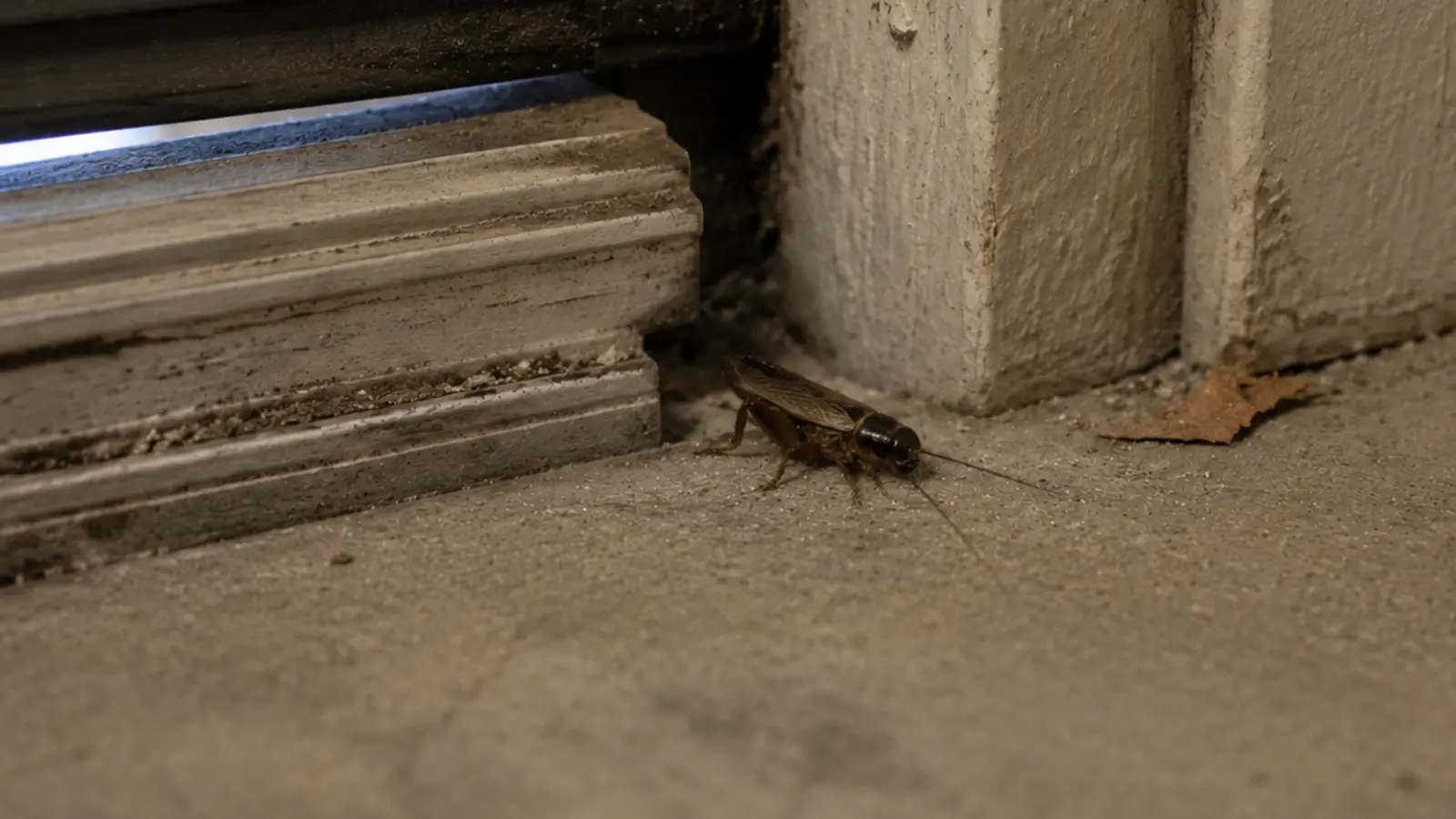
A cricket in the garage is a mild curiosity. A cricket somewhere inside the wall of a bedroom, chirping at a steady interval from 11pm onward, is one of the more genuinely maddening pest problems there is — partly because the sound is designed by evolution to carry, and partly because it stops the instant you get close and resumes the moment you give up. Every year around this time the calls start, and they are rarely about damage. They are about sleep.
Why are crickets coming into my house in the fall?
Cooling night temperatures push them toward warmth and moisture. Field crickets spend the summer outdoors in landscaping, mulch, woodpiles, and ground cover, and as nights drop they move toward the warm, humid conditions a building offers — entering at ground level through door gaps, garage seals, foundation vents, and utility penetrations. The chirping seems louder at the same time for two reasons: it is a mating call that peaks late in the season, and you are indoors with the windows closed, so a sound that was part of the background outside becomes the only thing you can hear. They are a nuisance rather than a health risk.
The Short Version
- Fall entry is temperature-driven. Crickets move toward warmth and moisture as nights cool, and they enter at ground level.
- Only male field crickets chirp, by rubbing their wings together, and it is a mating call — which is why it peaks in late season.
- Camel crickets are the humpbacked, long-legged, silent ones found in garages and crawl spaces. They do not chirp at all.
- Exterior lighting is the most underrated factor. Lights near doors draw crickets to the threshold, and then inside.
- Damage is minor — occasional feeding on fabric, paper, and houseplants. There is no health concern.
- Large or repeated numbers indoors usually indicate a moisture problem or an open entry point rather than a cricket problem as such.
Why Now, Specifically
Crickets are cold-blooded, and their activity tracks temperature closely. Through summer, outdoor conditions in Southern California suit them perfectly — warm nights, irrigated landscaping, mulch beds and ground cover holding moisture, and plenty of organic matter to eat. There is no reason to be inside a building.
What changes in fall is the gap between daytime and nighttime temperature. As nights cool, the interior of a structure — and especially a garage, a crawl space, or a utility room with a water heater in it — becomes markedly warmer and steadier than the yard. Crickets are also drawn to humidity, so the parts of a building that hold moisture are exactly the parts that appeal. They move toward that gradient, and they find whatever ground-level opening is available on the way.
That is the whole mechanism, and it explains the timing precisely. It also explains why cricket calls cluster in the same weeks each year and then taper — this is a migration driven by weather, not a population explosion.
Why the chirping suddenly seems worse
Two things happen at once, and they compound.
The first is biological: chirping is a mating call produced by males rubbing a scraper on one wing against a file on the other, and it intensifies late in the season as the breeding window narrows. A male calling from inside a wall void or under an appliance is also, unhelpfully, benefiting from the acoustics — an enclosed space amplifies and resonates, which is why an indoor cricket sounds so much louder than the dozens that were in your garden all summer.
The second is behavioral, and it is yours. As evenings cool, windows close and people spend more time indoors in the evening. A sound that was part of the outdoor background becomes the only sound in a quiet room. The cricket population has not necessarily changed at all; your relationship to it has.
One practical note, since people always ask: the chirping stops when you approach because crickets detect vibration acutely and go silent as a defense. That is why locating one is so frustrating — the closer you get, the less information you have. The reliable approach is to wait still and quiet in the room for several minutes until it resumes, then move very slowly.
Only males call, by rubbing their wings together. Females are silent, as are camel crickets of both sexes.
The temperature gradient between a cooling yard and a heated structure, plus interior humidity.
Door gaps, garage seals, foundation vents, and utility penetrations — almost always at ground level.
Field Crickets and the Silent Ones
Two very different insects get called crickets, and telling them apart matters mostly because it tells you whether the noise problem and the insect you found are actually the same problem.
Field crickets are the ones people picture: dark brown to black, roughly three quarters of an inch to an inch, with long antennae, flat wings held over the back, and powerful hind legs. Males chirp. These are the ones in your landscaping, and the ones responsible for the sound. House crickets, a lighter yellowish-brown relative, behave similarly and also chirp.
Camel crickets are a genuinely different-looking animal and the source of most "what on earth is this" photographs we get. They have a distinctly humpbacked profile, no wings at all, and disproportionately long back legs and antennae, giving them a spidery appearance that people find far more alarming than field crickets. They are tan or mottled brown and favor exactly the damp, dark places you would expect — crawl spaces, subareas, garages, basements, and under stored items. The two useful facts about them: they are completely silent, since without wings they have no way to chirp, and they are entirely harmless, though they do jump toward disturbance rather than away from it, which is unnerving in a confined crawl space.
So if you have noise, you have field or house crickets. If you have a humpbacked, silent, long-legged thing in the garage, that is a camel cricket and it is not what is keeping you awake — though the presence of either points at the same underlying conditions.
How Much Should You Actually Care?
Honestly, not much, from a damage standpoint. Crickets do not bite in any meaningful sense, do not sting, do not transmit disease, and do not damage structures. They are not a health concern for a household.
What they can do, in numbers and over time, is chew on soft materials — fabric, paper, cardboard, and occasionally houseplants. Camel crickets in particular will graze stored fabric and paper in a garage or crawl space. Feeding damage is usually superficial, and it takes a sustained population rather than a stray individual to amount to anything worth noticing.
The real cost is the noise, and it is worth taking seriously as a cost. Sleep disruption is a genuine problem, and we would rather treat "I cannot sleep" as a legitimate reason to act than tell somebody their pest is harmless and therefore not worth addressing.
What large numbers actually signal
A stray cricket or two indoors in autumn is normal and requires nothing but a cup and a piece of paper. Repeated or large numbers are a different message: it usually means either a persistent moisture problem in a garage, subarea, or utility room, or an open ground-level entry point that a lot of things besides crickets are also using. In that situation the crickets are the symptom that got your attention, not the thing worth treating.
Three Fixes, in Order of Effect
Change the exterior lighting near doors
This is the most underrated intervention and costs almost nothing. Crickets are drawn to light, and a bright fixture beside a door concentrates them at exactly the threshold you do not want them at. Switch to warm-toned or amber bulbs, which are far less attractive to insects than cool white or blue-white light, move fixtures away from entries where you can, or put them on a motion sensor so they are not burning all night. Aim landscape lighting at the path rather than back at the house.
Seal the ground-level entry points
Crickets come in low. Door sweeps on every exterior door including the garage-to-house door, an intact garage door bottom seal, weatherstripping at jambs, screened foundation and crawl space vents, and sealed gaps around plumbing and conduit penetrations. This is the same envelope work that handles a long list of other pests, which is why it is worth doing properly once.
Dry things out and clear the harborage
Address damp garages, subareas, and utility rooms — a dehumidifier where it is practical, better drainage where it is not, and repair of any leak feeding the problem. Outdoors, move mulch, leaf litter, woodpiles, and stored materials back from the foundation, since deep mulch against a wall is ideal cricket habitat that happens to be adjacent to your door.
For the individual cricket already inside and chirping: a cup and a card, if you can find it. Sticky monitoring traps placed along walls and in corners are genuinely effective for crickets, since they travel along edges rather than across open floor, and they will catch one you cannot locate. Vacuuming works for camel crickets in a crawl space.
When it is worth a professional visit: when numbers are persistent rather than occasional, when you are finding them in living space rather than the garage, when the moisture source is somewhere you cannot inspect, or when you would rather have the whole ground-level envelope assessed properly than work through it yourself. Perimeter treatment does work well for crickets, because they are entering from outside and travelling along the base of walls, which is exactly where a perimeter application sits.
Losing sleep over it?
Persistent crickets indoors usually mean an entry point or a moisture condition worth finding rather than a cricket problem as such. Xtermicon services the South Bay, Westside, and greater Los Angeles. Call (310) 370-0963 for a quote, over the phone, with no obligation.
Cricket FAQs
What people ask at the end of the second sleepless night.
How do I find a cricket chirping inside my wall?
Patience, and staying still. Crickets sense vibration and go silent as you approach, so the usual hunting approach actively defeats itself. Sit quietly in the room until it resumes, get a rough direction, then move very slowly and stop when it stops. Common hiding places are behind and under appliances, near a water heater, in a garage against a warm wall, and behind stored boxes. Sticky traps set along the base of walls in the area will often catch one you can never locate by ear.
Are crickets harmful, and do they bite?
No, on both counts as a practical matter. Crickets do not sting, do not transmit disease, and are not a health concern. Their mouthparts can nip if you handle one persistently, but they do not bite people in any normal sense. The damage they cause is minor and limited to chewing on soft materials — fabric, paper, cardboard, occasional houseplants — and it requires a sustained population to amount to anything. The genuine problem with crickets is the noise.
What is the humpbacked one in my garage that does not chirp?
Almost certainly a camel cricket. They are wingless, which is why they are silent — no wings means no way to produce the sound — and they have a distinctly arched back with very long legs and antennae. They favor damp, dark spaces like crawl spaces, subareas, and garages. They are harmless, though they jump toward a disturbance rather than away from it, which people find alarming in a crawl space. Their presence is a moisture signal more than anything else.
Will they go away on their own when it gets colder?
Outdoor populations decline as the season progresses, yes. But the ones that have already moved into a heated structure are in conditions that suit them, so they can persist indoors well past the point at which the yard has quieted down — which is exactly why the fall entry is worth interrupting rather than waiting out. The mild climate here also means the outdoor decline is gentler and slower than in colder regions.
Does changing my porch light really make a difference?
More than most people expect, and it is close to free. Crickets and a long list of other insects are drawn to light, so a bright fixture beside a door creates a concentration of them at the exact spot you least want it, and some proportion will find their way in. Warm-toned or amber bulbs attract far fewer insects than cool white light, and a motion sensor means the fixture is not running all night as a beacon. Aiming landscape lighting at paths rather than back at the house helps for the same reason.
Do I need pest control for a couple of crickets?
No. One or two indoors in autumn is normal, and a cup and a piece of paper resolves it. What is worth a call is a pattern rather than an incident — persistent numbers, crickets in living space rather than the garage, or a recurrence each year, all of which usually point at an open ground-level entry or a moisture condition. In that case the useful work is finding what is actually letting them in, which tends to fix several other things at the same time.
Related Reading
The exclusion work and the other moisture-driven pests this overlaps with.
- The Labor Day pest exclusion checklistThe ground-level sealing work that keeps crickets and much else outside.
- Crickets: species profileIdentification quick reference in the pest library.
- Silverfish in Southern CaliforniaThe other pest whose presence is really a humidity reading.
- Fall rodent season in Southern CaliforniaThe same seasonal trigger, with a considerably higher-stakes pest.
- Landscaping habits that invite pestsMulch, ground cover, and irrigation against the foundation — prime cricket habitat.
- Residential pest controlPerimeter service, which is what actually addresses pests entering at ground level.
Sydney Pardey is the owner of Xtermicon, a family-owned pest control company serving the South Bay and greater Los Angeles area since 2015. All content is written from direct operational experience and reviewed against current California Structural Pest Control Board standards.
Specialists you
can count on.
Xtermicon was founded in 2015 with one focus: protect Southern California homes and businesses from the pests that threaten them. The name says it all — eXterminate TERmites & pest CONtrol — and that's exactly what we do. We're a family-owned team specializing in termite control, pest control, and rodent exclusion. From West LA and East LA to the beach cities and Orange County, we're local neighbors who treat your property like our own.