Wolf Spiders in Southern California: Big, Fast, and Mostly Harmless
The big brown spider that just sprinted across the living room is almost certainly not out to get you. Here is how to tell what it is, and how to keep its relatives outside.
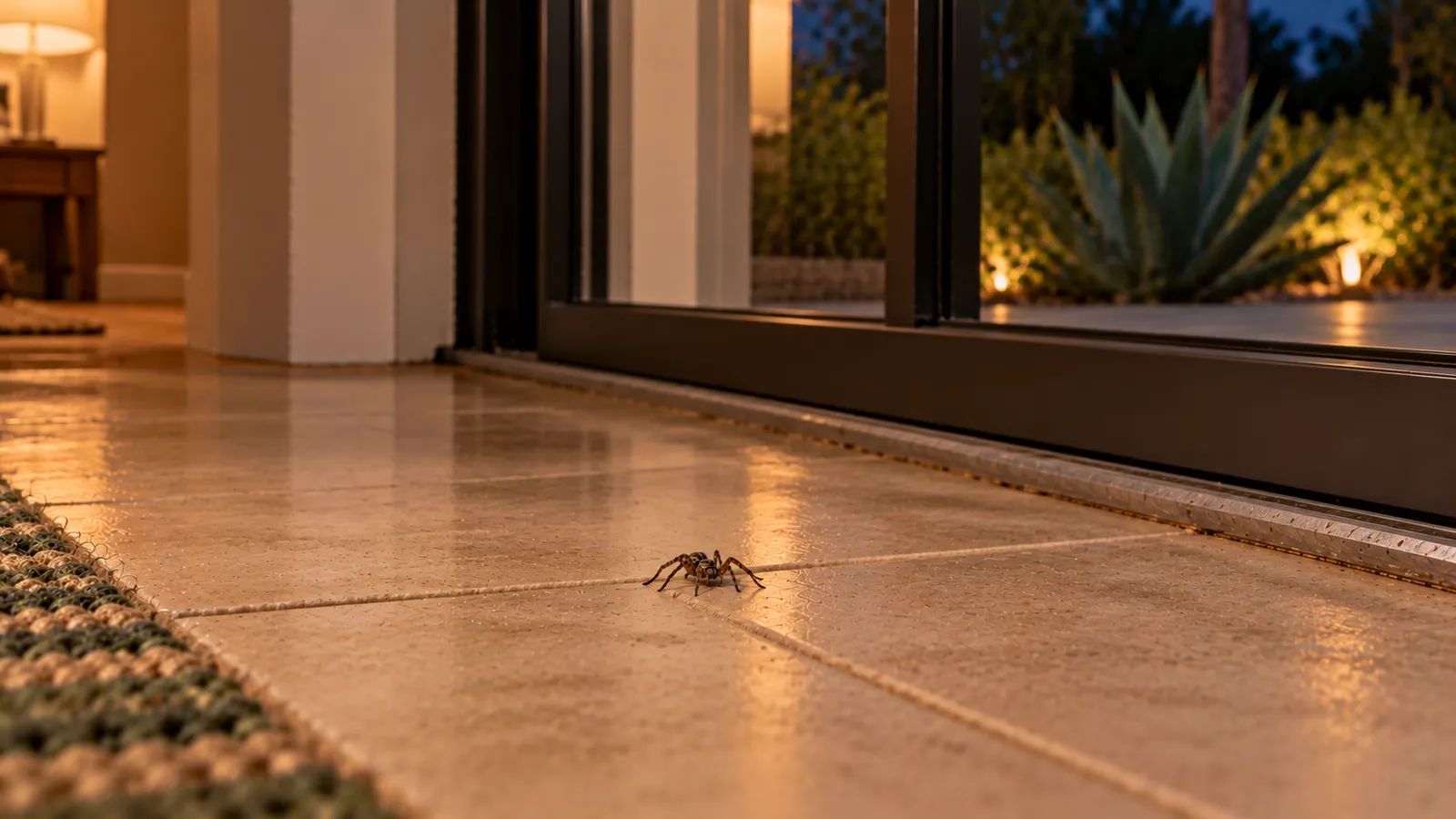
It's almost always at night, it's almost always on the floor, and it is always moving. A big brown spider comes out from under the bookcase, crosses six feet of tile faster than anything with eight legs has a right to, and vanishes under the couch. Now nobody wants to sit on the couch. If that sounds familiar, and especially if it happened this fall, there's a good chance you just met a wolf spider.
Is the big, fast brown spider in my house a wolf spider, and is it dangerous?
If it's large, hairy, mottled brown or gray, low to the ground, and running rather than sitting in a web, it is very likely a wolf spider. Wolf spiders hunt on foot instead of building webs, which is why you see them crossing floors rather than hanging in corners. They are not considered dangerous to people. Bites are uncommon, happen mostly when one is handled or trapped against skin, and for most people are no worse than a bee sting. They tend to show up indoors in fall, following insects and looking for shelter as the nights cool.
The Short Version
- Wolf spiders are big, hairy, brown-and-gray hunters that run rather than spin webs. Size and speed are what make them scary.
- The eyes give them away: two large eyes facing forward above a row of smaller ones, and they shine back at a flashlight.
- Bites are uncommon and, for most people, comparable to a bee sting.
- Fall sightings indoors usually mean one followed its prey inside or slipped in for shelter as nights cooled.
- They eat other bugs. Sealing gaps and cutting down the insects they hunt works far better than spraying for one spider.
- If you are seeing a lot of them, the real question is what they are finding to eat.
What a Wolf Spider Looks Like
Wolf spiders are built for running. They are sturdy, hairy and long-legged, with a body that sits low to the ground. Southern California has several species and they vary in size, but the ones that end up in living rooms tend to be the bigger ones, often around the size of a half-dollar or more with their legs spread. That size, plus the speed, is most of why they are alarming.
The coloring is camouflage: brown, gray, tan and black in mottled patches or stripes, often with darker lengthwise stripes on the front section of the body. On bare dirt, mulch or dry grass they disappear completely, which is the point. On a pale tile floor at 11pm, they don't.
The eyes are the giveaway
If you can get a look at the face (a phone camera zoomed in from a respectful distance works fine), wolf spiders have a distinctive eye arrangement. There are eight eyes in three rows: four small eyes along the bottom, two large eyes facing straight forward above them, and two more on top of the head looking up and back. Those two big forward-facing eyes give the spider a look of paying attention to you, because it is. Wolf spiders hunt by sight more than most spiders do.
Those eyes also reflect light. Walk the yard at night with a flashlight held up near your own eyes and you may see tiny green-white glints in the grass or mulch. Many of those are wolf spiders, sitting still and waiting for something to wander past. It's a little unsettling the first time and interesting after that.
The mother with a backpack
Female wolf spiders carry their egg sac attached to the back end of the body, a round grayish-white ball they drag along wherever they go. When the eggs hatch, the spiderlings climb onto the mother's back and ride around for a while before dispersing. If you have ever seen a lumpy-looking spider seem to fall apart into dozens of tiny spiders when someone swatted it, that was a wolf spider mother. It is also the best argument there is for the cup-and-card method over the shoe.
Two large forward-facing eyes in the middle row are the easiest way to recognize one.
They stalk or ambush prey on the ground instead of waiting in a web.
Bites are uncommon and usually mild, comparable to a bee sting for most people.
What they get confused with
Tarantulas
The hairy legs and size cause the mix-up. Tarantulas are much heavier-bodied, move slowly and deliberately, and are not something you would expect to find walking across a typical South Bay or Westside living room.
Grass spiders
Similar colors and similar size, but grass spiders build flat sheet webs with a funnel at one side, usually in ground cover or shrubs, and wait at the mouth of the funnel. A wolf spider has no web to go home to.
Widow spiders
Not really alike, but they get lumped together as "the dangerous spider." Black and brown widows are shiny and round-bodied, hang in messy webs in low, sheltered spots, and are almost never seen strolling across a floor. Our widow articles cover them in detail.
Recluses
Plenty of brown spiders get called recluses. The brown recluse is not considered established in California, and the desert recluse lives in desert regions, not coastal neighborhoods. Recluses have six eyes in pairs instead of eight, smooth legs rather than hairy ones, and a uniform tan color.
Hunters, Not Weavers
Most spiders people know build a web and wait. Wolf spiders go looking. They hunt at night on the ground, either stalking prey or sitting perfectly still until something gets close enough to pounce on. Some species live in silk-lined burrows in the soil or under stones and wait at the entrance. None of them rely on a web to catch food.
That is why the encounter always plays out the same way. You don't find a wolf spider sitting in a corner. You find one in motion, crossing open floor, usually heading for the nearest dark gap. When it seems to run at you, it is usually running toward the shadow under your chair or the gap behind your feet. They move in bursts, stop dead, and start again, which makes them hard to catch and easy to lose.
Indoors, a wolf spider is in the wrong habitat. It is there because it followed something to eat or slipped in looking for shelter, and it usually doesn't settle in the way web-building house spiders do. They don't form colonies, and one wolf spider in the den is not the leading edge of an infestation.
Do Wolf Spiders Bite?
They can, but they rarely do. A wolf spider would much rather run than fight, and bites mostly happen when one gets pressed against skin: stepped on barefoot, trapped in a shoe or a glove, or picked up. Their venom is not considered medically significant for people. For most people a bite means local pain, redness and some swelling, a lot like a bee sting, and it settles on its own.
As with any bite or sting, some people react more strongly than others. Wash the spot with soap and water, use a cold pack for the swelling, and keep an eye on it. If redness is spreading, the pain is getting worse instead of better, there are signs of infection, or anyone has trouble breathing, get medical care. This is general information rather than medical advice, and a physician is the right person for anything that isn't settling down.
Doctors also point out that a lot of skin sores blamed on spider bites turn out to be something else, such as a skin infection. If nobody actually saw a spider bite, that is another reason to have a sore that is getting worse looked at rather than assuming.
Why You See More of Them in the Fall
They follow their food
Crickets, earwigs, silverfish and other insects drift toward houses as nights cool, and wolf spiders follow. A wolf spider in the garage is often a sign there are crickets in the garage.
Cooler nights
A garage or ground-floor room is warmer and drier than the yard on a cool fall night, and spiders wander in through the same gaps everything else uses.
Bigger spiders
Spiders that hatched earlier in the year have had all summer to grow, so by fall the ones you meet are closer to full size.
Fall yard work
Pulling out summer plants, moving pots, raking mulch and clearing woodpiles all disturb spiders that were living there, and some of them run the wrong way.
Gaps at ground level
Wolf spiders come in low: under doors without sweeps, through worn garage door seals, along sliding door tracks, and through torn vent screens.
Getting One Out, and Keeping the Rest Outside
The one in the living room
A cup and a stiff piece of paper, the same as any other spider. Lower the cup over it, slide the paper underneath, and walk it out to the garden. A vacuum works too if you can't face that. If it's in the garage, honestly, you can leave it there. It is eating things you want gone.
Keeping them outside
Door sweeps everywhere
Including the door between the garage and the house. If you can see daylight under a door, a spider can walk under it.
The garage door seal
Worn or split bottom seals, especially at the corners, are one of the most common ground-level gaps on any house.
Screens and vents
Repair torn window screens and make sure foundation and crawl space vents have intact screening.
The small gaps
Close up gaps where pipes, cables and AC lines enter the wall with a suitable sealant.
The edge of the house
Pull mulch, leaf piles, stacked pots, firewood and dense ground cover back from the foundation. That strip is prime hunting ground.
The porch light
Bright white light by the door pulls in insects, and the spiders come for the insects. Warm-toned or amber bulbs attract far fewer bugs.
The garage floor
Lidded plastic bins on shelves give spiders and their prey fewer places to hide than cardboard boxes sitting on concrete.
Why we don't spray for wolf spiders
We don't recommend a chemical treatment aimed at wolf spiders, and our spider service doesn't offer one. Wolf spiders wander rather than sit in one place, so they rarely meet a treated surface, and they are useful predators of the insects you actually want gone. Our spider service is dewebbing: physically removing webs and egg sacs from eaves, windows, garages and patios. That's aimed at web-building spiders, and a wolf spider doesn't leave any webs to remove.
When to Bring Someone In
One wolf spider in October is not a pest problem. Seeing them regularly indoors is a different message, and the message is usually about what they are eating. A steady supply of crickets, earwigs, silverfish or cockroaches is what keeps hunters coming in, and those insects usually point back to moisture, clutter or open entry points at ground level.
That is the part a professional visit can help with. An inspection looks at where insects are getting in, where they are living around the foundation and in the garage, and what is drawing them. For ongoing insect pressure, a recurring general pest plan focused on the perimeter is usually the right tool, and quarterly visits are our usual recommendation for a typical home. If you also have web-building spiders around the eaves and windows, dewebbing can be added on or done as a one-off.
And if you aren't sure what kind of spider you're looking at, a clear photo helps, along with where you found it and what it was doing.
Seeing more spiders than seems normal?
It usually means there's plenty out there for them to eat. Xtermicon is a family-owned pest control company working across the South Bay, the Westside and greater Los Angeles. Call (310) 370-0963 and tell us what you're seeing; quotes are free over the phone, with no obligation.
Wolf Spider FAQs
Are wolf spiders dangerous to dogs and cats?
Wolf spiders are not considered dangerous to pets. A curious dog or cat that gets bitten on the nose or a paw may have some local swelling and soreness, much like a bee sting. If the swelling is significant, involves the face or throat, or your pet seems unwell, call your veterinarian. More often, pets just chase them.
How can I tell a wolf spider from a brown recluse?
Look at the eyes and the legs. Wolf spiders have eight eyes in three rows, with two large eyes facing forward, and hairy legs with a mottled or striped pattern. Recluses have six eyes arranged in pairs, smooth legs, and a uniform tan color with a darker violin-shaped mark on the front of the body. The brown recluse is also not considered established in California, and the desert recluse lives in desert areas rather than coastal Los Angeles.
Can wolf spiders infest a house?
Not in the way people usually mean. Wolf spiders don't build colonies or webs and don't settle into a house the way web-building spiders do. The ones you see indoors are usually individuals that wandered in. The exception is a mother carrying spiderlings, which can scatter if she is disturbed, but the young disperse and rarely last long indoors without prey.
Why do wolf spiders carry babies on their backs?
It is how they protect their young. The mother carries the egg sac attached to the back of her body until it hatches, then the spiderlings climb onto her back and ride along for a while before going off on their own. It is one of the more unusual parenting habits among spiders, and a good reason not to squash one if you can avoid it.
What attracts wolf spiders to my house?
Mostly food and shelter. They follow crickets, earwigs, silverfish and other insects toward the house, especially as nights cool in fall. Ground-level gaps under doors and garage doors, clutter on the garage floor, and bright lights near entrances, which draw insects in, all make your house more interesting to a hunting spider.
Related Reading
If you are still working out which spider you have.
- Wolf spider profileIdentification quick reference in the pest library.
- Brown widow vs. black widowThe two widows you are more likely to find around a SoCal home, and how to tell them apart.
- Where black widows hideThe garage corners and outdoor spots worth checking with gloves on.
- Crickets in the house in fallThe fall visitor that often brings wolf spiders in behind it.
- Spider control and dewebbingWeb and egg sac removal for the spiders that do build webs.
- What bit me?A guide to common bites and when to see a doctor.
Sydney Pardey is the owner of Xtermicon, a family-owned pest control company serving the South Bay and greater Los Angeles area since 2015. All content is written from direct operational experience and reviewed against current California Structural Pest Control Board standards.
Specialists you
can count on.
Xtermicon was founded in 2015 with one focus: protect Southern California homes and businesses from the pests that threaten them. The name says it all — eXterminate TERmites & pest CONtrol — and that's exactly what we do. We're a family-owned team specializing in termite control, pest control, and rodent exclusion. From West LA and East LA to the beach cities and Orange County, we're local neighbors who treat your property like our own.