Brown Widow vs. Black Widow: The Spider You're More Likely to Find in SoCal
Brown widows have quietly displaced black widows across much of coastal Southern California — and they hide in very different places. The egg sac tells you which one you have before the spider does.
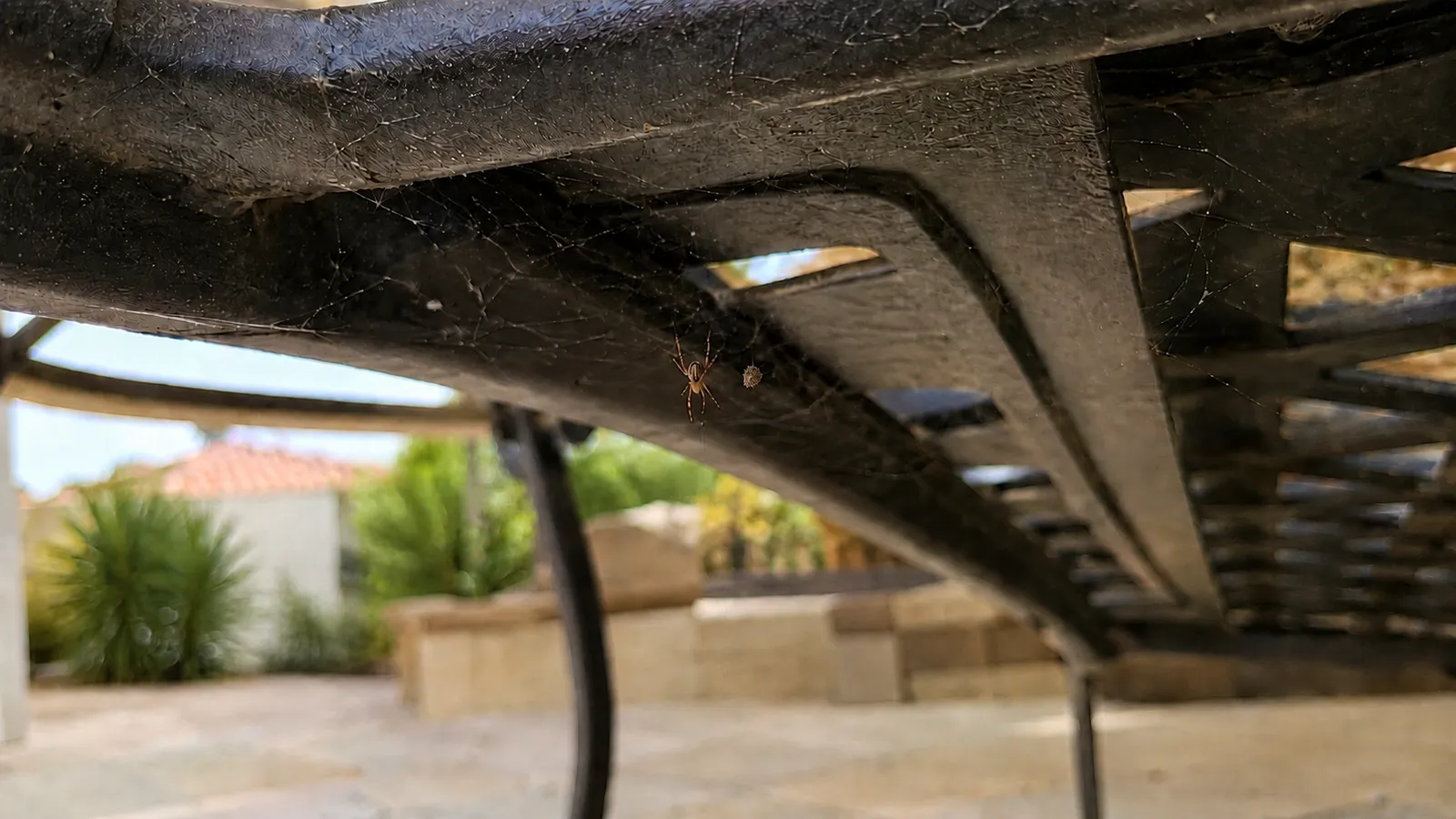
You tip up a patio chair that has been sitting through the summer, and there is a spider on the underside of the seat with a web that feels wrong — messy, strong, and clearly not an orb. Your first thought is black widow, because that is the only widow most people in Southern California know by name. Increasingly, it is not. Across much of the coastal LA Basin the spider under that chair is a brown widow, and the reason it matters is not that one is dramatically more dangerous than the other. It is that they live in completely different places, and the brown one lives where your hands go.
How do I tell a brown widow from a black widow?
Look at the egg sac first — it is unambiguous and you do not need to get close to the spider. A brown widow egg sac is covered in small spiky projections, like a tiny mace or a spiky golf ball. A black widow egg sac is smooth, round, and papery. For the spiders themselves: a black widow is glossy jet black with a bright red hourglass and uniform legs, while a brown widow is mottled tan, brown, and grey with banded legs and an orange or yellowish hourglass rather than red. Location helps too — black widows favor dark, undisturbed, low places, while brown widows sit in exposed high-contact spots like the undersides of patio furniture, toy handles, and trash can rims.
The Short Version
- The egg sac is the fastest and safest identifier: spiky and mace-like means brown widow, smooth and round means black widow.
- Brown widows are mottled tan-to-brown with banded legs and an orange or yellowish hourglass. Black widows are glossy black with a bright red one.
- Brown widows have become more common than black widows across much of coastal Southern California in recent years.
- They occupy different niches: black widows hide low, dark, and undisturbed; brown widows sit in exposed, frequently touched spots.
- Brown widow venom is generally considered less medically severe than black widow venom, but a bite is still painful and worth watching.
- Removing egg sacs is what actually reduces the population — knocking down webs alone leaves the next generation behind.
The Egg Sac Settles It Faster Than the Spider Does
Most identification guides start with the spider, which means getting close enough to a widow to study the underside of its abdomen. That is backwards. The egg sac is a better identifier, it does not move, and you can read it from a comfortable distance.
A brown widow egg sac is unmistakable once you have seen one: roughly pea-sized, tan, and covered in small pointed projections all over its surface. People describe it as a tiny mace, a spiky golf ball, or a miniature sea urchin. Nothing else in a Southern California yard makes anything like it.
A black widow egg sac is smooth — round to teardrop-shaped, papery, off-white to tan, with no projections at all. If you find a smooth sac in a dark corner of the garage and a spiky one under the patio table, you have just identified both species without looking at a single spider.
Telling the Two Apart by Sight
If you can see the spider clearly, these are the differences that hold up. Both are widows — same body plan, same bulbous abdomen and thin legs, same messy tangled web with no pattern to it.
Black widow
Body
Glossy, almost lacquered jet black. Mature females are about a half inch in the body with a round, distinctly bulbous abdomen.
Hourglass
Bright, saturated red on the underside of the abdomen. Sometimes it appears as two separate triangles rather than a joined shape.
Legs
Uniformly black, long and thin, with no banding.
Behavior
Shy and reclusive. Typically retreats deeper into the web when disturbed rather than moving toward you.
Brown widow
Body
Mottled rather than solid — tan, brown, grey, and sometimes darker patches, often with a faint patterned look along the top of the abdomen. Similar size and shape to a black widow, so silhouette will not distinguish them.
Hourglass
Orange to yellowish rather than bright red. It is usually well-defined, but the color is the tell.
Legs
Banded — alternating light and dark segments. This is often visible from farther away than the hourglass is.
Behavior
Also shy, and quicker to drop from the web and play dead when disturbed. They tend to be found in more open, exposed positions than black widows.
One caution worth flagging: a darker brown widow can look convincingly black in poor light, particularly at night with a flashlight. If the legs are banded or the hourglass reads orange rather than red, it is a brown widow regardless of how dark the body appears. And if there is a spiky sac anywhere nearby, that settles it.
They Live in Completely Different Places
This is the part that matters most in practice, and it is the reason a brown widow is worth knowing about even though its venom is the less severe of the two.
Black widows want dark, sheltered, undisturbed places low to the ground. Meter boxes, the underside of decking, woodpiles, the back corner of a garage behind stored boxes, block wall cavities, irrigation valve boxes, the gap under an outdoor storage bench. Places you visit rarely and reach into carefully.
Brown widows want structure and shelter but tolerate far more exposure, and the spots they choose are ones people touch constantly:
The undersides of patio furniture
Chair seats, table rims, the inside of hollow tubular frames. The single most common find.
Children's outdoor toys
Handles, the underside of ride-on toys, the hollow tubing of play structures, anything left out through a season.
Trash and recycling can rims
Under the lip and the handle — exactly where hands go, every week.
Mailbox undersides and gate hardware
Latches, handles, the underside of a mailbox, and the recesses in a gate frame.
Block wall weep holes and fence rails
Small recesses at a convenient height along a wall or fence line.
Potted plant rims and stored items
The lip of a pot, the underside of a saucer, and the gaps in anything that has been stacked and left.
The location is the risk, not the venom
Brown widow venom is generally considered less medically severe than black widow venom, and on that measure alone the arrival of brown widows is good news. But neither species is aggressive, and bites almost always happen the same way: a spider gets pressed against skin when someone reaches under, into, or around something without looking. That is where the practical picture flips. A black widow in a meter box is somewhere you approach carefully once a month. A brown widow under the handle of a child's ride-on toy is somewhere a hand goes every day without a thought.
What Happens If You Are Bitten
Worth being accurate here rather than either alarming or dismissive, and worth saying up front that this is general information rather than medical advice — anything concerning goes to a doctor, not a pest control company.
A black widow bite is the more significant of the two. The venom acts on the nervous system, and beyond pain at the site it can produce muscle cramping and spasms — often in the abdomen or back rather than near the bite — along with sweating, nausea, and elevated blood pressure. Symptoms can develop over hours. Serious outcomes in healthy adults are uncommon and effective medical treatment exists, but a suspected black widow bite warrants medical attention, and more urgently for a young child, an older adult, or anyone with a heart condition.
A brown widow bite is generally milder. The prevailing understanding is that although the venom is comparable in potency, brown widows deliver far less of it, so effects are usually confined to pain, redness, and swelling around the bite rather than the systemic symptoms a black widow can produce. That said, "generally milder" is not "harmless" — a painful bite that starts spreading, cramping, or producing symptoms away from the bite site should be seen by a doctor regardless of which spider you think it was.
For either one: wash the area, apply a cold pack, and if you can safely photograph or contain the spider without risking a second bite, that helps whoever treats you. Do not go hunting for it.
Reducing Them Around the House
Spider control is different from other pest work, and it is worth understanding why before anyone sells you a spray. Spiders pick up far less surface residue than crawling insects do — their long legs hold their bodies up off treated surfaces, and they do not groom themselves the way insects do. That means a perimeter spray does much less to a spider population than people assume.
What actually works is physical: removing the webs and, critically, the egg sacs. Dewebbing takes out the current population and the next one at the same time. Clearing webs while leaving spiky sacs behind is why people find brown widows back in the same spot a few weeks later — each sac is a fresh generation waiting.
Check before you reach
Tip patio chairs up, look under table rims and trash can lids, and check toy handles before handing them to a child. Ten seconds, and it addresses the way nearly every bite actually happens.
Remove egg sacs, not just webs
Bag and dispose of them rather than knocking them onto the ground. This is the single highest-value thing you can do.
Wear gloves for the seasonal jobs
Moving stored boxes, clearing a woodpile, working in a meter box or valve box, reaching behind anything that has sat all summer.
Cut down the clutter they use
Stacked pots, stored items along a fence line, and unused furniture left out through a season are all brown widow habitat that did not have to exist.
Store outdoor toys inside
The highest-contact, highest-risk category, and the easiest one to fix.
Keep it recurring if the pressure is high
Spiders and webs come back — dewebbing is like lawn service rather than a one-time repair, and on a property that keeps producing widows, a recurring schedule is what keeps it down.
Finding widows around the patio or the play area?
Dewebbing is a physical service — we take the webs and the egg sacs down by hand, which is what actually reduces the population rather than relocating it. It can be a one-time visit or added onto a recurring plan. Xtermicon has served the South Bay, the Beach Cities, and greater Los Angeles since 2015. Call (310) 370-0963 if widows are turning up where your family spends time.
Widow Spider FAQs
What Southern California homeowners ask most about the two widows. For anything medical, please talk to a doctor.
Are brown widows really more common than black widows now?
Across much of coastal Southern California, yes. Brown widows are not native here — they established relatively recently and spread quickly through the LA Basin, and in many urban and suburban settings they are now the widow you are most likely to encounter around a house. Black widows have not disappeared and are still readily found, particularly in the darker, more sheltered, less disturbed spots they favor. What has changed is which one is sitting under your patio furniture.
Is a brown widow dangerous to my kids or pets?
They are worth taking seriously without being alarmed about. Brown widow venom is generally considered less medically severe than black widow venom, largely because far less of it is delivered, and bites typically produce local pain, redness, and swelling rather than the systemic symptoms a black widow can cause. The reason to care is location rather than potency: brown widows favor exactly the exposed, hand-height spots children touch — toy handles, play structure tubing, patio chair undersides. Storing outdoor toys inside and checking before reaching handles most of the practical risk.
I found a spiky egg sac. What should I do with it?
Remove it and dispose of it rather than knocking it to the ground, where it will simply hatch somewhere less visible. Bag it, seal the bag, and bin it. Wear gloves and check the immediate area first, because the female is usually close by. If you are finding multiple sacs across a property, that is the point where clearing them one at a time stops keeping up and a proper dewebbing pass is worth it — each sac left behind is the next generation.
Does spraying get rid of widow spiders?
Far less than people expect, and it is worth knowing why before paying for it. Spiders do not pick up surface residues the way crawling insects do — their long legs keep their bodies off treated surfaces and they do not groom themselves the same way, so they simply have much less contact with a treated surface. The effective approach is physical: removing webs and egg sacs by hand. Any company selling you a spider problem solved purely with a spray is describing something that does not work as advertised.
Do widow spiders come inside the house?
Occasionally, but both species are overwhelmingly outdoor spiders here, and the ones that make it indoors are usually in the transitional spaces rather than living areas — garages, sheds, subareas, and storage rooms. Interior sightings often trace to something carried in: a box that sat in the garage, firewood, patio cushions brought inside, or a plant pot. The productive place to focus is the exterior, because that is where the population actually is.
How do I know it is a widow and not a harmless lookalike?
The false widow is the common source of confusion — similar shape and size, dark and glossy, but with no hourglass at all on the underside. Cellar spiders, sometimes called daddy long-legs, get mistaken for widows too, but they have much longer, thinner legs and a small elongated body rather than a bulbous one. The hourglass and the egg sac are the two reliable checks. No hourglass and no spiky sac almost certainly means you are looking at something harmless.
Related Reading
More on widows, where they hide, and how spider work actually gets done.
- Where black widows hide in SoCal homesThe companion piece — the dark, low, undisturbed spots black widows prefer.
- Brown widow pest libraryIdentification, the spiky egg sac, and the harborages they favor.
- Black widow pest libraryBiology, behavior, and bite information at a glance.
- Our spider control & dewebbing servicePhysical removal of webs and egg sacs, one-time or recurring.
- How to keep pests off your patioThe outdoor-living areas where brown widows are most often found.
- Pest control in TorranceSpider work across Torrance and the South Bay since 2015.
Sydney Pardey is the owner of Xtermicon, a family-owned pest control company serving the South Bay and greater Los Angeles area since 2015. All content is written from direct operational experience and reviewed against current California Structural Pest Control Board standards.
Specialists you
can count on.
Xtermicon was founded in 2015 with one focus: protect Southern California homes and businesses from the pests that threaten them. The name says it all — eXterminate TERmites & pest CONtrol — and that's exactly what we do. We're a family-owned team specializing in termite control, pest control, and rodent exclusion. From West LA and East LA to the beach cities and Orange County, we're local neighbors who treat your property like our own.