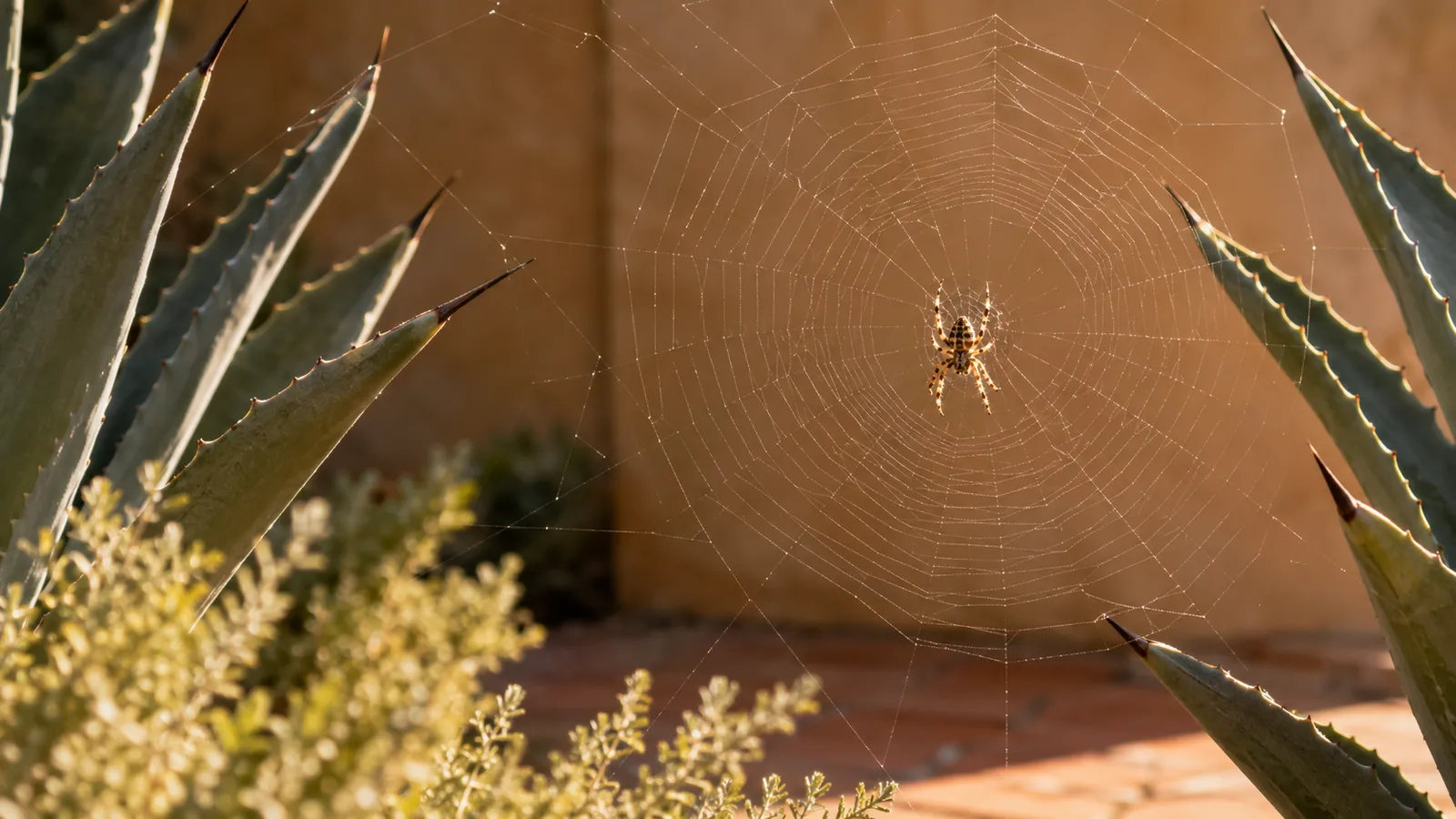
What is dewebbing, and does it get rid of spiders?
Dewebbing is the physical removal of spider webs and egg sacs from around a structure — eaves, soffits, door frames, window frames, patio covers, garages, and block walls. It is done by hand rather than sprayed, because spiders are poorly affected by surface residues: their long legs keep their bodies off treated surfaces and they do not groom the way insects do. Removing the webs takes out the current population and, critically, the egg sacs that would become the next one. Spiders and their webs do return, which is why we recommend dewebbing on a recurring basis rather than as a one-off fix.
Service Overview
Dewebbing is the service here, and it is a physical one: we remove the webs and the egg sacs by hand rather than relying on a product to do it. That matters because spiders do not pick up surface residues the way crawling insects do — their legs keep their bodies off treated surfaces and they do not groom themselves the same way. Taking the webs and the next generation of egg sacs down is what actually reduces the spider population around a house. It is available as a standalone visit or as an add-on to a recurring service plan, and for most properties recurring is the version that keeps working.
Key Takeaways
- Dewebbing is physical removal by hand — webs and egg sacs both — not a spray application.
- Spiders pick up far less surface residue than crawling insects do, which is why physical removal is the effective approach.
- Removing egg sacs is the part that matters most, because it takes out the next generation rather than just the current one.
- It is an additional service: available as a one-time visit, or added onto a recurring service package.
- Spiders and their webs will return. Like recurring lawn service, ongoing dewebbing is what keeps spider problems at bay.
- Black and brown widows favor low, sheltered spots — meter boxes, block walls, under patio furniture, stored items in the garage.
- Brown widows are now extremely common here and leave a distinctive spiky egg sac.
Key Benefits
- ✓Webs and egg sacs physically removed, including the next generation
- ✓Specific attention to widow harborage near doors, garages, and play areas
- ✓Available one-off or as an add-on to a recurring plan
- ✓Recurring visits keep webs from re-establishing around entries and eaves
Physical Removal, By Hand
Webs and egg sacs come down physically on accessible exterior surfaces. Spiders pick up very little surface residue, so this is the part that actually reduces the population.
One-Off or Recurring
Dewebbing is an additional service. Book it as a standalone visit, or add it onto a recurring service package so it happens automatically alongside your regular visits.
Widow-Focused Inspection
We specifically check the low, sheltered spots widows use around entries, garages, yards, and play areas, rather than walking the house generically.
Our Decisive Process
Walk the Structure
We survey eaves, soffits, door and window frames, patio covers, garages, block walls, meter boxes, and stored items — including the low, sheltered spots widows prefer.
Physical Dewebbing
Webs are removed by hand from the accessible exterior surfaces. This is the part that reduces the population, and it is why the service is physical rather than chemical.
Egg Sac Removal
Egg sacs come down with the webs. Leaving them behind means the population simply rebuilds, so this is the step that determines how long the result holds.
Set the Recurring Interval
Webs return, so we agree how often to come back — either as a standalone schedule or folded into an existing recurring service plan.
The spiders worth taking seriously here
Most Southern California spiders are harmless and genuinely useful. Two are worth respecting, and one is mostly a myth locally.
- ✓Black widow — glossy black with a red hourglass; venomous bite warranting medical attention. Favors low, dark, sheltered voids
- ✓Brown widow — mottled tan with an orange hourglass and a distinctive spiky egg sac; now very common, less potent than a black widow but far more numerous
- ✓Desert recluse — exists in California but in desert habitat, not coastal urban areas; the vast majority of suspected "recluse" bites here are something else
- ✓Wolf, orb weaver, garden, cellar, and house spiders — harmless, and worth leaving alone outdoors where you can
Where widows actually turn up
Widows do not hunt people; almost every bite happens because a hand went somewhere a hand could not see. The pattern is consistent enough to act on: check under and behind anything that has sat undisturbed at ground level. Water meter boxes, block wall weep holes, the underside of patio chairs and tables, stacked pots, garage boxes, the lip beneath a barbecue, and the gap behind a gate latch. If you have children, those spots around the yard and play equipment are the ones worth a flashlight before the season starts.
Why we recommend dewebbing on a recurring basis
Spiders come back, and so do their webs. A single dewebbing visit gives you a clean structure and a real reduction in population, but the surrounding spider pressure has not gone anywhere — new spiders move in, build, and lay again. It is the same logic as recurring lawn service: nobody expects one mow to be permanent. Ongoing dewebbing at a sensible interval is what keeps webs off the eaves and entries and keeps spider problems from re-establishing, and it can simply ride along with a recurring service plan rather than being something you have to remember to book.
Service FAQs
"Why dewebbing instead of spraying for spiders?"
Because spiders are poorly affected by surface residues. Their long legs keep their bodies off treated surfaces, and they do not groom themselves the way insects do, so they pick up very little of what they walk across. Physically taking down the webs and egg sacs removes the current population and the next one, which is a far more direct route to fewer spiders around the house.
"Is dewebbing a one-time service or ongoing?"
Either. It is an additional service, so you can book a standalone visit, or add it onto a recurring service package so it happens alongside your regular visits. We recommend recurring for most properties, because webs come back and a single visit is a snapshot rather than a solution.
"How often should dewebbing be done?"
It depends on the property — how much vegetation is around it, how many eaves and covered entries it has, and how much insect pressure is feeding the spiders. We will give you a straight recommendation after walking it. Think of the interval the way you would a lawn service: frequent enough that it never gets away from you.
"How do I know if I have black widows or brown widows?"
Black widows are glossy black with a red hourglass and build strong, irregular webs in dark sheltered voids. Brown widows are mottled tan-and-brown with an orange hourglass, and their egg sacs are unmistakable — round with spiky projections. If you find a spiky egg sac, it is a brown widow. Both belong in the "leave it and call us" category.
"Are there brown recluses in Southern California?"
Essentially no. Brown recluses are not established here. There is a native desert recluse, but it lives in desert habitat rather than coastal urban neighborhoods, and it is uncommon even there. Most bites blamed on recluses locally turn out to be another spider or a non-spider skin condition entirely.
"Will you remove the webs of harmless spiders too?"
Dewebbing clears the accessible exterior surfaces of the structure, so yes — it is not species-selective. That said, we are happy to leave garden and orb-weaver populations working out in the yard away from the house. Tell your technician what you would rather keep and we will work around it.
Identify What You're Dealing With
Treatment starts with correct identification. These pest library entries cover the species we target with this service.
Specialists you
can count on.
Xtermicon was founded in 2015 with one focus: protect Southern California homes and businesses from the pests that threaten them. The name says it all — eXterminate TERmites & pest CONtrol — and that's exactly what we do. We're a family-owned team specializing in termite control, pest control, and rodent exclusion. From West LA and East LA to the beach cities and Orange County, we're local neighbors who treat your property like our own.