West LA vs. the Beach Cities: How Pest Pressure Compares Across the Service Area
One is dense, older, and largely multi-unit. The other is lower-rise, salt-exposed, and built on sand. The pests follow the buildings, not the postcode.
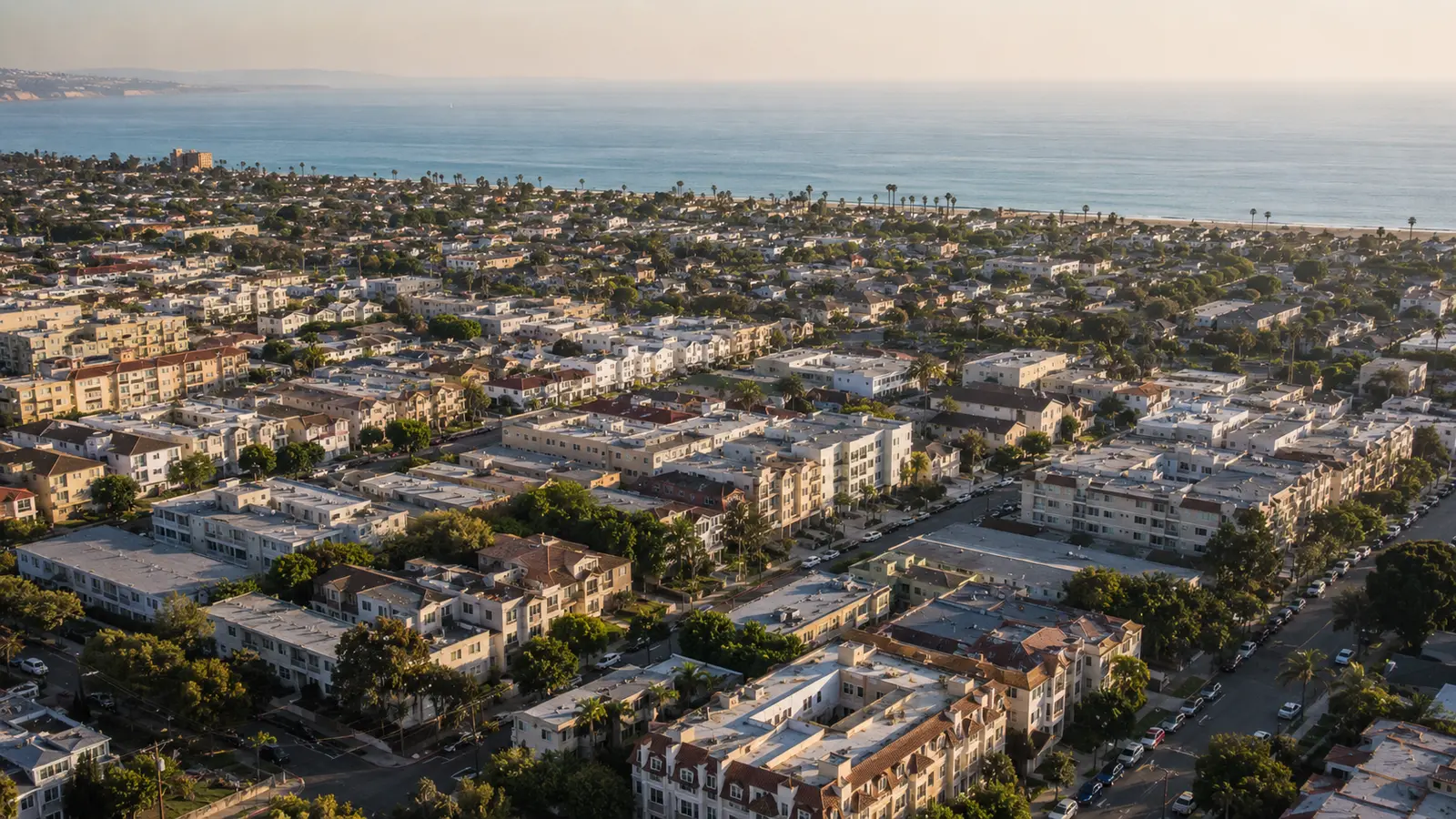
We service both halves of this comparison on the same days, and the difference in what the trucks are set up for is genuinely noticeable. A morning in West Los Angeles skews toward rodent exclusion, cockroach work, and multi-unit coordination. An afternoon in the Beach Cities skews toward termite findings, ant programs, and single-family perimeters. Same company, same week, same weather. The variable is what got built, when, and how densely.
How does pest pressure differ between West LA and the Beach Cities?
Denser urban West Los Angeles — with more older multi-unit buildings, shared walls, alley trash collection, and continuous street frontage — tends to see the pressure typical of dense urban cores: rodents moving between adjacent structures, and cockroaches spreading through shared plumbing chases and utility runs. The Beach Cities, with more low-rise single-family stock and consistent coastal humidity, lean more toward termites and ants. Both types of termite are common near the water, because salt air degrades exterior paint and caulking, and coastal soil moisture supports subterranean colonies. These are tendencies driven by building stock rather than hard rules, and any individual property can run against its neighborhood pattern.
The Short Version
- Housing density and building age explain more of the difference than geography does.
- West LA leans toward rodents and cockroaches — the pattern of dense urban cores with shared structure and continuous building frontage.
- The Beach Cities lean toward termites and ants — lower-rise stock, coastal humidity, and more ground-level perimeter per household.
- In multi-unit buildings, a pest problem is a building condition rather than a unit condition. That is the single biggest practical difference between the two areas.
- Coastal humidity works on buildings as well as insects: salt air degrades exterior paint and caulking, which is how drywood termites get in.
- These are tendencies, not rules. A 1920s single-family home in West LA behaves like a Beach Cities property, and a dense condo in Hermosa behaves like West LA.
Buildings Determine Pests More Than Neighborhoods Do
Before the comparison, the caveat that makes it useful rather than misleading. Neither of these areas is uniform, and the pattern is driven by what is typical rather than what is universal. West Los Angeles contains plenty of detached single-family homes on generous lots; the Beach Cities contain plenty of dense multi-unit buildings. What follows describes the dominant housing pattern in each, and the honest way to use it is as a starting hypothesis about a property rather than a conclusion.
Three building characteristics do most of the work, and they travel anywhere:
Shared structure
Common walls, stacked plumbing, shared attic runs, and continuous foundations let a problem in one unit become a problem in five. This is the defining feature of denser stock and it changes both the diagnosis and the scope of any treatment.
Perimeter-to-household ratio
A detached house has a large amount of ground-level exterior wall, landscaping, and soil contact per household — which is where termites and ants come from. A twenty-unit building has comparatively little ground-level perimeter spread across many households, but far more interior shared space.
Waste handling
Alley bins and shared enclosures serving many units concentrate food waste in a way that individual household bins do not. Consolidated waste is one of the most reliable predictors of rodent and cockroach pressure anywhere.
The Dense Urban Pattern
The parts of West Los Angeles with older multi-unit stock — the apartment corridors, the courtyard buildings, the dingbats and their later replacements — produce the pest profile you would expect of any dense urban core.
Rodents are the headline. Continuous building frontage, alleys, shared waste enclosures, and structures built close to or against each other create connected routes at ground level and above it. A rodent population displaced by construction or a teardown relocates within the block rather than leaving, which is why activity in these neighborhoods tends to recur along a corridor rather than at an address. Roof rats do particularly well here, moving along fence lines, utility runs, and mature street trees, and getting in at the roofline rather than the foundation.
Cockroaches are the second, and they are more specifically a shared-structure problem. German cockroaches live inside units and travel between them through the plumbing chases where supply and waste lines pass through framing — penetrations that are almost never sealed tightly. This is why treating a single reporting unit so often pushes part of the population next door instead of resolving it, and why any serious cockroach work in a multi-unit building has to include the adjacent, above, and below units to be worth doing.
Termites are still present — older West LA housing stock has plenty of them — but they are less often the presenting complaint, partly because in a multi-unit building the structural exterior is the association's or owner's problem rather than something an individual resident is watching.
The Coastal Low-Rise Pattern
Across the beach-adjacent cities, the balance tips the other way, for reasons that are as much about the ocean as the buildings.
Termites lead, and both types matter. Drywood termites need no soil contact at all and colonize eaves, fascia, window frames, and attic framing — and the mechanism that lets them in is salt air, which steadily degrades exterior paint and caulking and opens the weathered cracks they enter through. That is a genuinely coastal effect, and it applies regardless of foundation type or how well a house is maintained inside. Subterranean termites, meanwhile, are supported by soil that stays damp under the marine layer, entering through ground contact wherever irrigation, planter beds, or grade keep moisture against a foundation.
Ants are the second. A lower-rise property has substantially more ground-level perimeter per household, more landscaping in contact with the structure, and more irrigation — and Argentine ants exploit exactly that, trailing out of watered planters and following slab edges and plumbing penetrations inside. Late-summer heat drives it hardest, when colonies come looking for water rather than food.
Coastal humidity also supports moisture-dependent pests that are less prominent inland — silverfish in bathrooms, closets, and garages being the most common. And rodents are certainly present, but in a lower-rise setting the entry route is more often a specific structural gap or an overhanging branch than a shared wall with a neighbor.
Common walls, plumbing chases, and consolidated waste — the conditions rodents and German cockroaches exploit.
Degrades exterior paint and caulking, opening the weathered cracks drywood termites enter through.
Ground-level exterior wall and landscaping per household — high in low-rise stock, low in multi-unit.
How This Affects the Work Itself
The practical consequence is not that one area is worse. It is that the same problem requires a different scope in each.
Scope of inspection
On a detached Beach Cities property, the inspection is the building and its perimeter, and one visit can cover it. In a West LA multi-unit building, the reporting unit is the starting point and often the whole job — plenty of issues are contained to one unit and get resolved there. Where it pays to look wider is with the pests that travel through shared structure, German cockroaches, bed bugs and rodents in particular. For those, access to the neighboring units and the shared spaces — the trash enclosure, the laundry, any shared attic or subarea run — is what turns a repeat problem into a solved one.
Who has to agree
A single-family homeowner can authorize the work. In a multi-unit building, the effective response depends on access to units that are not yours, which means coordination with management, notice to residents, and a schedule. That is often the real constraint rather than anything technical.
Exclusion versus perimeter
Low-rise coastal work leans on perimeter treatment and landscaping fixes, where the pressure is coming from the ground and the yard. Dense urban work leans harder on exclusion and sealing, because the pressure is coming from an adjacent structure you have no control over.
Termite inspection cadence
Worth being routine near the water regardless of what you are seeing, because the coastal weathering effect is continuous and drywood activity is silent for years. Less commonly the presenting issue in a multi-unit setting, where it is usually an ownership-level rather than resident-level concern.
What recurring service is doing
In both cases it is keeping a structure from being the path of least resistance. What differs is where that path is — the shared wall and the enclosure in one, the perimeter and the roofline in the other.
The through-line, and the reason we open every job with an inspection rather than a routine: the building tells you where to look. A company that runs the same protocol in a Sawtelle fourplex and a Hermosa Beach bungalow is not really inspecting either of them.
The Two Areas Do Not Run on the Same Calendar
A difference worth knowing if you are trying to get ahead of a problem rather than react to one: the seasonal rhythm is not identical across the service area, even though the weather broadly is.
Coastal properties moderate earlier. The marine layer keeps summer temperatures down and the transition into fall is gentle, so the late-summer heat spike that drives ants indoors looking for water is less pronounced at the beach than a few miles inland. What coastal properties get instead is a longer, flatter curve — humidity-driven pressure that never really peaks and never really stops, which is why moisture pests and both termite types are a year-round consideration rather than a seasonal one.
Denser inland-of-the-coast West LA runs warmer, and the seasonal peaks are sharper. Ant activity spikes harder in late summer heat, and cockroach activity extends later into fall. The rodent shift as nights cool is also more pronounced, partly because there is more structure to move into and partly because the temperature gradient between outside and inside is larger.
The practical use of that: in the Beach Cities, the calendar item worth setting is a routine termite inspection, because the weathering effect is continuous and silent. In denser West LA, the calendar item is exclusion work ahead of the fall rodent shift, because that is when the pressure to get inside is at its highest and a sealed envelope is what determines the outcome. Both areas benefit from both, but if you are only going to be organized about one thing, those are the two to pick.
Across the Westside and the coast
Xtermicon services West Los Angeles, Santa Monica, Culver City, Mar Vista, Playa del Rey and the surrounding Westside, along with the Beach Cities and the wider South Bay. Family-owned since 2015, California Structural Pest Control Board Company License No. 10100. Call (310) 370-0963 — quotes over the phone, no obligation.
Regional Pest Pressure FAQs
What people ask when comparing their situation to a friend across town.
Is one of these areas actually worse for pests?
No, and we would be suspicious of anyone who ranked them. The pressure differs in kind rather than severity. Dense West LA stock sees more of what dense housing anywhere sees — rodents moving between structures and cockroaches moving between units. Coastal low-rise stock sees more termites and ants. Both are entirely manageable, and the variation between two properties in the same neighborhood is usually larger than the variation between the neighborhoods.
I live in an apartment. Why does treating my unit not fix it?
Often it does, and plenty of problems are contained to one unit and clear up there. Where it gets harder is with the pests that move through shared structure — German cockroaches, bed bugs and rodents travel the plumbing chases, wall voids, and shared attic or subarea runs that connect units, so a population treated in one place can relocate rather than disappear. If one of those keeps coming back after treatment, that is the signal the neighboring units and the shared spaces need to be part of the work, which is usually a coordination question for your management rather than a technical one.
Do I need termite inspections if I live near the beach?
It is worth doing on a routine basis, yes, and more so than inland. Salt air continuously degrades exterior paint and caulking, which opens the weathered cracks drywood termites use — and they need no soil contact, so no foundation type is exempt. Coastal soil moisture separately supports subterranean colonies. Both are silent for years, so the value of an inspection is finding activity before it is visible, not confirming what you already suspect.
Why do I have ants and my neighbor does not?
Usually irrigation and structural contact rather than anything either household does indoors. Argentine ants trail out of watered planters and follow slab edges and plumbing penetrations, so a property with beds built up against the foundation and daily irrigation is a much easier route than one with a dry, clear perimeter. On smaller lots you are frequently sharing the same colony network with your neighbors, and you simply happen to be the current path of least resistance.
Does coastal humidity make everything worse?
It makes some things worse and other things better. Elevated humidity supports moisture-dependent species like silverfish year-round, and it accelerates the weathering that lets drywood termites in. But some pests do better in drier, hotter inland conditions — ant and cockroach activity runs later into the fall a few miles inland than it does at the coast. There is no single axis where closer to the water means more pests.
Do you service both areas, and does the approach change?
Both, on the same days. The approach changes because the buildings do — dense multi-unit work leans harder on exclusion, sealing, and coordinating access across units, while low-rise coastal work leans on perimeter treatment, landscaping and irrigation fixes, and routine termite inspection. Every job opens with an inspection for exactly that reason. Call (310) 370-0963 and we can talk through which pattern your property fits.
Related Reading
The other regional comparisons, and the multi-unit material.
- South Bay vs. Westside vs. ValleyThe wider regional comparison across greater Los Angeles.
- Redondo Beach vs. Torrance vs. Manhattan BeachThe city-level version, zoomed into the South Bay.
- Areas we serveCity-by-city pest profiles across the Westside, South Bay, and greater LA.
- Pest control for multifamily buildingsWhat changes when the building is a connected system.
- German vs. American cockroachesWhich species spreads between units, and why it matters in dense housing.
- Drywood vs. subterranean termitesThe two coastal termite problems and how they differ.
Sydney Pardey is the owner of Xtermicon, a family-owned pest control company serving the South Bay and greater Los Angeles area since 2015. All content is written from direct operational experience and reviewed against current California Structural Pest Control Board standards.
Specialists you
can count on.
Xtermicon was founded in 2015 with one focus: protect Southern California homes and businesses from the pests that threaten them. The name says it all — eXterminate TERmites & pest CONtrol — and that's exactly what we do. We're a family-owned team specializing in termite control, pest control, and rodent exclusion. From West LA and East LA to the beach cities and Orange County, we're local neighbors who treat your property like our own.