Do You Really Need to Tent? Fumigation vs. Local Treatment for Drywood Termites
The inspection found drywood termites, and the first question is whether the house has to be tented. How that decision gets made, what each option involves, and what to ask before you sign off.
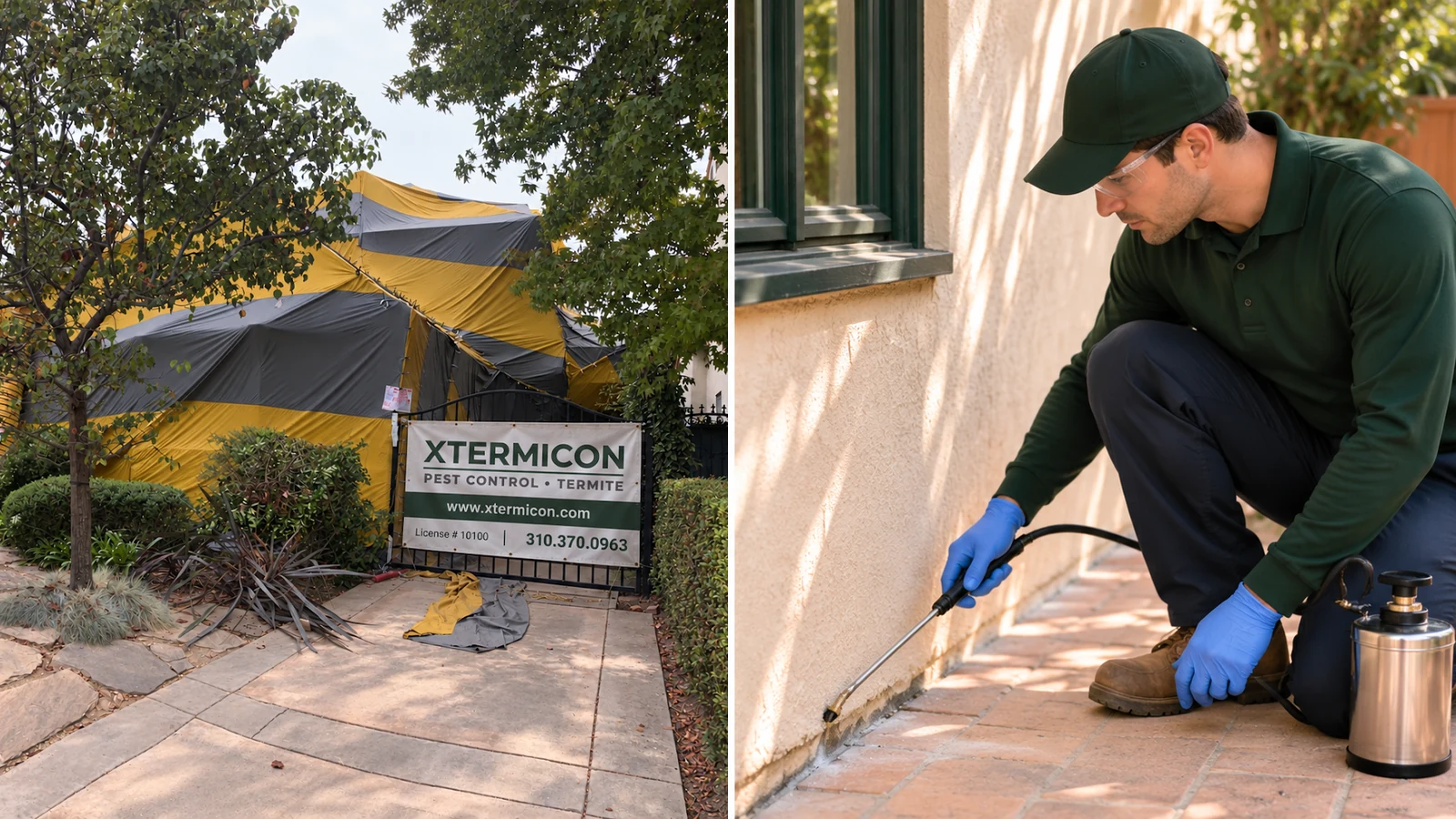
Most people hear the word "fumigation" for the first time standing in their own driveway, holding an inspection report. The inspector has pointed out the little piles of pellets under the window frame and the kick-out holes in the attic, and somewhere in the conversation the question comes up, usually from the homeowner and usually with a wince: do we have to tent? The picture that comes to mind is the striped tarp over the whole house, two nights in a hotel and bags of groceries sealed up on the counter. Sometimes that is the right answer. Often it isn't, and the reason comes down to what the inspection actually found.
Do I need to tent my house for drywood termites?
Not necessarily. Fumigation, or tenting, treats the whole structure at once and is the recommendation when drywood termite activity is widespread or sits in places that can't be reached, such as inside finished walls or framing that can't be opened up. When the activity is limited to specific areas that can be reached, local or spot treatment aimed at those areas is often the better fit. The choice comes from the inspection: how many areas are active, how spread out they are and whether the wood can be reached. Fumigation also takes more planning, since it is scheduled at least a week out so the household can prepare, while a local treatment can sometimes be done the same visit once you sign off.
The Short Version
- Tenting is a whole-house treatment for drywood termites. Local or spot treatment targets the specific areas where activity was found.
- Fumigation makes sense when activity is widespread or hidden where it can't be reached. Contained, reachable activity is a candidate for local treatment.
- The decision comes from the inspection, not a price sheet. Ask the inspector where the activity is and what couldn't be seen.
- Fumigation is scheduled at least a week out, takes a 50% deposit up front, and needs a neighbor's written consent if the crew has to use any of their property.
- If the termites are subterranean, tenting isn't the answer at all. They live in the soil and are treated differently.
What Each Option Actually Means
Drywood termites live inside the wood they eat. Unlike subterranean termites, they don't need contact with the soil, so a colony can sit in a window frame, a rafter or a piece of trim anywhere in the house. That's what makes the treatment decision tricky. You're not treating a nest in the yard. You're treating the wood the colony is living in, wherever that happens to be.
Local or spot treatment
A local treatment is aimed at the specific pieces of wood where the inspection found activity. Instead of treating the whole house, the technician treats the infested areas directly: the window frame with the pellets under it, the section of attic framing with the kick-out holes, the door casing that sounds hollow. The house stays a house. Nobody packs a bag, and nothing needs to be sealed up in the kitchen. Fumigation is sometimes necessary, but we evaluate and offer high-precision localized treatments when possible.
The trade-off is scope. A local treatment covers what was found and can be reached. If there's a second colony inside a wall nobody can see into, a local treatment of the first one won't touch it. That's why the quality of the inspection matters so much, and why periodic inspections afterward are worth keeping up.
Fumigation (tenting)
Fumigation treats the entire structure at once. The house is covered and sealed, a fumigant is introduced and held for a set period, and then the structure is aired out and checked before anyone goes back in. Because the fumigant reaches throughout the structure, it treats drywood termites in wood nobody could get to, including colonies the inspection couldn't see.
The trade-off here is disruption. The household has to leave, along with pets and plants, food and medicine have to be bagged or removed, and the whole thing has to be scheduled and coordinated. Fumigation also doesn't leave anything behind in the wood that keeps new termites out later. It deals with the termites that are there. Our step-by-step article on what happens during tenting walks through the day itself, and the fumigation prep guide covers what the household needs to do.
Fumigation is for drywood termites living in the structure. Subterranean termites live in the soil and are treated differently.
Fumigation is scheduled at least a week out so the household has time to prepare.
If the crew has to use even a foot of a neighbor's property, that neighbor's written consent is needed.
What the Inspection Is Really Deciding
The question isn't which option is better in general. It's which one fits what's in this house. That comes down to a few things the inspector is looking at, and they're worth understanding, because they're also the questions you should ask when you get the report.
How many areas are active
Activity in one window frame is a different situation from activity in the attic, the garage, three window frames and the eaves on two sides of the house.
How spread out it is
Several active spots clustered in one part of the house can sometimes be handled locally. The same number scattered all over the structure points toward fumigation.
Whether the wood can be reached
Local treatment needs access to the infested wood. Activity inside finished walls, enclosed soffits, wall voids or framing that can't be opened makes a local treatment hard or impossible to do properly.
What couldn't be inspected
Every inspection has limits: attic areas with no clearance, finished ceilings, stored belongings against walls. The more that couldn't be seen, the more weight goes on what might be hiding there.
Whether it's drywood at all
Fumigation is for drywood termites. If the inspection finds subterranean termites, the treatment is aimed at the soil where they're getting in, and tenting doesn't address that.
Notice what isn't on that list: the price. The recommendation should come from where the termites are and whether they can be reached, and the cost follows from that. With us, treatment is priced only after the inspection, for exactly that reason. You get a written report with a diagram of the house, notes on what was found and where, and the cost of the recommended treatment, and you decide from there whether to go ahead.
Questions worth asking about your report
Where exactly is the activity?
Ask to see it on the diagram, and ask how many separate areas were found.
Is it drywood, subterranean, or both?
The answer changes the treatment completely. Our drywood vs. subterranean article explains the difference.
What couldn't be inspected, and why?
Inaccessible areas are part of the picture, not a footnote.
If local, which areas will be treated?
You should come away knowing exactly which wood is being treated.
If fumigation, why isn't local enough?
A good answer refers to the extent of the activity and whether it can be reached.
What "can't be reached" looks like in a real house
In Southern California homes, the hard-to-reach spots tend to be the same ones: framing behind finished drywall and plaster, wood sealed under stucco, enclosed eaves and soffits, built-in cabinetry, and the parts of an attic where the roof pitch leaves no room to crawl. Pellets coming out of a baseboard or a crack in the drywall are a common sign that the colony is somewhere behind the finished surface rather than in wood you can see. One spot like that doesn't rule out a local treatment. Several of them, in different rooms, start to tip the balance.
Condos, Townhomes and Shared Walls
Attached housing changes the decision. In a condo or townhome, the wood between units is shared, and a drywood colony doesn't stop at the property line inside a wall. A local treatment can still make sense when activity is contained in wood that belongs to one unit and can be reached from inside it. When activity is in shared framing, a common attic or several units, the conversation usually moves to the building as a whole.
Fumigating an attached building means every unit under that roof is part of the job, with every household preparing and leaving at the same time. That is a decision for the association and its manager rather than one owner, and it takes longer to arrange. If you live in a community association and your unit's inspection finds drywood termites, let the manager know early, because what's in your wall may also be in your neighbor's.
What Happens After You Say Yes
If it's a local treatment
Local treatment is the faster path. Once you sign off on the recommendation, it can sometimes be done during the same visit as the inspection, depending on what was found and what the treatment involves. Otherwise it's scheduled like any other service appointment. There's no tarp, no hotel and no bagging the pantry.
If it's fumigation
Fumigation is scheduled at least a week out, so the household has time to prepare and the crew can plan the job. A 50% deposit is taken up front when it's booked. Before the day, the household works through the prep: arranging somewhere to stay, taking pets and most plants out, and bagging food, medicine and other consumables or removing them from the house. Our fumigation prep guide lists all of it.
One requirement catches people by surprise. Tenting a house means the crew needs room to work around it, and in a lot of Southern California neighborhoods, particularly on narrow beach-city lots and in older tracts where houses sit close to the property line, that room may be on the neighbor's side. If the crew has to use even a foot of a neighbor's property, the neighbor's written consent is needed before the job can go ahead. It's worth having that conversation with the neighbor early rather than the week of.
Talk to the neighbor early
If your house sits close to the property line, ask during the inspection whether the crew would need to use the neighbor's side for a fumigation. If so, their written consent is required before the job can be scheduled. A friendly heads-up a couple of weeks ahead goes a long way, especially if their side yard has plants or a fence the crew will need to work around.
After Either Treatment
Neither option makes a house termite-proof. Drywood termites swarm in Southern California, and new colonies can start in any exposed, unprotected wood. After a local treatment, the areas that weren't treated are still open to new activity, and after fumigation, nothing in the wood keeps new termites out. That isn't a flaw in either approach. It's how drywood termites work, and it's why people who have had termites once tend to keep an eye on the house afterward.
Sweep up the old pellets
Clean up existing piles after treatment, so any new pellets that show up later are easy to spot.
Keep exterior wood painted or sealed
Bare, weathered wood on eaves, fascia and window trim is easier for swarmers to get into.
Screen attic and foundation vents
Intact screens make it harder for swarmers to reach the wood inside.
Watch for swarmers
Winged termites or piles of wings indoors are worth reporting. Our swarmers vs. flying ants guide helps you tell what you found.
Get inspected periodically
A regular inspection catches new activity while it's still small, which is usually when local treatment is an option.
We also offer annual termite control, with terms that vary by home. Whether it makes sense for yours is something to talk through after the inspection.
Got a termite report and a decision to make?
If you're looking at a report and trying to decide between tenting and a local treatment, we're happy to talk it through. Xtermicon is a family-owned, licensed termite and pest control company working across the South Bay, the Westside and greater Los Angeles. Call (310) 370-0963; quotes are free over the phone, with no obligation.
Tenting vs. Local Treatment FAQs
Is local termite treatment as effective as fumigation?
For the areas it treats, it can be. The difference is scope. A local treatment covers the infested wood that was found and can be reached, while fumigation treats the whole structure, including wood nobody could see into. When activity is contained and accessible, local treatment is often the better fit. When it's widespread or hidden, fumigation is usually the recommendation.
How do I know if my termite problem is too big for spot treatment?
The inspection tells you. Activity in many separate areas, activity spread across different parts of the house, or activity inside walls and framing that can't be opened all point toward fumigation. Ask the inspector to show you where each area is on the report's diagram, and what parts of the house couldn't be inspected.
Does tenting kill subterranean termites?
Fumigation is a treatment for drywood termites living in the structure. Subterranean termites live in the soil and travel up into the house through mud tubes, so they're treated where they're getting in, at the soil. If your inspection finds subterranean termites, the treatment plan will look different. Our drywood vs. subterranean article explains how to tell the two apart.
How far ahead do I need to book a fumigation?
Fumigation is scheduled at least a week out, which gives the household time to prepare and the crew time to plan. If your house sits close to the property line and the crew needs to use part of the neighbor's property, their written consent is needed first, so start that conversation early.
Can a local treatment be done during the inspection visit?
Sometimes. Once you sign off on the recommendation, a local treatment can occasionally be done during the same visit, depending on what was found. Otherwise it's scheduled as a separate appointment, and there's no need to leave the house or bag food the way there is with fumigation.
Will termites come back after fumigation?
Fumigation deals with the drywood termites in the structure at the time, but it doesn't leave anything in the wood that keeps new termites out. New swarmers can start colonies later, which is why keeping exterior wood painted, vents screened and inspections up to date matters after any treatment.
Related Reading
The rest of the drywood termite picture.
- What happens during termite fumigationThe tenting day, step by step.
- How to prepare for termite fumigationThe household checklist for the days before a tenting.
- Drywood vs. subterranean termitesWhy the two species need different treatment.
- Drywood termiteIdentification and signs, in the pest library.
- Termite inspectionWhat the inspection covers and what the report includes.
- Termite controlLocal and spot treatments, fumigation when it's necessary, and soil treatment for subterranean termites.
Sydney Pardey is the owner of Xtermicon, a family-owned pest control company serving the South Bay and greater Los Angeles area since 2015. All content is written from direct operational experience and reviewed against current California Structural Pest Control Board standards.
Specialists you
can count on.
Xtermicon was founded in 2015 with one focus: protect Southern California homes and businesses from the pests that threaten them. The name says it all — eXterminate TERmites & pest CONtrol — and that's exactly what we do. We're a family-owned team specializing in termite control, pest control, and rodent exclusion. From West LA and East LA to the beach cities and Orange County, we're local neighbors who treat your property like our own.