Red Imported Fire Ants in Southern California: What They Are and Why They're Worth Taking Seriously
Fire ants are nothing like the Argentine ants in your kitchen, and the first rule is not to poke the mound.
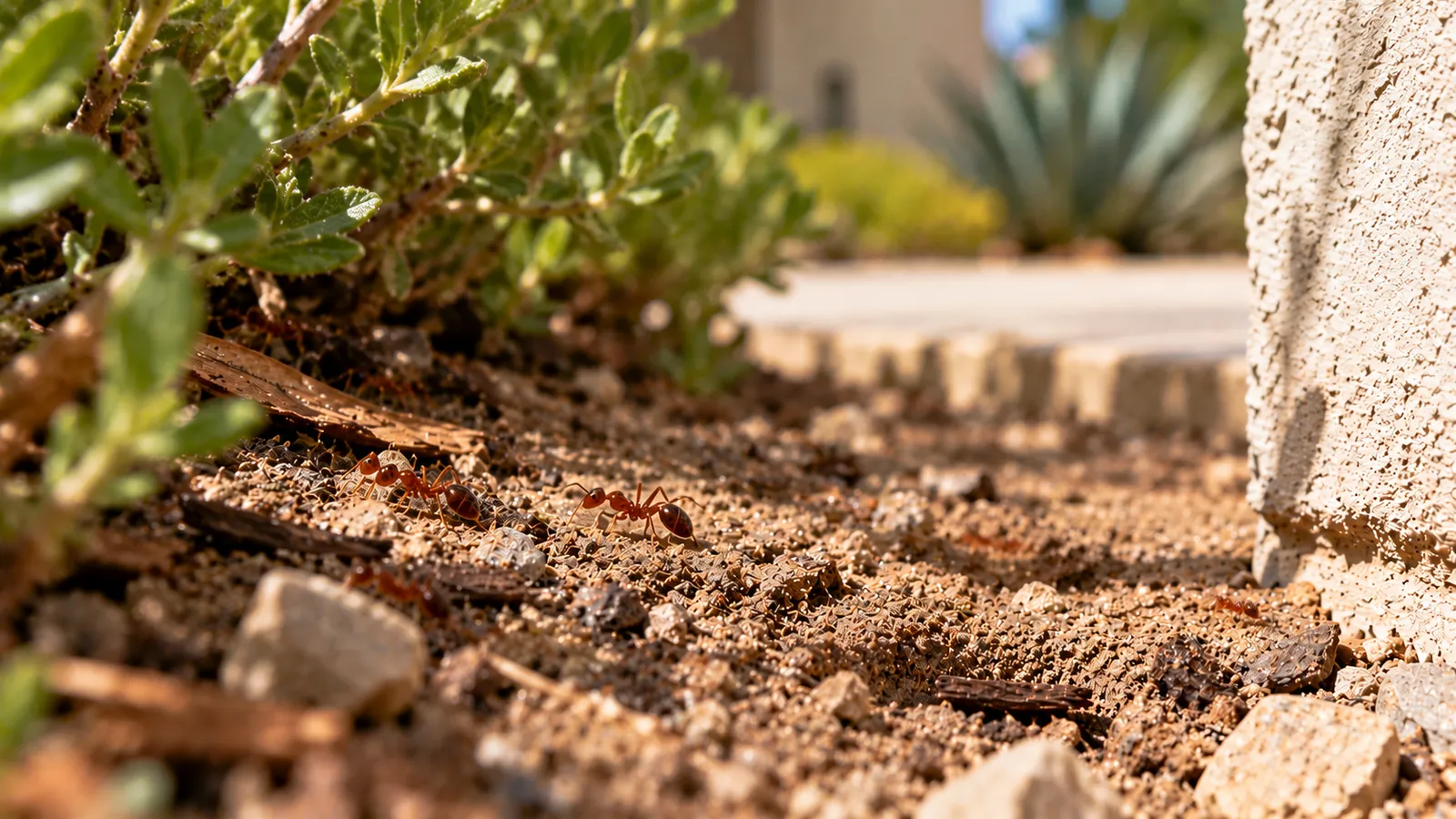
Most people in Southern California have a settled relationship with ants. They show up in the kitchen in a thin, determined line, you wipe them up, you call someone, life goes on. Nobody has ever been chased by an Argentine ant. Red imported fire ants are a different conversation. You don't usually find out you are standing on a fire ant mound by seeing the ants. You find out a few seconds later, when dozens of them have climbed your shoe and your ankle and sting at more or less the same moment.
What are red imported fire ants, and are they in Southern California?
Red imported fire ants are an invasive, reddish-brown ant from South America that builds loose dirt mounds and defends them aggressively, with a burning sting that leaves itchy welts and, a day or so later, small white pustules. State agricultural officials list all of Orange County and parts of Los Angeles and Riverside counties as quarantine areas, and the ants have turned up outside those zones before, including a 2024 infestation in Montecito that Santa Barbara County officials believe arrived on nursery stock. Unlike the Argentine ants most of us deal with, fire ants swarm out and sting when their mound is disturbed, which can be serious for people allergic to insect stings. A suspected mound is worth having identified rather than poked.
The Short Version
- Red imported fire ants are an invasive species. State officials list all of Orange County and parts of Los Angeles and Riverside counties as quarantine areas.
- They spread mostly with people, in nursery stock, sod, soil and landscaping material. Santa Barbara County's 2024 Montecito infestation is believed to have arrived that way.
- Look for loose, fluffy dirt mounds with no opening on top, often in irrigated lawns, and reddish ants of mixed sizes that pour out fast when disturbed.
- The sting burns, raises a welt and usually leaves a small white pustule. For anyone allergic to insect stings, it can be serious.
- Don't kick, flood or pour anything on a suspected mound. It provokes an attack and can scatter the colony.
- Get a suspected mound identified, and ask your county agricultural commissioner or vector control district whether they want it reported.
What Is Going On With Fire Ants in California
Red imported fire ants, often shortened to RIFA, are native to South America and have spread widely across the southern United States over the past century. In California they have been established in parts of Southern California for years, and state agricultural officials have placed all of Orange County, plus parts of Los Angeles and Riverside counties, under a quarantine.
The Montecito case shows how a find outside those areas happens. In July 2024, Santa Barbara County's agricultural commissioner announced an infestation on a private property there, which officials believed began with infested nursery stock shipped in from Riverside County the previous September. At the time it was the only known infestation in the county, and the county was treating the site and monitoring it. Fire ants can spread a short way on their own, but the long jumps almost always involve people moving plants, sod or soil.
Colonies and queens hitch rides in nursery stock, potted plants, sod, soil, mulch and landscaping material, and on equipment that has been sitting on infested ground. That is the reason the quarantine exists: it regulates the movement of the kinds of material that can carry a colony out of an infested area. For a homeowner, the practical takeaway is to buy plants, sod and soil from reputable sources, and to keep an eye on new landscaping for the first few months after it goes in.
How to Tell a Fire Ant From the Ants You Usually See
The ant most Southern California homeowners deal with is the Argentine ant, which we have covered at length elsewhere. Once you know what to look for, fire ants look and behave very differently.
Color
Fire ants are reddish-brown to coppery, often with a darker rear section. Argentine ants are a uniform dull brown.
Size, and the mix of sizes
Fire ant workers from a single mound come in a range of sizes, from small to noticeably larger. Argentine ant workers are small and all look alike. A mix of sizes coming out of one nest is one of the most useful clues.
The nest
Fire ants build mounds. Argentine ants don't; they nest under mulch, stones and pavers, and in wall voids, with nothing visible on top.
Behavior
Disturb a fire ant mound and workers pour out fast and climb anything touching it. Disturb Argentine ants and they scatter or reroute the trail.
The sting
Fire ants sting, and it hurts. Argentine ants don't sting at all.
The mound
Fire ant mounds are made of loose, crumbly, fluffy-looking soil, a bit like a patch of freshly worked garden dirt. They range from small bumps to sizeable domes and often pop up or grow after rain or heavy irrigation. The detail that surprises people is that there is usually no hole in the top. The ants come and go through underground tunnels that open some distance away, so a fire ant mound can look completely quiet right up until someone steps on it.
Ants from one mound come in a range of sizes. Argentine ant workers are all the same small size.
Loose, fluffy soil with no opening on top. The ants travel through tunnels underneath.
Each ant grips with its jaws and stings, often more than once, and many sting at once.
Other ants here that sting
Fire ants aren't the only ants in California that sting. There is also a native fire ant species, and harvester ants, which clear large bare patches around a nest with an obvious central opening, can sting painfully too. That is one more reason to get a photo or a sample identified rather than assuming. The response to a native ant and to an invasive, quarantined one isn't the same.
Why the Sting Is Different
Fire ants defend their mound as a group. When the nest is disturbed, workers boil out and climb whatever is touching it, usually a shoe or an ankle, and they don't sting the instant they arrive. They spread out, grip the skin with their jaws, and then sting, often several times each. The result is a cluster of stings landing at almost the same time, which is why a fire ant encounter feels nothing like a single ant bite.
The sting burns, which is where the name comes from, and raises an itchy welt. Within a day or so, a small white pustule usually forms at each sting site. Leave those alone; scratching or breaking them open invites infection. For most people, the pain and itching fade over several days.
The real concern is allergic reactions. For people allergic to insect stings, fire ant stings can cause a serious reaction, and many stings at once raise the stakes for anyone. Small children, older adults and pets are more vulnerable simply because they can't move away as quickly and may take more stings before anyone notices. This is general information, not medical advice. If you have a known sting allergy, talk to your physician about what to keep on hand, and contact a doctor or your county public health department with questions.
When a sting is an emergency
Call 911 if someone stung by fire ants has trouble breathing, swelling of the face, lips or throat, dizziness or fainting, or a widespread rash, or if a small child or anyone with a known sting allergy has been stung many times. Those can be signs of a severe allergic reaction.
Where Fire Ants Tend to Turn Up
Fire ants like open, sunny, disturbed ground with reliable moisture, which in Southern California describes a lot of the places people spend time outdoors.
Irrigated lawns and turf
Front lawns, parkways, parks, school fields, golf courses and sports fields.
Landscaped areas
New plantings, nursery stock, sod, planters and commercial landscaping, especially where material was brought in from elsewhere.
Along hard edges
The edges of sidewalks, driveways, curbs and patios, where soil meets concrete.
Around equipment
Electrical boxes, irrigation valve boxes, AC units and other utility equipment. Fire ants are known for nesting in and around electrical housings, and they can damage what is inside.
After rain or watering
Mounds often appear or grow right after rain or heavy irrigation, when the soil is easy to work.
They are mostly an outdoor ant. Workers sometimes forage indoors at ground level, through slab cracks or gaps near doors, but a fire ant nest inside a living space is unusual.
Please Don't Kick It, Flood It, or Pour Anything on It
The instinct with any ant mound is to do something to it, right now. With fire ants, every common version of that instinct backfires.
Kicking or stepping on it
That's exactly what triggers the mass attack, and the mound looks like nothing more than loose dirt.
Flooding it with a hose or boiling water
The colony extends well below the mound, and the queens are deep. You provoke the ants, scald the lawn, and may send the colony off to build a new mound a few feet away.
Pouring fuel or household chemicals on it
Dangerous to you, harmful to the soil and to anything downhill, a fire risk, and still unlikely to reach the queens.
Retail ant sprays
A surface spray kills the ants it hits and can push the colony to move or split, which spreads the problem rather than solving it.
Digging it up or moving the soil
Besides the stings, moving soil from an infested spot is exactly how fire ants get spread to new places.
What to Do If You Think You've Found One
Keep people and pets away
Mark the spot if you need to, and keep kids and dogs off that part of the yard until you know what it is.
Take a photo from a distance
Get the mound and, if you can do it without disturbing anything, a few ants on a nearby surface.
Note where and when
Where it is in the yard, what is nearby (new sod, a valve box, recent planting), and when you first noticed it.
Get it identified
A licensed pest control professional can tell you whether you are looking at red imported fire ants, a native species, or something else entirely.
Ask whether it should be reported
Your county agricultural commissioner's office or local vector control district may want to know about suspected fire ants, especially in a new area, and can tell you how reports are handled where you live.
Treat based on what was found
If treatment is needed, the method should match the species and the site, not whatever was on the hardware store shelf.
On the treatment side, we approach fire ants the way we approach ants generally: the method, whether spray, bait or both, is decided by the species and what the inspection finds, and it is applied with kids and pets in mind. There are limits, though. Where fire ants are established, they are controlled rather than eliminated, and new colonies can move in from neighboring properties. A single mound is one thing; ongoing pressure is where recurring service and monitoring make sense.
Found a mound you don't like the look of?
Don't poke it. Xtermicon is a family-owned, licensed pest control company serving the South Bay, the Westside and greater Los Angeles. Call (310) 370-0963 to describe what you are seeing; quotes are free over the phone, with no obligation.
Fire Ant FAQs
What do fire ant stings look like?
At first, a cluster of red, raised, intensely itchy or burning welts, often grouped where several ants stung at once. Within a day or so, small white or yellowish pustules usually form at the sting sites. Don't break them open. If the reaction spreads well beyond the stings, or involves trouble breathing or swelling of the face or throat, get medical care right away.
Do Argentine ants sting?
No. Argentine ants, the small brown trailing ants that show up in most Southern California kitchens, don't sting. They can technically bite, but most people never notice it. If ants are stinging you, especially near a mound of loose soil, that alone is a reason to get them identified.
Can fire ants get inside my house?
Occasionally. Fire ants are mainly an outdoor species, but foragers can come in at ground level through slab cracks, gaps under doors and utility openings, especially when a mound is close to the house. An indoor nest is unusual. Seeing fire ants inside more than once is worth a professional look.
Should I report a fire ant mound?
It is worth asking. Red imported fire ants are under agricultural quarantine in parts of Southern California, and your county agricultural commissioner's office or local vector control district may want to know about suspected mounds, particularly in areas where they haven't been found before. They can tell you how reports are handled where you live.
Are fire ants dangerous to dogs and cats?
They can be. Dogs in particular tend to investigate mounds with their noses and paws and can be stung many times very quickly. Watch for swelling of the face or muzzle, pawing at the face, drooling, vomiting or lethargy after a possible encounter, and call your veterinarian. Keep pets away from a suspected mound until it has been dealt with.
Will one treatment get rid of fire ants?
It may knock out the mound you can see, but where fire ants are established, new colonies can move in from neighboring properties and common areas. Fire ants are controlled rather than eliminated, so a recurring approach with ongoing monitoring is usually more realistic than a single visit.
Related Reading
For the ants you are more likely to meet, and how we handle them.
- How to get rid of ants in the houseWhat actually works for the everyday ants of Southern California.
- The Argentine ant guideThe tiny invader behind most kitchen ant trails, and how it differs from fire ants.
- Why ants keep coming backWhy Argentine ants get worse in the heat, and why one-time treatment rarely holds.
- Fire antsIdentification notes in the pest library.
- Ant controlHow we approach ants, from inspection to recurring service.
- What bit me?A guide to common bites and stings, and when to see a doctor.
Sydney Pardey is the owner of Xtermicon, a family-owned pest control company serving the South Bay and greater Los Angeles area since 2015. All content is written from direct operational experience and reviewed against current California Structural Pest Control Board standards.
Specialists you
can count on.
Xtermicon was founded in 2015 with one focus: protect Southern California homes and businesses from the pests that threaten them. The name says it all — eXterminate TERmites & pest CONtrol — and that's exactly what we do. We're a family-owned team specializing in termite control, pest control, and rodent exclusion. From West LA and East LA to the beach cities and Orange County, we're local neighbors who treat your property like our own.