Why Ant Problems Get Worse in the Heat — and Why One-Time Treatment Rarely Works
You sprayed the trail, it disappeared for four days, and now they are coming in somewhere else. That is not a failed product. It is what happens when you treat a colony network by its visible edge.
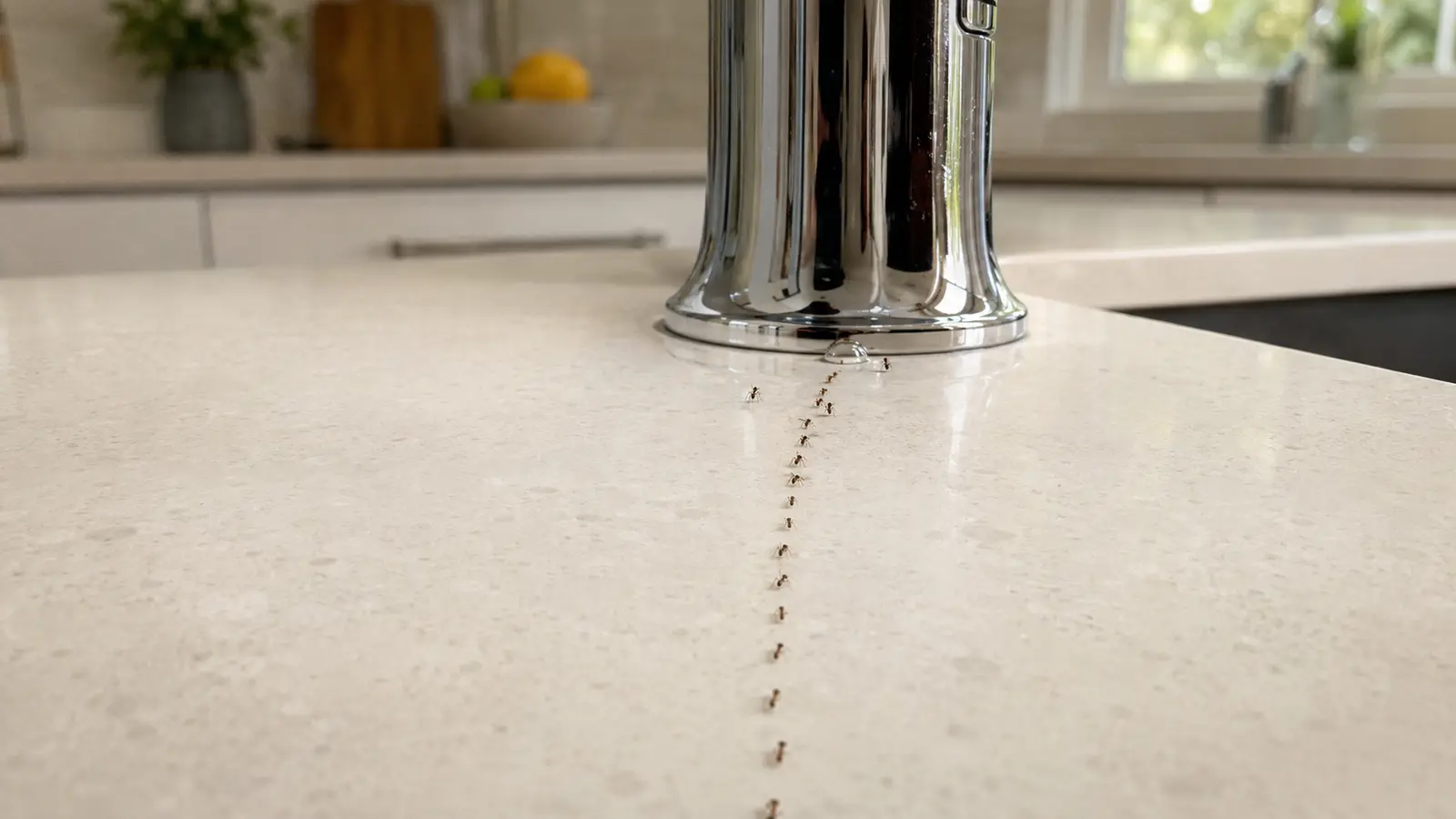
The call we get most often in September is not from someone who has never treated for ants. It is from someone who has. They sprayed the trail along the baseboard, watched it vanish within the hour, enjoyed four or five clean days, and then found a new line running up the dishwasher gasket on the other side of the kitchen. The natural conclusion is that the product did not work, or that this house is somehow worse than the neighbors. Neither is usually true. What actually happened is that the treatment did exactly what it was capable of doing, and the thing it was aimed at was never the problem.
Why do ants keep coming back after treatment?
Because the ants you can see are a small, replaceable fraction of a colony network that mostly lives outdoors and off your property. In Southern California, the species behind most home invasions is the Argentine ant, whose colonies contain many egg-laying queens and cooperate with neighboring nests rather than fighting them — so removing a visible trail does not reduce the population that produced it. Late-summer heat compounds the problem by pushing that population indoors in search of moisture. Lasting control comes from treating inside and outside together on a recurring cadence, so the pressure gets knocked back repeatedly as it rebuilds, rather than once.
The Short Version
- Late-summer ant pressure is driven by water more than food. As soil dries out, foraging shifts toward the wettest places available, which is why trails end at sinks, dishwashers, condensate lines, and shower drains.
- Argentine ants — the dominant invader here — are structured differently from the one-queen, one-nest species most people picture. Many queens, many interconnected nests, no fighting between them.
- That structure is the reason a single treatment does not hold. You are removing foragers from a network that keeps producing them.
- Exterior-only service is the single most common cause of ant call-backs. Treating only outside can push activity in rather than out. Interior and exterior have to be handled together.
- Quarterly service is the right starting cadence for typical ant pressure. Monthly is worth considering for a severe or persistent problem that quarterly is not keeping up with.
- Ants in this region are controlled, not eliminated. Anyone promising permanent removal of an Argentine ant population is describing something that does not exist here.
Heat Sends Them Looking for Water, Not Crumbs
There is a persistent idea that ants indoors means a cleanliness problem. It is one of the least accurate beliefs in pest control, and September is when it falls apart most obviously — because the homes calling us are frequently spotless, and the trails frequently lead somewhere with no food at all.
What changes in late summer is the outdoor moisture budget. Weeks of heat with no meaningful rain dry out the top layer of soil, and the mulch beds, leaf litter, irrigation seams, and planter edges where ants normally find water stop supplying it reliably. A colony under that pressure does what any organism does: it expands its foraging range until it finds a source that does not run out. In a Southern California neighborhood, the most dependable water within reach of an outdoor nest is inside the buildings.
This is why the geography of a late-summer ant call is so consistent. It is rarely the pantry. It is the kitchen sink, the dishwasher door seal, the base of a faucet, the drip line behind the refrigerator, a bathroom vanity, the shower drain, a pet water bowl. Follow a September trail and it usually terminates at moisture. Food is opportunistic along the way.
Sinks and their cabinets
Condensation on supply lines, a slow trap drip, and a damp cabinet floor make the space under a sink the most reliable indoor water source in most homes — and the plumbing penetration in the cabinet wall is a direct route in from the exterior.
Dishwashers and refrigerators
Both hold residual water and both sit against a wall with a supply line running through it. Door gaskets, drip pans, and defrost drain lines all stay damp between uses.
Bathrooms
A room that is wet on a daily schedule, with plumbing chases connecting it into the wall structure. Trails to a shower drain or a vanity base are extremely common and almost never about food.
Air conditioning condensate lines
An overlooked one, and specific to this season. A running system produces a steady trickle of water where the line discharges, which is an outdoor attractant sitting directly against the structure.
Pet bowls and drip trays
Standing water at floor level, refreshed daily. Worth noting that these draw ants for the water at least as much as for the food.
The Colony You Can See Is Not the Colony
Here is where most homeowner intuition goes wrong, and it is not the homeowner's fault — it is that the mental model almost everyone carries is drawn from a different kind of ant.
The picture most people have is a single mound with a single queen at the center. Find the nest, treat the nest, problem over. That model is broadly right for a number of species, and it is the logic that makes a can of spray feel like a complete solution. It is close to useless for the ant actually walking across your counter.
Argentine ants are built the opposite way. A colony holds many egg-laying queens rather than one, and — this is the part with real consequences — workers from neighboring nests do not treat each other as rivals. Where most ant species defend a territory against their own kind, Argentine ants merge. Nests link into networks, networks link into larger ones, and entomologists studying the species in California have documented that cooperation extending across a very large stretch of the coast as one continuous population, among the largest such structures known anywhere.
You do not need the research detail to act on this. You need the practical translation: the ants in your kitchen are not a household colony that took up residence in your walls. They are the visible tip of a population that spans your yard, your neighbors' yards, and the parkway strip between them — and it is not organized in a way that has a single point of failure you can hit.
Not one. Removing workers, or even a queen, does not stop egg production the way it would in a single-queen species.
Neighboring Argentine ant nests cooperate instead of competing, which is what lets separate colonies function as one connected population.
A frost-free coastal climate means there is no dormant season to wait out. Pressure eases and returns; it does not stop.
Why One Treatment Buys Days, Not Seasons
Put the two halves together and the pattern that felt like bad luck becomes predictable. A treatment aimed at a visible trail removes foragers. Foragers are the most expendable and most rapidly replaced part of the structure. The nests that produced them are unaffected, still under the same heat pressure, still looking for the same water, and still connected to a network with plenty of capacity to send more.
So the trail goes quiet, which reads as success, and then activity resumes — often at a different entry point, which is what makes it feel like a new and separate problem rather than a continuation of the same one. It is the same population, rerouting.
There is a second failure mode worth naming, because it is the one that turns a manageable problem into a worse one. Repellent products bought off a shelf and applied heavily can stress a colony into splitting, a behavior called budding, where part of the group relocates and establishes elsewhere. The result is more trails in more places than before treatment. This is the most common way a homeowner accidentally makes an ant problem bigger, and it is why we would rather you call before the third can than after it.
The honest version of the goal
Ants here are controlled, not eliminated. The regional population is larger than any property, and treating your home does not remove it from the neighborhood. Think of it the way you think of lawn service — the grass keeps growing, and the job is keeping it where you want it rather than ending it permanently. Any company promising elimination of Argentine ants in Southern California is promising something the biology does not allow.
Exterior-Only Service Is Why Ants Come Back
Of everything on this page, this is the point we would most like homeowners to take away, because it explains the largest share of call-backs we see — including on properties that were already paying someone for service.
A perimeter-only program treats the outside of the structure and nothing else. On paper it sounds like the right idea: stop them before they get in. In practice, with a colony network already established against the building and interior activity already underway, treating only the exterior can push that activity further inside rather than out. The ants that are already in have less reason to travel back out, and the ones outside reroute to whatever gap is not covered. The homeowner experiences it as service that made things worse, and they are not imagining it.
Interior and exterior have to be handled as one job. That does not mean spraying every room — most interior work is targeted at the specific runs, voids, and penetrations the inspection actually found, and much of the volume is applied outside where the pressure originates. But an ant program that never treats inside is not an ant program, and exterior-only is the number one cause of ant call-backs in our experience.
How We Treat a Recurring Ant Problem
There is no single ant protocol, and any company running the same routine on every house is not inspecting. What the visit actually looks like:
Identify the species before choosing the method
Argentine, odorous house, pavement, and carpenter ants behave differently and respond to different approaches — and carpenter ants raise a moisture and wood question the others do not. The identification determines the treatment, not the other way around.
Trace the trails to the entry, not just the room
A trail is a directional clue. We follow it back to where it crosses the building envelope — a slab edge, an expansion joint, a plumbing or conduit penetration, a weep hole, a utility gap, a branch touching the roofline — because that is the point worth treating.
Treat inside and outside on the same visit
Spray, bait, or both, decided by the species and what the inspection found. The two do different jobs: bait is what reaches the queens, since workers carry it back and share it before it takes effect, while spray addresses the foragers and the routes they are using to get in. Which of those a property actually needs is what the inspection is for. Interior work is targeted at the active runs and voids it found rather than applied broadly.
Deal with the conducive conditions
The leaking fixture, the irrigation head soaking the foundation, the mulch bed built up over the slab line, the vegetation bridging the perimeter. These are the reasons pressure re-concentrates in the same spot, and no product substitutes for fixing them.
Come back on a schedule and adjust
Ant pressure moves with weather and with the season's shift between sweet and protein feeding. A recurring visit is where placements get refreshed, new routes get picked up, and the program gets adjusted to what the property is actually doing rather than what it was doing in September.
What Recurring Service Actually Fixes — and How Often
The case for a recurring plan with ants is not a sales argument dressed up as advice. It follows directly from the biology above. If the population rebuilds continuously and there is no winter that stops it, then the only thing that produces a durable result is repeated pressure over time, applied to a property whose weak points somebody already knows.
That is also, candidly, why our one-time general pest visits carry no service guarantee while our recurring plans are the path we recommend. It is not a fine-print trick — it is us declining to promise an outcome a single visit cannot deliver against this pest. A one-time visit is a legitimate purchase for a specific, contained problem, and we will happily sell you one. For Argentine ants in a Southern California neighborhood, it buys relief, not resolution, and we would rather say so up front.
On frequency: for typical ant pressure, quarterly service is the right place to start, and it is what most households here end up on. Four scheduled visits a year keep the perimeter and the known interior runs from going untreated long enough for the population to fully re-establish, and they put someone on the property often enough to catch a new route early. Monthly service is worth considering specifically when a problem is severe or persistent — when quarterly visits are followed by activity returning well before the next one is due. That is a real situation and monthly is the right tool for it. It is not the default answer for every ant problem, and we will tell you if we do not think you need it.
Still fighting the same trail?
If you have treated the same spot more than twice this summer, the issue is almost certainly what is outside the wall rather than what is on the counter. Xtermicon is family-owned, licensed and insured, and has worked ant pressure in the South Bay, the Westside, and greater Los Angeles since 2015. Call (310) 370-0963 for a quote — we can give you one over the phone, and there is no obligation to go ahead.
Recurring Ant Problem FAQs
What homeowners ask after the second or third round of ants in the same summer.
Why do I keep getting ants even though my house is clean?
Because late-summer ant pressure is driven by water, and a clean house has just as much of it as a messy one. As outdoor soil dries out, colonies extend their foraging into buildings looking for reliable moisture, which is why trails end at sinks, dishwashers, and shower drains rather than in the pantry. Cleaning removes an opportunistic food reward along the route, which is worth doing, but it does not address the reason they came inside.
Does killing the queen get rid of the colony?
With many ant species it would help substantially. With Argentine ants it does not, because a colony holds many egg-laying queens rather than one, and neighboring nests are cooperating parts of the same broader population. There is no single point of failure to target. That is the specific biological reason this species is managed with sustained pressure rather than one decisive treatment.
Is quarterly enough, or do I need monthly ant service?
Quarterly is the right starting point for typical ant pressure and is what most households here settle on. Monthly is worth considering when a problem is severe or persistent — specifically, when activity comes back well before the next quarterly visit is due, rather than holding between them. That is a genuine reason to increase frequency. If your ant issue is seasonal and quarterly is holding it, monthly is not buying you much and we will say so.
Why did my ant problem get worse after I sprayed?
Repellent products applied heavily can stress a colony into budding — part of the group splits off and relocates rather than dying. What you experience afterward is more trails in more places than you started with. It is the most common way a homeowner accidentally enlarges an ant problem, and it is also why professional treatment mixes methods based on the species rather than reaching for the same product every time.
Can you just treat the outside? I would rather not have anything applied indoors.
It is a reasonable preference and worth raising with the technician, but understand the trade-off. Exterior-only treatment on a property with established interior activity can drive that activity further in rather than out, and it is the most common cause of ant call-backs we see. If indoor application is a concern, tell us — there is real flexibility in what gets used and where, including essential-oil-based options for particularly sensitive households, and targeted interior work is very different from broad spraying.
Will ants ever be gone for good?
Not in Southern California, and you should be skeptical of anyone who says otherwise. The regional Argentine ant population is far larger than any one property, and treating your home does not remove it from the block. What recurring service does is keep your structure from being the path of least resistance to water and food, so the pressure stays outside where it belongs. Controlled, consistently — not eliminated.
Related Reading
The identification, the step-by-step, and the service behind ant control here.
- How to get rid of ants in the houseThe practical, step-by-step version — what to do first and what to stop doing.
- The Argentine ant guideFull background on the species behind most Southern California ant calls, including the scale of the regional supercolony.
- Argentine ants: species profileIdentification, behavior, and how to tell them from the other ants you might be seeing.
- Our ant control serviceWhat an ant program covers, inside and out.
- Residential pest controlRecurring plans for homes across the South Bay, Westside, and greater Los Angeles.
- Why your pest control is not workingThe broader version of this problem, across pests other than ants.
Sydney Pardey is the owner of Xtermicon, a family-owned pest control company serving the South Bay and greater Los Angeles area since 2015. All content is written from direct operational experience and reviewed against current California Structural Pest Control Board standards.
Specialists you
can count on.
Xtermicon was founded in 2015 with one focus: protect Southern California homes and businesses from the pests that threaten them. The name says it all — eXterminate TERmites & pest CONtrol — and that's exactly what we do. We're a family-owned team specializing in termite control, pest control, and rodent exclusion. From West LA and East LA to the beach cities and Orange County, we're local neighbors who treat your property like our own.