Carpet Beetles vs. Clothes Moths: The Fabric Pests You Might Bring Out With Fall Storage
Small holes in a wool sweater you haven't worn since March? How to tell which of the two usual suspects did it, and how to store things so it doesn't happen again.
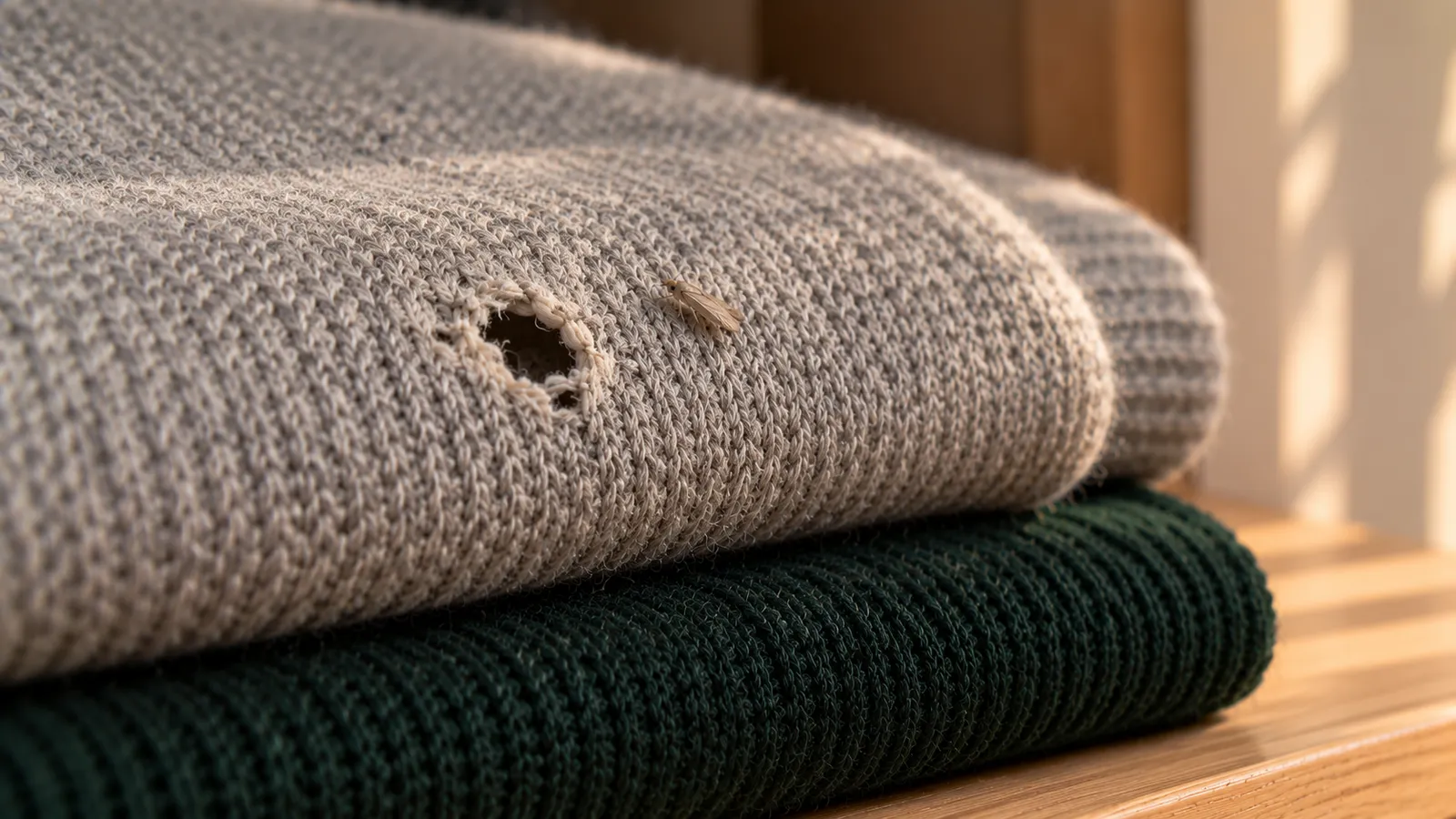
Sweater weather in Southern California is short, so the sweaters spend most of the year in a bin. Then one cool morning you pull out the good wool cardigan, hold it up, and the light comes through in places it shouldn't. A small, ragged hole at the elbow. Two more near the hem. In the fold at the bottom of the bin, something that looks like a tiny, bristly caterpillar, or a few papery husks that look like one. Nobody touched that cardigan for seven months. Something else did.
What is eating holes in my stored sweaters, carpet beetles or clothes moths?
Usually one or the other, and in both cases the larvae do the damage, not the adults. Carpet beetle larvae are small, fuzzy, banded and bristly, and leave empty shed skins behind as they grow. Clothes moth larvae are pale, soft caterpillars that often leave silky webbing or small cases on the fabric. Both feed on animal fibers like wool, silk, cashmere, fur and feathers, and both do best in items that sit undisturbed for months, especially if they were stored with sweat or food residue on them. Cleaning items before storage and keeping them in sealed containers prevents most of the damage.
The Short Version
- The adults aren't the problem. Carpet beetle larvae and clothes moth larvae do all the eating.
- Carpet beetle larvae are bristly and banded and leave shed skins. Clothes moth larvae are pale and leave webbing or little cases.
- Both go after animal fibers (wool, silk, cashmere, fur, feathers, felt) plus pet hair and lint in corners.
- Stored clothing is ideal for them because nothing disturbs it for months. Stains and body oils make it more attractive.
- Clean before storing, use airtight containers, and check stored textiles a few times a year.
- Damage in more than one closet or room usually means a source beyond the closet. That is when a professional look makes sense.
Who's Who in the Closet
These two get blamed for each other's work all the time, partly because the damage looks similar and partly because most people never see the culprit. Both are secretive, both avoid light, and in both cases the stage doing the damage looks nothing like the adult.
Carpet beetles
Adult carpet beetles are small, rounded beetles, smaller than a ladybug. The most common kind has a mottled pattern of white, brown and yellowish scales, almost like a tiny calico; another is plain shiny black or dark brown. Adults feed on pollen and nectar outdoors, and they are attracted to light, so the place you are most likely to notice them is on a windowsill, trying to get out.
The larvae are the ones eating your sweater. They are small, carrot-shaped and covered in stiff bristles, often banded light and dark brown, with a tuft of longer hairs at the back end. People describe them as tiny woolly caterpillars. They move slowly, avoid light, and shed their skins several times as they grow, and those hollow, bristly skins are often the first evidence anyone finds.
Clothes moths
Clothes moths are small and plain: narrow, golden-buff wings, and in the most common species a little tuft of reddish hair on the head. Unlike most moths, they avoid light. You won't find them circling a lamp. What you see instead is a small moth fluttering weakly out of a closet when you move the hangers, or running into a fold of fabric rather than flying.
The larvae are creamy white caterpillars with a darker head. One common species spins silky patches and tunnels across the fabric as it feeds; another builds a small portable case out of silk and fibers and carries it around. Either way, the silk is a strong clue that you are dealing with moths rather than beetles.
Adult carpet beetles eat pollen. Adult clothes moths don't feed at all.
The protein in wool, silk, fur, feathers and hair. Plain cotton and synthetics are mostly left alone unless soiled or blended.
Bins, closets, under furniture, and anywhere lint and pet hair build up undisturbed.
Not to be confused with
If the moths you are seeing fly around the kitchen at night and land near the pantry, those are almost certainly pantry moths, which eat stored food, not clothes. Our pantry pests article covers them. Silverfish can also damage fabric, especially starched cotton and linen, along with paper and book bindings, but they are fast, silvery and wingless, and we have a separate piece on them. All three are "found in storage" pests, but the biology and the fix are different for each.
Why You Find the Damage in the Fall
In much of the country, wool comes out in October and goes back in April, a six-month rotation that at least gets everything handled twice a year. Here, the cold season is shorter and less reliable, and a lot of heavier clothing gets worn a handful of times, then sits. That long, quiet storage stretch is exactly what these larvae need.
Items packed away in spring often go in after being worn once or twice, which seems clean enough but leaves body oils, sweat and the occasional food spot behind. Those residues make fabric much more attractive and more nutritious to the larvae. Then the bin goes into a closet, under a bed or into the garage, where warm summer temperatures can speed insect development along. By the time the weather turns and the bin comes back out, the larvae have had months.
Cardboard boxes, garment bags that don't close fully, open shelves and bins with loose lids all let insects in. The adults are small enough to slip through gaps you wouldn't notice.
Clean Houses Get Them Too
People are often embarrassed to find fabric pests, and they shouldn't be. These insects are not attracted to dirt in the usual sense. They are attracted to animal protein, and a very clean house has plenty of it: wool rugs, a down comforter, a felt hat, a cashmere scarf, the pet hair that collects under the sofa, the lint that builds up in a heating vent.
Stains make a big difference, though. A wool sweater with a faint spill on it is more appealing than a clean one, and cotton or synthetic blends that would normally be ignored can get damaged in a stained area. That is why "clean before storing" is the single most useful prevention step.
It helps to take stock of what in your house counts as food for them, because it's usually more than people expect: wool rugs and runners, down pillows and comforters, felt hats, a yarn stash, wool-blend upholstery, natural-bristle brushes, the fur collar on an old coat, decorative feathers, even the felt inside a piano. Most of those are fine as long as they get used, moved or cleaned regularly. The ones at risk are the ones that just sit.
Carpet beetles in particular can also be coming from somewhere you would never think to look: an accumulation of dead insects in a light fixture or window track, an old nest or a dead rodent in an attic or wall void. If you keep finding adults on the windowsills every spring and larvae in more than one room, the source may not be in the closet at all.
How to Tell Which One It Was
Silky webbing, tunnels or small cases
Clothes moths. Look in folds, under collars and along seams, where the larvae like to work out of sight.
Hollow, bristly shed skins
Carpet beetles. They often collect at the bottom of a bin or drawer, or in the folds of a garment.
Tiny pellets the same color as the fabric
Usually clothes moth droppings. Larvae feeding on a red sweater leave red frass.
Irregular holes scattered across one area
Either one. Carpet beetle damage tends to be more scattered and ragged; moth damage often concentrates in hidden spots.
Bare patches on a wool rug
Either one, usually along edges and under furniture, where nobody vacuums and nothing gets walked on.
Itchy skin and the bed bug scare
The bristles on carpet beetle larvae can irritate some people's skin, and the resulting itchy bumps are sometimes mistaken for bites, including bed bug bites. That's one reason a bed bug inspection starts with confirming the insect really is a bed bug. If you have unexplained skin irritation, see a physician rather than assuming; this is general information, not medical advice.
Storing Fabrics So They're Still Whole Next Fall
Clean everything first
Wash or dry-clean wool, silk and other natural fibers before long-term storage, including the things you only wore once.
Use airtight containers
Plastic bins with tight, gasketed lids or sealed storage bags. Cardboard boxes and loose garment bags don't keep insects out.
Store inside the house if you can
A hall closet is better than a hot garage or attic, which run warmer and see more insect traffic.
Check stored textiles a few times a year
Take things out, shake them, brush wool along the grain, and let them air in sunlight. Larvae hate being disturbed and exposed.
Vacuum where lint lives
Closet floors and corners, under furniture, along baseboards, rug edges and vents. Empty the vacuum outdoors afterward.
Don't lean on cedar
Cedar smells nice and may have a modest effect while it's fresh, but the scent fades. It's not a substitute for sealed storage.
A word about mothballs
Mothballs are a pesticide, not an air freshener. Their labels require them to be used in tightly sealed containers, because the fumes are what does the work. Tossed loose into a closet or a drawer in a bedroom, they fill the room with vapor that nobody, including kids and pets, should be breathing day after day. If you use them at all, follow the label exactly. Clean, sealed storage does the job without them.
What to Do With the Things You Already Found
Bag the damaged items
Take them out of the closet right away in a sealed bag so larvae don't move to the next shelf.
Wash, dry-clean or freeze
Hot washing, a hot dryer or dry cleaning kills all life stages in items that can take it. For delicate pieces, a sealed bag in a deep freezer for several days does the same; let it thaw in the bag.
Clean the container and the closet
Vacuum thoroughly, wash out the bin, and wipe down shelves before anything goes back in.
Check the neighbors
Go through everything stored near the damaged item, especially wool, silk, fur and feathers.
Look for the source
Check rugs, under furniture, pet beds, vents and window tracks for larvae or shed skins.
Monitor
Sticky traps placed near closets and along baseboards help show whether activity is continuing. Pheromone traps for clothes moths catch males and are useful for monitoring, but they won't solve an infestation on their own.
When It's More Than One Sweater
One damaged sweater from one bin is usually a do-it-yourself job, and the steps above will handle it. It becomes worth a professional visit when you are finding damage in more than one closet or room, when wool rugs or upholstery are affected, when adult carpet beetles keep turning up on windowsills season after season, or when the larvae seem to be everywhere no matter how much you clean.
At that point, the job is mostly detective work. A technician inspects the areas of concern and looks for what is feeding the population, including spots you are unlikely to check yourself, like attic or subarea access and the dead insects that collect in light fixtures and window tracks. Treatment, where it is needed, is based on what the inspection finds, and it works best alongside the cleaning and storage steps above rather than instead of them.
Finding damage in more than one place?
Damage in a closet, a rug and a sofa usually means something is feeding outside the closet too. Xtermicon is family-owned and serves the South Bay, the Westside and greater Los Angeles. Call (310) 370-0963 and tell us what you're finding; quotes are free over the phone, with no obligation.
Carpet Beetle and Clothes Moth FAQs
Do carpet beetles bite?
No. Neither the adults nor the larvae bite people. The bristly hairs on the larvae can irritate sensitive skin, which sometimes leads to itchy bumps that get mistaken for bites. If you have unexplained skin irritation, a physician can help sort out the cause.
Why do I keep finding small beetles on my windowsills?
Those are very likely adult carpet beetles. Adults are attracted to light and head for windows, often because they are trying to get outdoors to feed on flower pollen. A few in spring is common. Steady numbers every year suggest larvae are developing somewhere inside, and it is worth checking closets, rugs and other stored textiles.
Does freezing really kill clothes moths and carpet beetles?
Yes, if it is cold enough and long enough. Seal the item in a plastic bag, put it in a deep freezer for several days, and let it come back to room temperature inside the bag so condensation forms on the plastic instead of the fabric. A refrigerator or a quick stint in a kitchen freezer that gets opened constantly is less reliable.
Do clothes moths eat cotton or polyester?
Not usually on their own. Clothes moths and carpet beetles go after animal fibers. But they will damage cotton or synthetics that are blended with wool or that have food, sweat or other residue on them, which is another reason to clean things before storage.
Are these the same moths I see in my kitchen?
Almost certainly not. Moths flying around the kitchen and gathering near the pantry are pantry moths, which feed on grains, flour, cereal, nuts and similar foods. Clothes moths avoid light and are rarely seen flying in the open. The fix for each is completely different.
Related Reading
The other pests that turn up in storage, and the references for these two.
- Pantry pests in flour and cerealThe moths and beetles that go after food instead of fabric.
- Silverfish in Southern CaliforniaThe fast, silvery storage pest that prefers paper and starch.
- MothsIdentification notes for the moths found in and around homes.
- BeetlesThe beetle library, including the ones that live indoors.
- What bit me?For itchy bumps that may or may not be bites.
- General pest controlRecurring service for the insect pressure around your home.
Sydney Pardey is the owner of Xtermicon, a family-owned pest control company serving the South Bay and greater Los Angeles area since 2015. All content is written from direct operational experience and reviewed against current California Structural Pest Control Board standards.
Specialists you
can count on.
Xtermicon was founded in 2015 with one focus: protect Southern California homes and businesses from the pests that threaten them. The name says it all — eXterminate TERmites & pest CONtrol — and that's exactly what we do. We're a family-owned team specializing in termite control, pest control, and rodent exclusion. From West LA and East LA to the beach cities and Orange County, we're local neighbors who treat your property like our own.