Pantry Pests: The Bugs Hiding in Your Flour and Cereal Boxes
The uncomfortable part is not that they got in. It is that they were almost certainly already inside the package when you carried it home from the store.
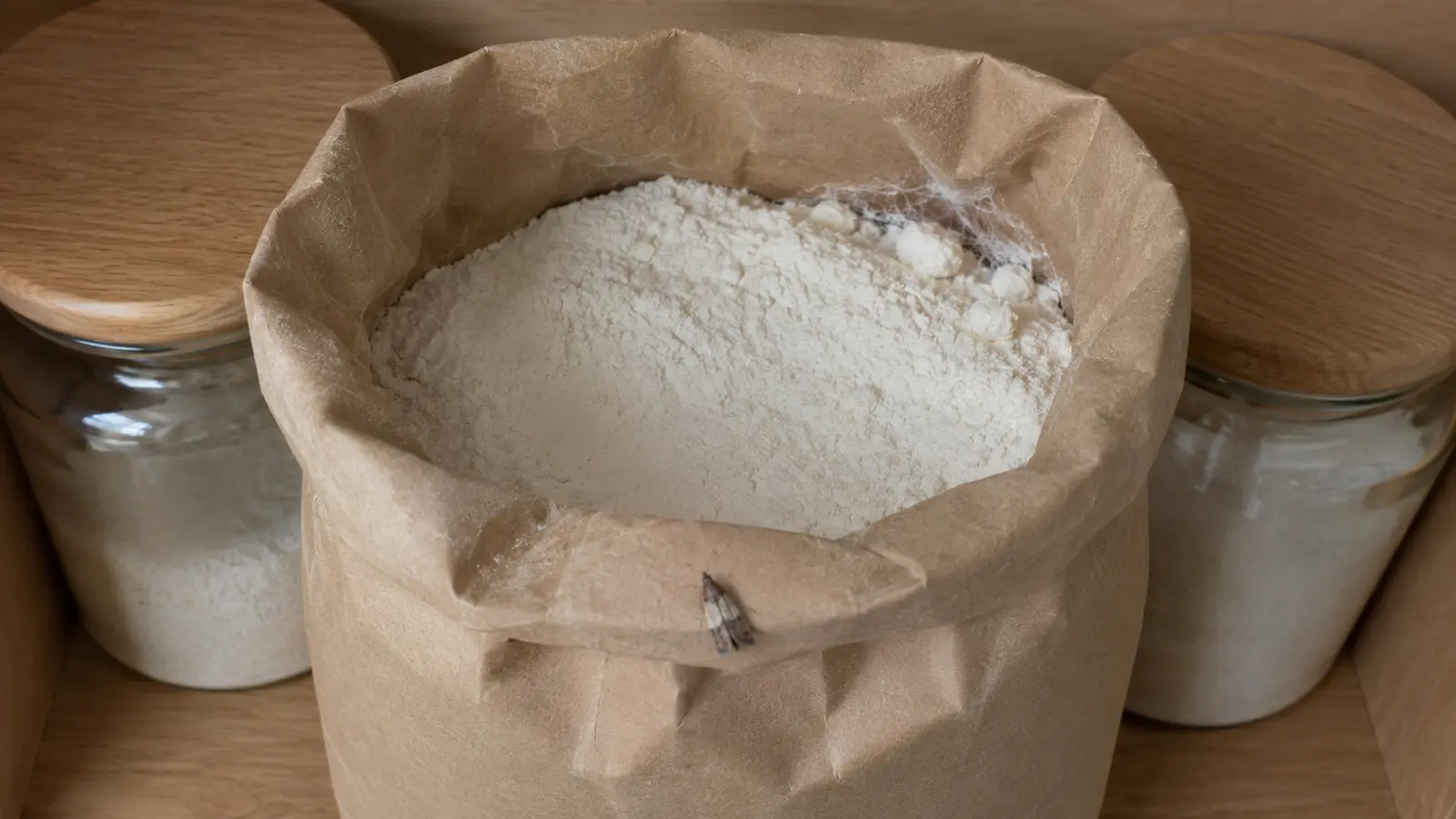
It usually starts with a small moth in the kitchen at night. Then another one, a few days later, and a third — never many at once, always around the same corner of the room. Eventually someone reaches to the back of a cabinet for a bag of flour that has been there since spring, and finds it faintly clumped together, with what looks like a thin cobweb running through it. That is the moment the moths make sense. And the first honest thing worth saying about pantry pests is the part people find hardest to accept: this almost certainly did not come in through a window.
Where do pantry bugs come from?
Nearly always from packaged food you brought home, not from outside the house. Indian meal moths and grain weevils infest dry goods at some point along the chain — in storage, in processing, in a warehouse, or on a store shelf — and arrive as eggs or larvae inside packaging that looks perfectly sealed. Once inside a pantry, larvae chew through paper, cardboard, cellophane, and thin plastic to reach other packages, which is how one contaminated bag becomes a cabinet-wide problem. This is why finding them says nothing about how clean your kitchen is, and why airtight storage matters far more than any spray.
The Short Version
- Two culprits account for most cases: Indian meal moths, which leave webbing in dry goods, and flour and rice weevils, small snouted beetles that bore into whole grains.
- They arrive inside packaged food. This is a supply-chain reality, not a housekeeping failure.
- Larvae chew through paper, cardboard, cellophane, and thin plastic — so an unopened box is not protected.
- Webbing and clumping in flour, cereal, or grains is the clearest sign. So are small beetles in rice or pasta and a musty smell in stored goods.
- Discard infested packages entirely. Scooping out the visible insects leaves eggs behind and the problem returns.
- Pet food, birdseed, and bulk grains are the most commonly overlooked reinfestation sources in the house.
The Two You Are Most Likely to Have
Indian meal moths
The most common stored-product pest in home kitchens, and the one people usually notice first because the adults fly. An adult is small — roughly half an inch across the wings — and the wing pattern is genuinely distinctive once you know it: the half nearer the body is pale grey or cream, and the outer half is a coppery bronze or reddish brown, with a fairly sharp line between the two. No other moth you are likely to find in a kitchen looks like that.
The adults do not feed and do not damage anything. The larvae do all of it. They are small off-white or cream caterpillars with darker heads, and the sign they leave is the useful one: silk webbing. Meal moth larvae spin silk as they feed, so infested flour, cereal, or grain develops a matted, clumped texture with fine threads running through it, sometimes with visible larvae or small dark specks of frass. In a badly affected package the contents can look faintly cobwebbed throughout.
One behavior worth knowing because it sends people looking in the wrong place: when the larvae are ready to pupate, they leave the food and crawl, often a surprising distance. Finding small cocoons or larvae at the top corners of a cabinet, along the ceiling, or where the wall meets the ceiling well away from the pantry is characteristic. The food source may be several feet from where you are seeing them.
Flour and rice weevils
Small beetles, roughly an eighth of an inch, reddish brown to near black, and immediately identifiable by a distinctive downward-curving snout projecting from the head — genuinely elephant-like at close range. Rice weevils often show four lighter spots on the wing covers.
Their biology differs from the moths in a way that matters for the cleanout. A female weevil chews a tiny hole into an individual whole grain — a rice kernel, a wheat berry, a dried bean, a kernel of popcorn — lays a single egg inside, and seals it. The larva develops entirely within that one grain, hollowing it out, and emerges as an adult. So an infested container of rice can look completely normal, because everything is happening inside intact-looking kernels. The tell is adults walking around in the container, sometimes floating grains, and fine powdery dust at the bottom.
A few other stored-product beetles turn up here too — sawtoothed grain beetles and drugstore beetles among them — but the response to all of them is essentially identical, so precise identification matters less than recognising the category.
Silk threads and clumping through flour, cereal, or grain. The single most reliable indicator.
A downward-curving projection from the head. Development happens inside individual grains, so damage stays hidden.
Almost always already present in dry goods brought home, rather than entering from outdoors.
They Came Home in the Groceries
This is the point worth sitting with, because it changes the whole approach and because it takes the blame off the household.
Grain-based products pass through a long chain — field, storage, milling, packaging, warehousing, distribution, shelf. Stored-product pests are present at various points along it, and eggs are microscopic. A package can be infested at a stage where nothing is visible to anyone handling it, and remain apparently fine for weeks or months in your cabinet while development proceeds inside. The first visible evidence is often the adult moth flying in your kitchen, by which point the eggs went in long before.
The second half of the problem is that packaging is not a barrier. Meal moth larvae chew readily through paper, cardboard, foil pouches, cellophane, and thin plastic film. So one infested bag of birdseed in a garage does not stay one infested bag — the larvae move into adjacent boxes of cereal, crackers, pasta, and rice, and an unopened box is no protection at all. This is why the problem tends to appear cabinet-wide rather than in a single container, and why partial cleanouts so reliably fail.
This is not a cleanliness problem
We want to be unambiguous about this, because people are often embarrassed to call about it. A meticulously kept kitchen gets pantry pests at the same rate as any other, because the entry mechanism is the grocery bag rather than the floor. What a clean kitchen does help with is finding them sooner. Nothing about a meal moth infestation reflects on your housekeeping.
What an Active Infestation Looks Like
Webbing or clumping in dry goods
Flour, cornmeal, oats, cereal, and pancake mix that has gone matted or stuck together with fine threads through it. The clearest single sign of meal moths.
Small moths flying in the kitchen
Particularly at dusk, particularly the same corner of the room repeatedly, and typically a few at a time rather than a swarm.
Beetles or larvae in rice, pasta, or beans
Adults walking in the container, or small pale larvae. Grains that float when rinsed are frequently hollowed out.
A musty or stale smell
Heavily infested stored goods develop a distinct off odor. If a container smells wrong, look closely before you use it.
Cocoons in cabinet corners and ceiling lines
Small silken cases where surfaces meet, often well away from the food source. Very characteristic of meal moths, and easy to mistake for something else.
Fine dust at the bottom of a container
Powdery residue below whole grains, rice, or dry pet food — frequently the only visible sign of a weevil population.
How to Actually Clear It
The good news is that this is one of the more genuinely solvable pest problems, and most households resolve it without professional help. The bad news is that half-measures do not work at all, and the most common failure is stopping too early.
Empty the cabinet completely
Everything out, not just the suspicious items. You cannot assess what you cannot see, and the infested package is frequently not the one you suspected. This is the step people skip and the reason the problem comes back.
Inspect every dry good individually
Open and check flour, cereal, grains, pasta, rice, beans, cornmeal, baking mixes, dried fruit, nuts, spices, birdseed, and dry pet food. Pour whole grains into a bowl to look through them properly rather than glancing in the top of a bag.
Discard anything infested — the whole package
Do not scoop out the visible insects and keep the rest. Eggs and early larvae are not visible, and what remains reinfests. Bag discarded items and take them to an outdoor bin rather than leaving them in the kitchen trash. If something is questionable but you cannot bear to throw it out, several days in a freezer kills all life stages and makes it safe to keep.
Vacuum the empty cabinet thoroughly
Shelves, corners, the underside of shelves, hinge recesses, shelf-pin holes, and the crack where shelf meets wall. Larvae pupate in exactly these places. Empty the vacuum outside afterward. Then wipe down with soapy water — skip the bleach and strong chemical cleaners, which accomplish nothing here that soap does not.
Move everything into airtight containers
Glass, metal, or rigid heavy plastic with a genuine seal. This is the step that actually prevents recurrence, because it means the next infested package you unknowingly buy stays contained to itself rather than spreading through the cabinet. It also makes future problems obvious immediately.
Check the overlooked sources
Dry pet food, birdseed, grass seed, and bulk grains stored in a garage or utility room are the most common reinfestation points, and they are frequently in the original bag on a garage floor. Decorative items count too — dried flower arrangements, ornamental corn, and craft materials containing seed heads have all been the actual source in cases we have seen.
When it is worth calling someone: when moths persist for more than a few weeks after a genuinely thorough cleanout, when you cannot locate the source despite emptying everything, when the problem spans multiple rooms rather than one cabinet, or when you are dealing with it in a rental, a shared building, or a property you manage, where the source may not even be in your unit. In those cases the useful work is locating the reservoir rather than treating surfaces — and in a kitchen, targeted crack-and-crevice treatment and monitoring is the appropriate approach rather than anything broadcast.
Cleaned it out and they came back?
That usually means the source was never found — often in a garage, a utility room, or an adjacent unit. Xtermicon works pantry and stored-product pests across the South Bay, Westside, and greater Los Angeles. Call (310) 370-0963 for a quote, over the phone, with no obligation.
Pantry Pest FAQs
What people ask after finding the first webbed bag of flour.
Is it dangerous if I ate some?
Almost certainly not. Pantry pests do not bite, sting, transmit disease, or produce toxins, and eating contaminated food is unpleasant rather than harmful — this happens far more often than anyone realises, given how routinely these arrive in packaged goods. A small number of people develop an allergic sensitivity with heavy prolonged exposure, which is uncommon. If you are worried about a specific reaction, that is a question for a physician, not a pest control company.
Can I just freeze the food instead of throwing it out?
Yes, and it works well. Several days in a home freezer kills eggs, larvae, pupae, and adults at every life stage. The food is then safe to eat, though heavily infested flour or grain may be unappetising in texture regardless. Freezing is also a genuinely useful preventive habit for bulk purchases — a few days in the freezer when you get home kills anything that came with it before it can establish.
Why do they keep coming back after I cleaned everything out?
Three usual reasons. The source was somewhere you did not look — dry pet food, birdseed, or bulk grain in a garage or utility room is the most common. Or larvae had already left the food to pupate in cabinet cracks, hinge recesses, or shelf-pin holes, so cleaning out the food alone missed them. Or a package was kept because it looked fine and it was not. If the cleanout was genuinely complete and the problem persists past a few weeks, the source is somewhere outside the cabinet you cleaned.
Do I need to throw out unopened boxes?
Inspect them rather than assuming either way. Meal moth larvae chew through cardboard, paper, cellophane, and thin plastic, so unopened is not the same as protected — and a box can also have been infested before it was sealed. Open and check anything that was in the affected cabinet. Sealed glass, metal, and rigid containers with a real gasket are genuinely safe and do not need inspecting.
Will pest control spray solve this?
Not on its own, and any company that leads with spraying your pantry is doing it wrong. The insects live inside the food, so the cleanout is the actual solution and no product substitutes for it. Where professional help earns its place is in locating a source you cannot find, dealing with a problem that spans multiple rooms or units, and applying targeted crack-and-crevice treatment to the harborage points around a kitchen rather than anything broadcast near food.
Are these the same as silverfish?
No, and it is a useful distinction. Silverfish are a moisture-driven problem that feeds on starches, paper, and glue — book bindings, wallpaper paste, cardboard — and they turn up in bathrooms, closets, and storage areas. Pantry pests are stored-product insects that arrive inside packaged food and live in the food itself. Different biology, different rooms, different fixes: silverfish are addressed by drying the space, pantry pests by clearing and sealing the food.
Related Reading
Other stored-goods pests and the storage habits that overlap with this one.
- Silverfish: the bug you only notice after it is too lateThe other stored-goods pest — moisture-driven rather than food-borne.
- Pests in your pet foodThe single most overlooked reinfestation source in most houses.
- Grain beetles: species profileIdentification for the other beetles that turn up in stored goods.
- Rice weevils: species profileThe snouted beetle that develops inside individual grains.
- Moths: species profileTelling a pantry moth from a clothes moth.
- What attracts cockroaches to a clean houseThe same "this is not about your housekeeping" point, for a different pest.
Sydney Pardey is the owner of Xtermicon, a family-owned pest control company serving the South Bay and greater Los Angeles area since 2015. All content is written from direct operational experience and reviewed against current California Structural Pest Control Board standards.
Specialists you
can count on.
Xtermicon was founded in 2015 with one focus: protect Southern California homes and businesses from the pests that threaten them. The name says it all — eXterminate TERmites & pest CONtrol — and that's exactly what we do. We're a family-owned team specializing in termite control, pest control, and rodent exclusion. From West LA and East LA to the beach cities and Orange County, we're local neighbors who treat your property like our own.