What Is Sustainable Pest Management? California's New Push, Explained
The state is steering pest control toward prevention-first, least-toxic methods — with funding rather than mandates. Here is what the term actually means, what California is doing, and the questions worth asking a provider.
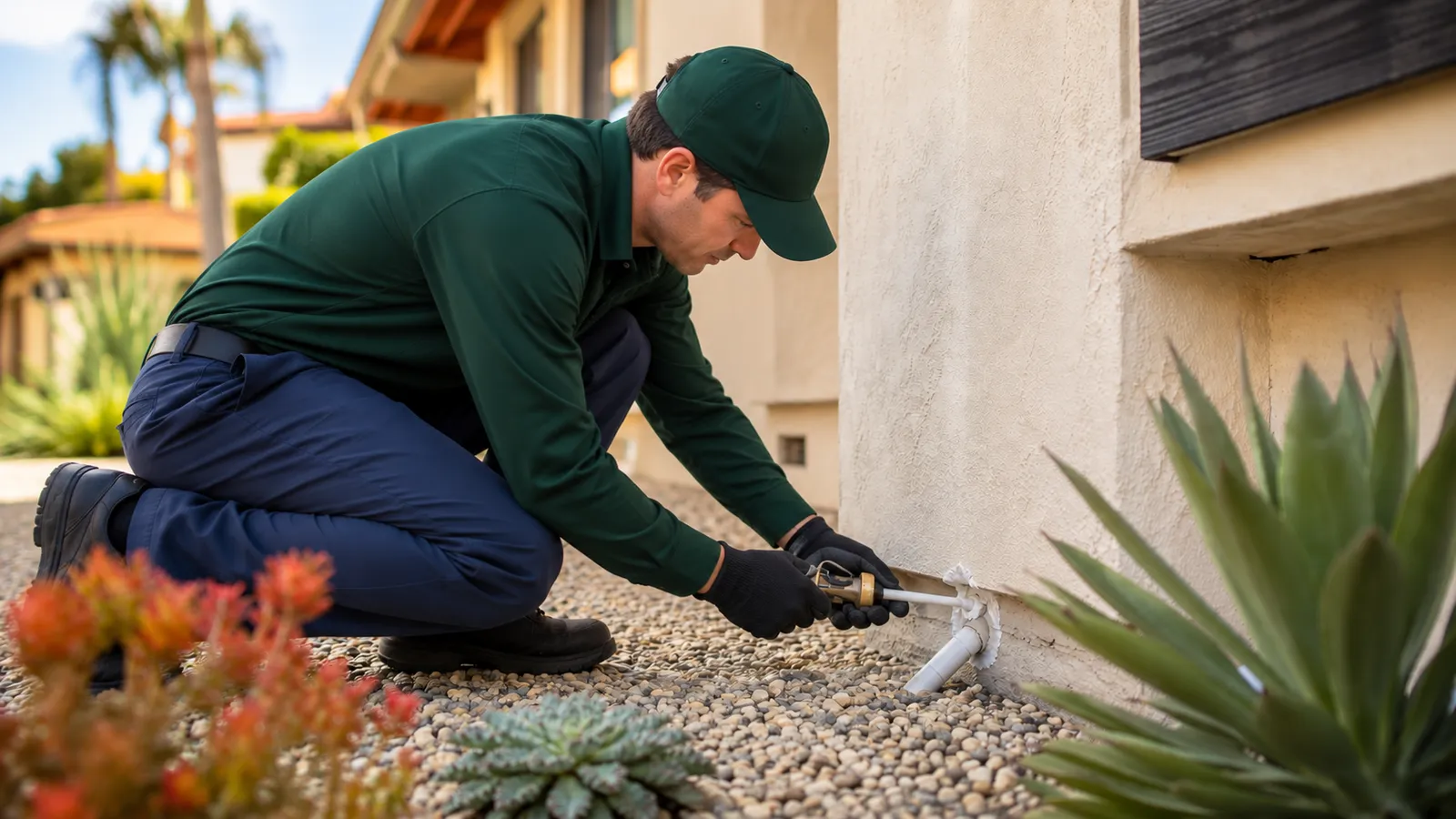
The question comes up more every year, and it is almost always phrased the same way: do you have an organic option? It is a fair question and it deserves a better answer than yes or no, because the thing most people are reaching for when they ask it is not really a product. It is an approach — the sense that there ought to be a way to solve a pest problem that does not start and end with spraying the house. There is. It has a name in California policy, a state agency behind it, and as of this summer, real money attached to it.
What is sustainable pest management, and is California requiring it?
Sustainable pest management, or SPM, is an approach rather than a product line: identify the pest, remove what is attracting it, seal how it is getting in, monitor, and then use the least-toxic effective treatment in targeted places rather than broadcasting product across a property. California is actively steering the industry this direction — the state Department of Pesticide Regulation opened its 2027 Sustainable Pest Management Grants Program in late July 2026, with up to $4.9 million available and applications closing September 1, 2026. But that is a funding deadline for organizations and practitioners applying for grants, not a compliance date for homeowners. Nothing about it requires you to do anything to your house.
The Short Version
- Sustainable pest management is a sequence, not a product line — identify, remove the attractant, exclude, monitor, then treat in targeted places with the least-toxic material that works.
- It is the modern name for what the trade has long called integrated pest management, with an added long-range goal of reducing reliance on the highest-risk materials.
- California is pushing this with funding, not homeowner mandates: DPR opened a 2027 grants round in late July 2026 with up to $4.9 million, applications closing September 1, 2026.
- That September 1 date applies to organizations and practitioners seeking grant money. It is not a deadline that applies to your property, and nothing you have becomes non-compliant.
- "Least-toxic" does not mean "no product." Prevention comes first in the sequence — it does not replace treatment on an active infestation.
- The most useful change a homeowner can make is what they ask a pest control company: approach and findings, not just price and schedule.
Sustainable Pest Management Is a Sequence, Not a Product
Strip away the policy language and SPM is an order of operations. It says: before you reach for a product, do the work that makes the product less necessary — and when you do reach for one, put it in the smallest, most targeted place that will actually solve the problem.
In practice that is five steps, and the order is the whole point.
Identify what you actually have
Species first, always. German cockroaches and American cockroaches are one word to a homeowner and two completely different jobs to us — different harborage, different biology, different treatment. Treating before identifying is how people end up paying for the wrong service twice.
Find what is drawing it in
Moisture, food, harborage. A rodent problem is usually a fruit tree, an unsecured bin, and dense ground cover before it is a rodent problem. Correcting conditions is the unglamorous part and it is the part that lasts.
Close how it is getting in
Exclusion: door sweeps, vent screens, sealed utility penetrations, sealed voids. On most properties this is the highest-return work there is, because unlike a treatment it does not wear off.
Monitor, before and after
Glue boards placed in strategic spots for roaches, tracked activity at stations, a record of what is showing up where. Monitoring is what tells you whether a treatment actually worked instead of assuming it did — and it is what tells you when to stop treating.
Treat — targeted, and least-toxic first
Product goes where the pest is: cracks, voids, harborage, the perimeter. Not broadcast across the surfaces people live on. Where a lower-risk material will do the job, it should be the first choice rather than the fallback.
None of that is new. The trade has called it integrated pest management for decades, and any competent company was already working roughly this way. What is new is the state putting structure, weight, and money behind it, and adding an explicit long-range goal of moving away from the highest-risk materials rather than simply using them carefully.
California Is Funding the Shift, Not Mandating It
California regulates pesticides more tightly than any other state, through the Department of Pesticide Regulation. Over the past several years DPR has moved from a purely regulatory posture — approving products, setting rules for how they are used — toward actively funding the development and adoption of alternatives.
The current example is concrete. In late July 2026, DPR opened its 2027 Sustainable Pest Management Grants Program, with up to $4.9 million available and applications due September 1, 2026. The money funds research, demonstration projects, and adoption work by organizations and practitioners. The theory behind it is that lower-risk approaches spread faster when they are made practical and affordable than when they are simply required.
The funding ceiling DPR set for the current Sustainable Pest Management Grants Program.
For organizations and practitioners applying for grant money — not a homeowner date.
DPR announced the 2027 program in the last week of July 2026.
To be clear about what this is not
This is a grant program, not a regulation. There is no new requirement for homeowners here, no permit to pull, no deadline to meet, and nothing about your existing pest control service becomes non-compliant on September 1. We are covering it because the direction of travel is genuinely useful when you are choosing a provider — not because anything is being asked of you. And to be equally clear: Xtermicon has not applied for and does not hold this grant. We are explaining the policy, not claiming a piece of it.
What This Looks Like on a Real Property
Policy language is abstract. Here is the same idea at the scale of one house in Torrance with ants in the kitchen.
Handled as a product problem, it goes like this: spray the trail, ants gone for two weeks, ants back. Handled as a sequence, it looks different. The species gets identified, because Argentine ants and odorous house ants do not behave the same way. The technician looks for why they came in — in summer it is almost always moisture, which means a hose bib, an irrigation head, a condensation line, a slow leak under a sink. That gets flagged. The entry route gets closed where it can be. Product goes on the trail and the harborage, inside and outside together, because exterior-only treatment pushes ants deeper into the structure rather than out of it — that single mistake is the number one cause of ant call-backs we see.
And the framing stays honest: control, not elimination. Argentine ant supercolonies run across entire neighborhoods. The realistic goal is keeping them out of your house, not removing them from your block, and any company promising the second thing is describing something that does not exist.
Where essential-oil products actually fit
This is usually the real question behind "do you have an organic option." The answer is yes — we offer essential-oil based treatments — and the trade-off is worth stating plainly rather than glossed over. They generally have lower efficacy and a shorter residual than conventional materials, which means they ask more of the maintenance schedule and need more frequent application.
For a household with genuine sensitivities — a chemically sensitive occupant, a very young child, a specific medical situation — that trade is often worth making, and we will tell you where it works well and where it does not. What they are not is a free upgrade. Anyone presenting a lower-toxicity product as equally effective at no cost is not being straight with you.
Worth noting: the biggest driver of a low-product outcome usually is not which product gets used. It is how much of the non-chemical work got done first. A house that is sealed, dry, and not feeding anything needs dramatically less treatment of any kind.
The Questions That Actually Tell You Something
If you take one practical thing from the state's direction of travel, make it this. Homeowners almost always ask pest control companies about price and schedule, and those are the two questions that tell you the least about what you will actually get. These tell you more.
What species do you think this is, and how did you determine that?
A specific answer with a reason behind it is the single best signal you are dealing with someone who inspects rather than runs a script. "Some kind of ant" is not an answer.
What conditions on my property are contributing to this?
A company working this way will have a list — moisture, vegetation contact, a gap, a bin. A company that is not will change the subject back to the treatment plan.
What are you sealing, and what are you treating?
Exclusion is the part that keeps holding after the service ends. If nothing at all is being sealed, it is fair to ask why not.
Where exactly is the product going, and how long until re-entry?
Targeted application has specific locations, and someone doing it can name them. For reference, ours dries in about three hours, interior and exterior, and you should stay out of the treated area until it does.
What are the lower-risk options here, and what do I give up?
The answer should include a real trade-off. "Nothing, it works exactly the same" is a sales answer, not a technical one.
Where "Green" Claims Go Wrong
Two things are worth knowing before you shop on the adjective alone.
First, "organic," "green," "natural," and "eco-friendly" are not regulated terms in structural pest control the way they are on food packaging. A company can use them without meeting any particular standard. What matters is the specific material and the specific approach — which is exactly why the five questions above are more useful than the wording on the truck.
Second, no legitimate approach clears an active infestation with prevention alone. Prevention-first means prevention comes first in the sequence, not that it substitutes for treatment. An established German cockroach population inside a wall void is not going to be resolved by a door sweep and a dehumidifier. If someone tells you otherwise, one of two things happens: the job fails, or product gets used quietly and you are not told about it. Neither is what you were asking for.
Want the approach, not just the spray?
That is how we prefer to work anyway, and it is worth asking for by name. Xtermicon has served the South Bay, the Beach Cities, the Westside, and greater Los Angeles since 2015. If you want to talk through a lower-toxicity approach for a sensitive household, or you simply want someone to identify what you actually have before quoting a treatment, call (310) 370-0963.
Sustainable Pest Management FAQs
What homeowners and HOA boards ask most often once the term comes up.
Is California banning pesticides?
No. Nothing described here bans anything, and there is no homeowner-facing prohibition attached to it. DPR regulates products individually — approving them, restricting specific uses, occasionally withdrawing one — and that process is separate from the sustainable pest management work. The SPM effort is funding and direction: make lower-risk approaches practical enough that the industry moves toward them. The long-range goal is to reduce reliance on the highest-risk materials over time by making better options available, not to leave people without a way to deal with termites.
Do I need to do anything before September 1, 2026?
No. That is the application deadline for DPR's 2027 grant round, and it applies to organizations and practitioners seeking funding. It creates no obligation for a homeowner, a landlord, or an HOA board, and nothing about your current pest control arrangement becomes non-compliant when it passes. If you saw the date somewhere and wondered whether it was a compliance deadline, it is not.
Is sustainable pest management the same thing as integrated pest management?
Very close. IPM is the long-standing name for the identify, prevent, monitor, then targeted-treat sequence, and it has been standard practice in the trade for decades. SPM keeps all of that and layers on an explicit goal of reducing reliance on the highest-risk materials over time, plus a broader view that takes in worker safety, water and air quality, and resistance management. At the scale of one house, the two look nearly identical in practice.
Does eco-friendly pest control actually work?
For some problems, genuinely yes. The honest version is that essential-oil based products are real tools with real limits: lower efficacy, shorter residual, more frequent application. They fit well for maintenance service and for sensitive households, and poorly as the only tool against an established German cockroach, bed bug, or termite problem. The larger point is that most of what makes an outcome "green" is not the product at all — it is the exclusion, moisture correction, and sanitation work, which reduces how much of anything is needed.
Does this approach cost more?
Not usually, and where it does, the cost is in labor rather than product. A service built around inspection, monitoring, and exclusion involves more time on the property than one built around a quick perimeter spray. What it tends to save is repeat visits and the cost of solving the same problem twice, plus the sealing work keeps paying off after the service ends. Pricing depends on the property, so the useful next step is a quote for your specific situation rather than a number in an article.
Is any of this safer for my kids and pets?
That is the question underneath most "do you have an organic option" calls, and it deserves a direct answer rather than a slogan. Targeted placement means less product in the areas people actually occupy, which is a real difference. Applications and stations are placed with children and pets in mind, dry time is roughly three hours for both interior and exterior work, and you should be out of the treated area until it dries. We wrote a longer piece specifically on this, linked in the related reading below.
Should an HOA board be asking about this?
Yes, and for a slightly different reason than a single homeowner. Common areas, pool decks, play areas, and shared landscaping mean broader exposure and more residents with opinions about it. A board that specifies approach in its vendor contract — species identification, monitoring records, targeted application, exclusion work — has a defensible answer ready when a resident asks what was applied near the play structure, and a paper trail worth having on file. It also tends to produce better pest outcomes in shared-wall buildings, where reactive spraying moves problems between units rather than resolving them.
Related Reading
The prevention-first side of pest control, and what it looks like in practice.
- Is pest control safe for kids and pets?The household-safety question in full — products, placement, and dry times.
- Landscaping habits that invite pestsThe conditions work that reduces how much treatment a property needs at all.
- Why your pest control is not workingWhat goes wrong when treatment happens without identification or exclusion.
- Our residential pest control serviceHow inspection-first service actually runs at a home.
- HOA & community pest controlFor boards writing approach into a vendor contract.
- Pest control in Santa MonicaServing Santa Monica and the wider Westside.
Sydney Pardey is the owner of Xtermicon, a family-owned pest control company serving the South Bay and greater Los Angeles area since 2015. All content is written from direct operational experience and reviewed against current California Structural Pest Control Board standards.
Specialists you
can count on.
Xtermicon was founded in 2015 with one focus: protect Southern California homes and businesses from the pests that threaten them. The name says it all — eXterminate TERmites & pest CONtrol — and that's exactly what we do. We're a family-owned team specializing in termite control, pest control, and rodent exclusion. From West LA and East LA to the beach cities and Orange County, we're local neighbors who treat your property like our own.