What to Expect During Your First Pest Control Visit
Nobody is going to judge your house. Here is what actually happens, what you will be asked to do, what is normal afterward, and the questions worth asking before you book.
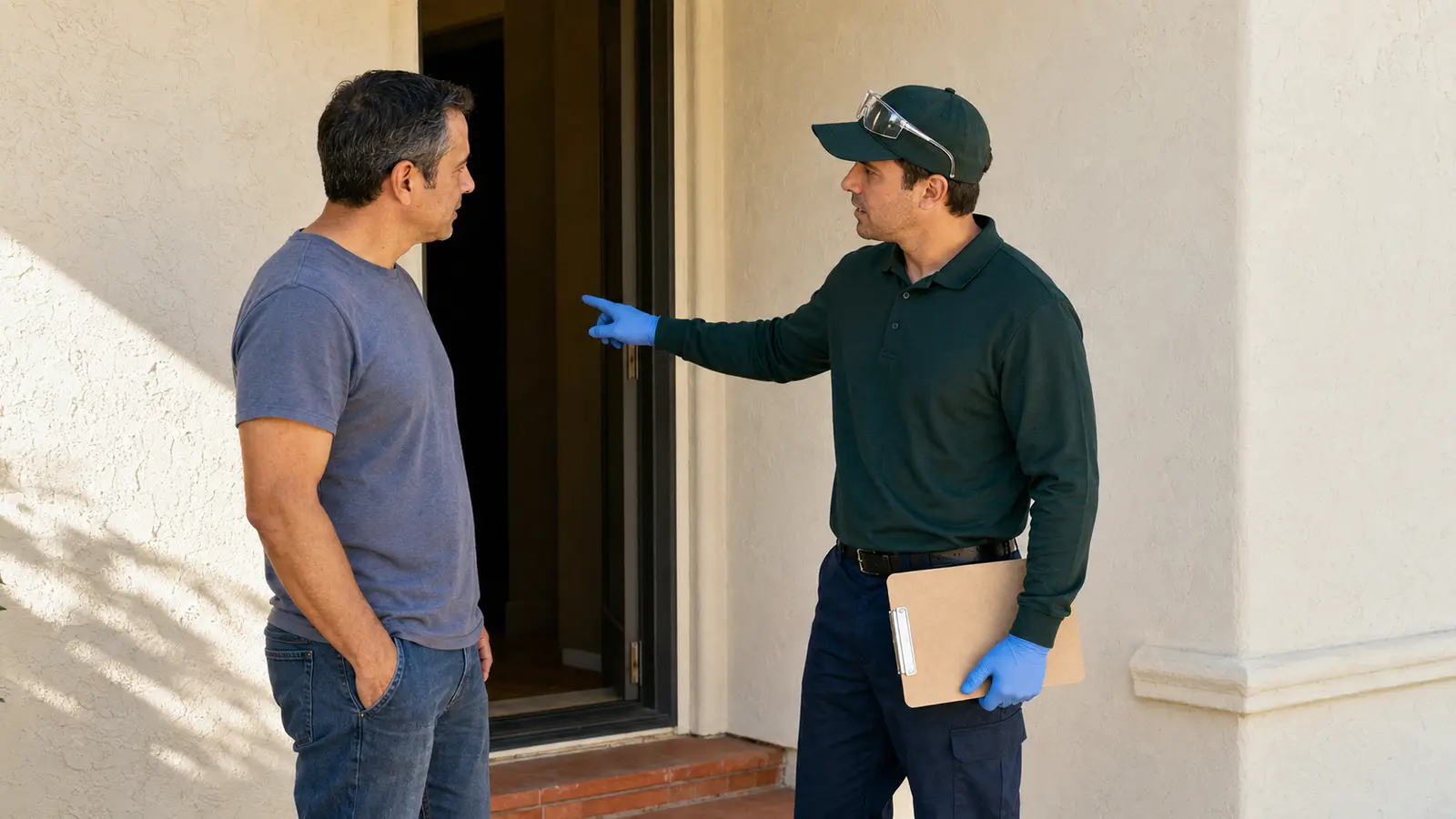
A surprising share of the people who call us have never hired a pest control company before, and a good number of them open with some version of an apology — for the state of a cabinet, for waiting too long, for calling about something they suspect is not a big enough problem to bother anyone with. So before anything practical: none of that is necessary. We have been in several thousand houses. Yours is not the worst one, it is very unlikely to be unusual, and the thing you are embarrassed about is almost certainly the thing we see every week.
What happens during a first pest control visit?
The technician inspects before treating anything. That usually means walking the interior areas where you have seen activity, the exterior perimeter, likely entry points, and any accessible attic or subarea — then explaining what they found and what they propose before applying anything. A typical appointment runs 30 minutes to an hour and a half depending on the property and the pest. You will generally be asked to clear access to affected areas and secure pets. If treatment is exterior only, you usually do not need to leave; if it is interior, you will need to be out of the treated area until it dries, roughly three hours. Expect a walkthrough of the findings before the technician leaves.
The Short Version
- Inspection comes first. A technician who starts spraying on arrival has skipped the step that determines whether any of it works.
- Nobody is judging your house. Pest problems correlate with construction, landscaping, and neighbors far more than with housekeeping.
- Have the specifics ready for the call: what you saw, where, when, how often, and what you have already tried.
- Prep is usually light — clear access, secure pets. Substantial preparation is only for specific jobs, and you will be told in advance.
- Seeing more activity in the first few days is often normal and does not mean it failed. Expect this so it does not alarm you.
- Ask what they found, not just what they used. A technician who cannot explain the why is a reason to keep looking.
The Phone Call, and What to Have Ready
The call is more useful than people expect, and a good one is diagnostic rather than transactional. What is worth having to hand:
What you actually saw
Not the identification — the description. Size, color, where it was, what it was doing. Do not worry about naming the species; that is our job and guesses over the phone are frequently wrong in both directions.
Where, and how often
Which rooms, which side of the house, indoors or outdoors, and whether it is one sighting or a pattern. A trail in the same spot every morning is a different problem from one insect once.
When it started and when you see it
Time of day matters more than people realize — it separates species and points at behavior. Recent onset versus an ongoing thing changes the approach.
What you have already tried
Be honest about this, including store-bought products. It genuinely changes what we do, because some retail products scatter a colony or drive roaches into voids, and knowing that in advance saves a wasted visit.
A photo, if you have one
Even a bad phone photo helps enormously. So does a specimen in a jar or a piece of tape. If you have been vacuuming up evidence, one saved sample is worth more than a description.
Household specifics
Children, pets, pregnancy, asthma, chemical sensitivities, fish tanks, beehives, or a pollinator garden. All of these change product choice and placement, and we would much rather know before arriving than at the door.
A note on quotes: ours are free, we can give you one over the phone, and there is no obligation to proceed. But treat a firm price given before anyone has seen the property as a soft number for anything beyond a straightforward job — the scope is what the inspection establishes, and a company that will not acknowledge that is worth a second look.
On Being Embarrassed About Your House
This deserves its own section because it stops people from calling, and delay is genuinely the thing that makes pest problems expensive.
The belief underneath it is that pests indicate poor housekeeping. It is one of the most persistent ideas in this field and it is mostly wrong. German cockroaches arrive in cardboard, grocery bags, and secondhand appliances, and thrive in immaculate kitchens. Ants come indoors in late summer looking for water, and a spotless bathroom has exactly as much of it as a messy one. Pantry moths arrive sealed inside packaged flour from the store. Bed bugs are a travel problem, entirely unrelated to cleanliness. Termites are about soil contact, moisture, and weathered exterior wood. Rodents are about a gap in the envelope and what your neighbors are doing.
What actually predicts pest pressure is construction type, foundation, landscaping, moisture, the age of the building, and density of the neighborhood. Housekeeping is a minor variable at the margins. So the practical advice is to call when you first notice something rather than after you have spent three weeks cleaning and three more on store-bought products — both because early problems are smaller, and because those products can genuinely make things worse before we arrive.
You do not need to clean before we come
People frequently do, and it is entirely unnecessary. In some cases it is actively unhelpful — wiping away trails, droppings, or frass removes the evidence a technician uses to work out what you have and where it is coming from. Leave it. If anything, the more we can see of the actual situation, the better the visit goes.
What Happens When Someone Arrives
The full operational sequence — timing, dry times, what happens on follow-up visits — is set out in our what-to-expect guide, linked at the end. The shape of a first visit, briefly:
A conversation first
The technician will want to hear it from you directly even if you covered it on the phone — what you have seen, where, and when. Walk them to the spots rather than describing them. Details you think are irrelevant frequently are not.
Inspection before treatment
This is the part that matters most and the part a rushed visit skips. Interior areas of concern, the exterior perimeter, entry points, and attic or subarea access where it exists. The technician is identifying the species, finding how it is getting in, and looking for the conditions supporting it — not just confirming you have a problem.
An explanation of the findings
Before anything is applied, you should hear what they found, what they think is happening, and what they propose to do about it. If that conversation does not happen, ask for it. You are entitled to understand the plan before it is carried out on your house.
Treatment based on what was found
Targeted to the species and the situation rather than a fixed routine — which is why two houses with the same complaint can get quite different work. Ask what is being used and where if you want to know; that is a reasonable question and a technician should answer it plainly.
A walkthrough before they leave
What was done, where, what you should and should not do next, and dry times. This is also when to raise anything you forgot.
On duration: a typical appointment runs 30 minutes to an hour and a half depending on the property and the pest, with follow-up visits usually at the shorter end. On preparation: for most general service there is very little to do beyond clearing access to the areas of concern and securing pets. Substantial preparation — emptying cabinets, laundering, moving furniture — applies to specific jobs like bed bug or heavy cockroach work, and you will be told well in advance rather than at the door.
The Part That Surprises People
This is the single most useful expectation to set in advance, because without it a normal outcome reads as a failure.
You may see more pest activity in the first few days after treatment, not less. That is frequently a sign that things are working rather than failing. Treatment disturbs harborage and drives insects out of voids and hiding places into the open, where you see them — and where they are contacting treated surfaces. Ants in particular can look worse before they look better. Roaches emerging into the open after years of never being visible in daylight is a normal post-treatment observation.
The corollary is that most treatments are not instant. Products that work at the colony level have to be carried back and distributed, which takes time by design — a product that killed everything on contact immediately would not reach the part of the population that matters. Give it the window the technician described before concluding anything.
A few other things worth knowing:
Do not wash treated surfaces
Mopping baseboards or hosing down a treated exterior removes the residual you just paid for. This is the most common way a good treatment gets undone within a week.
Dry times are about re-entry, not effectiveness
Roughly three hours, interior and exterior. Exterior: stay off the treated area, pets included. Interior: be out of the treated area until it dries.
Leave bait stations and monitors alone
Bait needs to be found and fed on to work, and monitoring traps are evidence about whether further treatment is warranted. Moving or cleaning them resets the information.
Report what you see
If activity is continuing past the window you were given, say so — that is useful information rather than a complaint, and it often means adjusting placement rather than repeating the same treatment.
Some work is yours
Fixing a leak, cutting back vegetation touching the structure, sealing a gap, changing where trash sits. A technician who gives you a list is not passing the buck — those conditions are usually why the problem recurs.
Reasonable Questions and Real Red Flags
Things worth asking, none of which should cause any hesitation from a good technician: What did you find, and where? What species is it, and how do you know? How is it getting in? What are you applying, and where? How long until I can be back in the space? What should I do on my end? What happens if it does not work?
What should give you pause: someone who begins treating before inspecting; who cannot or will not explain what they found; who quotes a firm price for substantial work sight-unseen; who recommends the maximum service frequency before diagnosing anything; who dismisses questions about products; who will not put the scope in writing; or who pressures you toward a decision on the spot. Licensing is a fair question too — in California, structural pest control operators are licensed by the Structural Pest Control Board, and any legitimate company will tell you their license number without hesitation.
First time calling anyone about this?
Describe what you are seeing and we will tell you what it sounds like, what it would involve, and honestly whether you need recurring service or a single visit. Xtermicon is family-owned, licensed and insured, and has served the South Bay, Westside, and greater Los Angeles since 2015 — California Structural Pest Control Board Company License No. 10100. Call (310) 370-0963. Quotes are free, over the phone, with no obligation.
First Visit FAQs
What first-time customers ask before booking.
Do I need to be home for the appointment?
For a first visit, yes, and it is worth arranging. The inspection depends on you showing the technician where you have seen activity, and the findings conversation afterward is the most valuable part of the visit. For later recurring visits that are exterior-only, many customers are not home and it works fine. If interior work is needed, someone has to provide access, and you will need to be out of the treated area until it dries.
How long does the appointment take?
Usually 30 minutes to an hour and a half, depending on the size of the property and what is being addressed. A large property with a subarea and attic access takes longer than a condo. Follow-up visits are generally shorter, since the inspection groundwork is already done. If someone is in and out in ten minutes on a first visit, that is not efficiency — that is an inspection that did not happen.
Will I have to leave the house, and what about my pets?
It depends on where the work is. For exterior-only treatment you generally do not need to leave — you and your pets just stay off the treated area until it dries, roughly three hours. For interior treatment you will need to be out of the treated area for about the same window. Tell us about pets in advance, including fish tanks and birds, since those change placement decisions. Aquariums should be covered and pumps addressed for any interior work nearby.
Do I need to clean or empty cabinets before you come?
For most general service, no — and cleaning away trails, droppings, or frass actively removes evidence the technician needs. Clear access to the areas of concern and secure pets, and that is usually the whole preparation. Substantial prep like emptying cabinets, laundering, or moving furniture applies to specific jobs such as bed bug or heavy cockroach work, and we tell you in advance so you have time to do it properly.
What if I see bugs the day after treatment?
That is often normal and sometimes a good sign. Treatment disturbs harborage and drives insects out of voids into the open, so activity can appear to increase briefly before it drops — particularly with ants and cockroaches. Products that work at the colony level are also deliberately slow, since they need to be carried back and shared. Give it the window the technician described. If activity is still going well past that, tell us, because the useful response is usually adjusting placement rather than repeating the same thing.
Related Reading
The detailed procedural guide, and the questions that come up right after a first visit.
- What to expect from your pest control serviceThe full step-by-step sequence, dry times, and preparation detail.
- How often should you really get pest control?One-time, quarterly, or monthly — how to tell which one you need.
- How long does pest control take to work?Realistic timelines by pest, and what is normal in the first few days.
- How much does pest control cost in Southern California?What actually drives a quote.
- Products and safetyWhat gets used, how it is applied, and the questions to ask about it.
- Residential pest controlWhat our residential service covers.
Sydney Pardey is the owner of Xtermicon, a family-owned pest control company serving the South Bay and greater Los Angeles area since 2015. All content is written from direct operational experience and reviewed against current California Structural Pest Control Board standards.
Specialists you
can count on.
Xtermicon was founded in 2015 with one focus: protect Southern California homes and businesses from the pests that threaten them. The name says it all — eXterminate TERmites & pest CONtrol — and that's exactly what we do. We're a family-owned team specializing in termite control, pest control, and rodent exclusion. From West LA and East LA to the beach cities and Orange County, we're local neighbors who treat your property like our own.