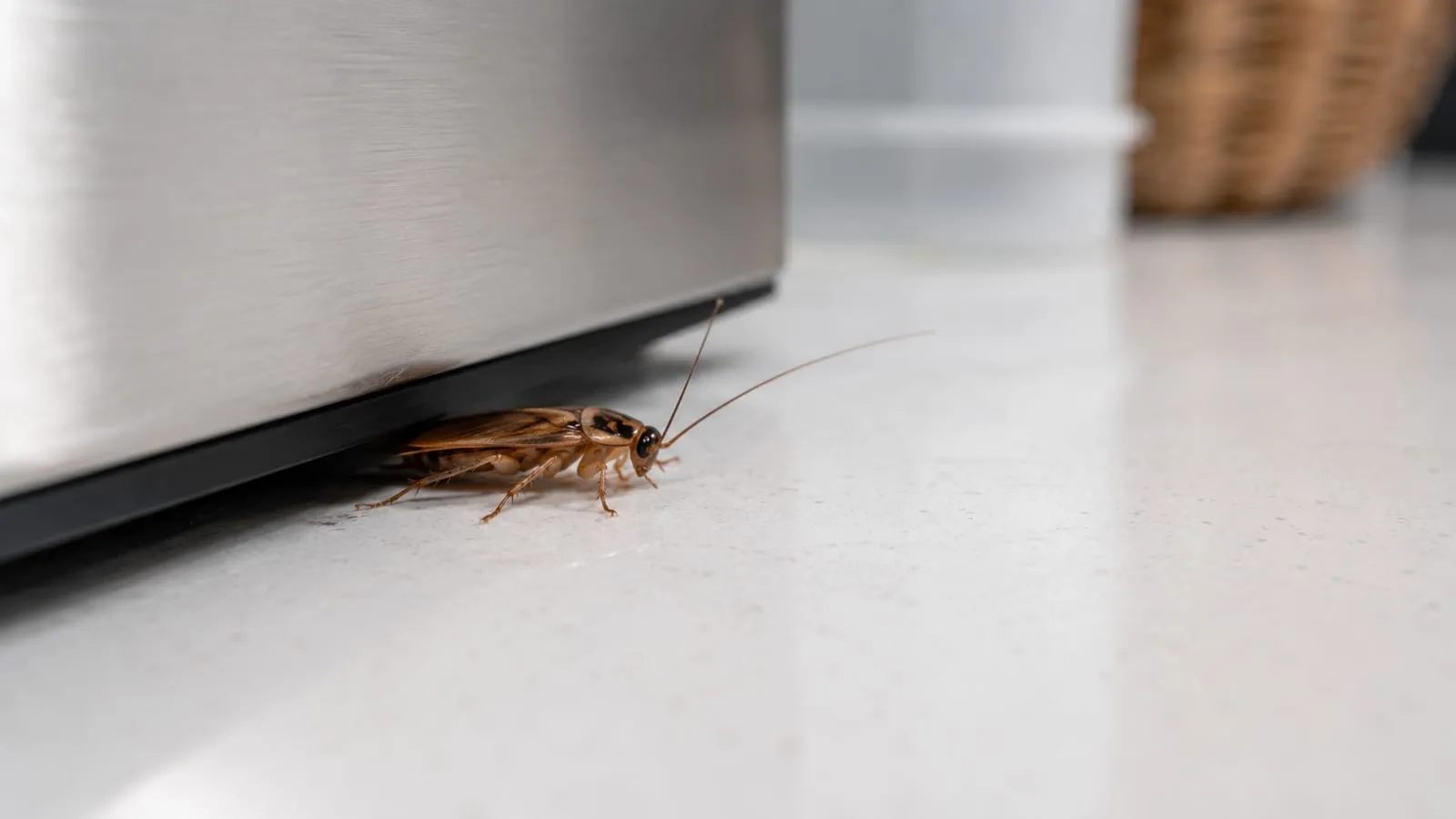
Why do store-bought roach sprays not solve the problem?
Because cockroaches live in wall voids, under appliances, and inside cabinet cavities, and most retail products are repellent — so instead of reaching the population they drive it deeper into the structure, sometimes into neighboring rooms or units. Egg cases are unaffected either way, so what is left rebuilds within weeks. Effective treatment places product into the harborage itself and pairs it with an insect growth regulator that stops the next generation from maturing. Professionals do use fogging, but selectively and for a different purpose — to flush roaches out of voids so they contact treated surfaces, not as the treatment itself.
Service Overview
A cockroach problem is a breeding problem. Every visible roach represents many more in wall voids, under appliances, and inside cabinet cavities, and a single German cockroach egg case holds dozens of nymphs. That is also why acting early matters so much: what you can see is a fraction of what is there, and the population grows while you decide. We treat the harborage directly, pair it with insect growth regulators so the next generation never reaches breeding age, and leave monitoring in place so the result is measurable rather than assumed.
Key Takeaways
- Roaches are a breeding problem, not a visibility problem — the ones you see are a small share of the population.
- Spraying product from a home repair store will often push roaches into wall voids rather than solving the problem.
- Treat sooner rather than later. Far more roaches are in the walls than you ever see, so tackling it early is the fastest path to resolving it.
- We place glue traps in strategic locations so activity can be monitored between visits and any further treatment is based on evidence.
- German cockroaches breed fastest and stay indoors; American, Oriental, and Turkestan roaches typically move in from drains, sewers, and exterior harborage.
- Turkestan cockroaches have largely displaced Oriental roaches across much of Southern California — species identification changes where we treat.
- Growth regulators are what break the cycle; without them you are only removing adults.
Key Benefits
- ✓Treatment placed directly into harborage areas rather than open surfaces
- ✓Growth regulators that stop nymphs from reaching breeding age
- ✓Sanitation and exclusion recommendations that remove what sustains them
- ✓Glue traps left in strategic locations so activity is monitored, not guessed at
- ✓Discreet service for multifamily, offices, and other sensitive properties
Growth Regulators
We use products that prevent nymphs from maturing into breeding adults, so the population cannot rebuild after the initial knockdown.
Crack & Crevice Precision
Product goes where roaches actually live — void gaps, appliance motor housings, hinge cavities — instead of across open surfaces where it does nothing but sit.
Glue Trap Monitoring
Traps placed in strategic locations turn "I think it is better" into something measurable. They also give us the evidence to justify further treatment where it is genuinely needed, and to stop where it is not.
Discreet Commercial Service
For multifamily, office, and other commercial properties we work with you to find a service time that is not disruptive, and leave documentation behind.
Our Decisive Process
Harborage Inspection
We locate the actual living areas — motor housings, void gaps, hinge voids, drain lines — rather than treating where roaches were last spotted.
Species Confirmation
German roaches signal an indoor breeding population; American, Oriental, and Turkestan roaches usually mean an entry route from outside or from drains.
Targeted Application
Gel baits and crack-and-crevice placements inside the harborage, combined with an insect growth regulator to break the breeding cycle.
Monitoring & Verification
We leave glue traps in strategic locations so activity between visits is measured rather than guessed at. What they catch tells us whether the population is collapsing and gives evidence for any further treatment.
A roach problem is not a cleanliness verdict
German cockroaches arrive in grocery bags, cardboard, appliances, and second-hand furniture, and in multifamily buildings they travel through shared walls and plumbing chases regardless of how any individual unit is kept. Sanitation absolutely affects how fast a population grows and how well treatment holds — but the arrival is usually a logistics accident, not a housekeeping failure. We say this plainly because embarrassment is the main reason people wait, and waiting is what turns a small problem into a structural one.
Sooner is genuinely cheaper than later
Cockroach populations are mostly invisible — far more are in the wall voids, cabinet cavities, and appliance housings than ever cross a floor in front of you. That means the problem is always larger than it looks, and it is compounding while you decide what to do. The fastest path to resolving it is tackling it early, when the population is still concentrated in a few harborage points rather than distributed through the structure. A problem caught in one kitchen is a very different job from the same problem three months later.
Why the species matters
Where we treat depends entirely on what we find, and the four common Southern California species behave very differently.
- ✓German — small, indoor breeder, kitchens and bathrooms; the hardest to eliminate and the fastest to multiply
- ✓American — large, often from sewers and drain lines; treatment focuses on plumbing and entry routes
- ✓Turkestan — now widespread here, breeding in exterior water meter boxes, planters, and block walls, then entering at ground level
- ✓Oriental — moisture-driven, subareas and drains; largely displaced by Turkestan roaches in much of the region
Service FAQs
"How long does it take to get rid of cockroaches?"
Expect meaningful reduction within one to two weeks and full elimination of a German cockroach population over roughly four to eight weeks, because the growth regulator has to outlast the eggs already laid. Larger or multi-unit infestations take longer, and results depend heavily on sanitation holding between visits.
"Do I need to empty my kitchen cabinets?"
For a significant German cockroach infestation, clearing cabinets and drawers lets us place product into the void gaps and hinge cavities where roaches actually harbor. We will give you a specific prep list before the visit rather than a generic one.
"Does one roach mean I have an infestation?"
Not necessarily. A single large American or Turkestan roach is often a wanderer that came in from a drain or under a door. Seeing small roaches, or seeing any roach in daylight, is the signal that matters — both suggest an established breeding population.
"Can you treat a single unit in an apartment building?"
We can, and it will help — but German cockroaches move through shared walls and plumbing chases, so single-unit treatment in a building with wider activity tends to be a holding action. Where we can work with the property manager on adjacent units, results hold far better.
"Can I just use a spray or a fogger from the hardware store first?"
We would rather you did not. Most retail products are repellent, so instead of reducing the population they push it deeper into wall voids — occasionally into the next room or the next unit — and they do nothing to egg cases. You end up with the same number of roaches in harder-to-reach places. Professionals do use fogging, but selectively and for a different job: flushing roaches out of voids so they contact treated surfaces. It is a tool within a treatment, not the treatment.
"Why do you leave glue traps behind?"
To measure rather than assume. Placed in the right spots, they show us what is still active between visits, where it is concentrated, and whether the population is genuinely dropping. That gives us evidence for further treatment where it is needed — and just as importantly, evidence to stop when it is not.
"Should I wait and see if it clears up on its own?"
It will not, and waiting is the expensive option. What you can see is a small fraction of the population, and the rest is breeding in the walls the whole time. Treating early, while activity is still concentrated in a few harborage points, is both faster and cheaper than treating the same problem once it has spread through the structure.
Identify What You're Dealing With
Treatment starts with correct identification. These pest library entries cover the species we target with this service.
Specialists you
can count on.
Xtermicon was founded in 2015 with one focus: protect Southern California homes and businesses from the pests that threaten them. The name says it all — eXterminate TERmites & pest CONtrol — and that's exactly what we do. We're a family-owned team specializing in termite control, pest control, and rodent exclusion. From West LA and East LA to the beach cities and Orange County, we're local neighbors who treat your property like our own.