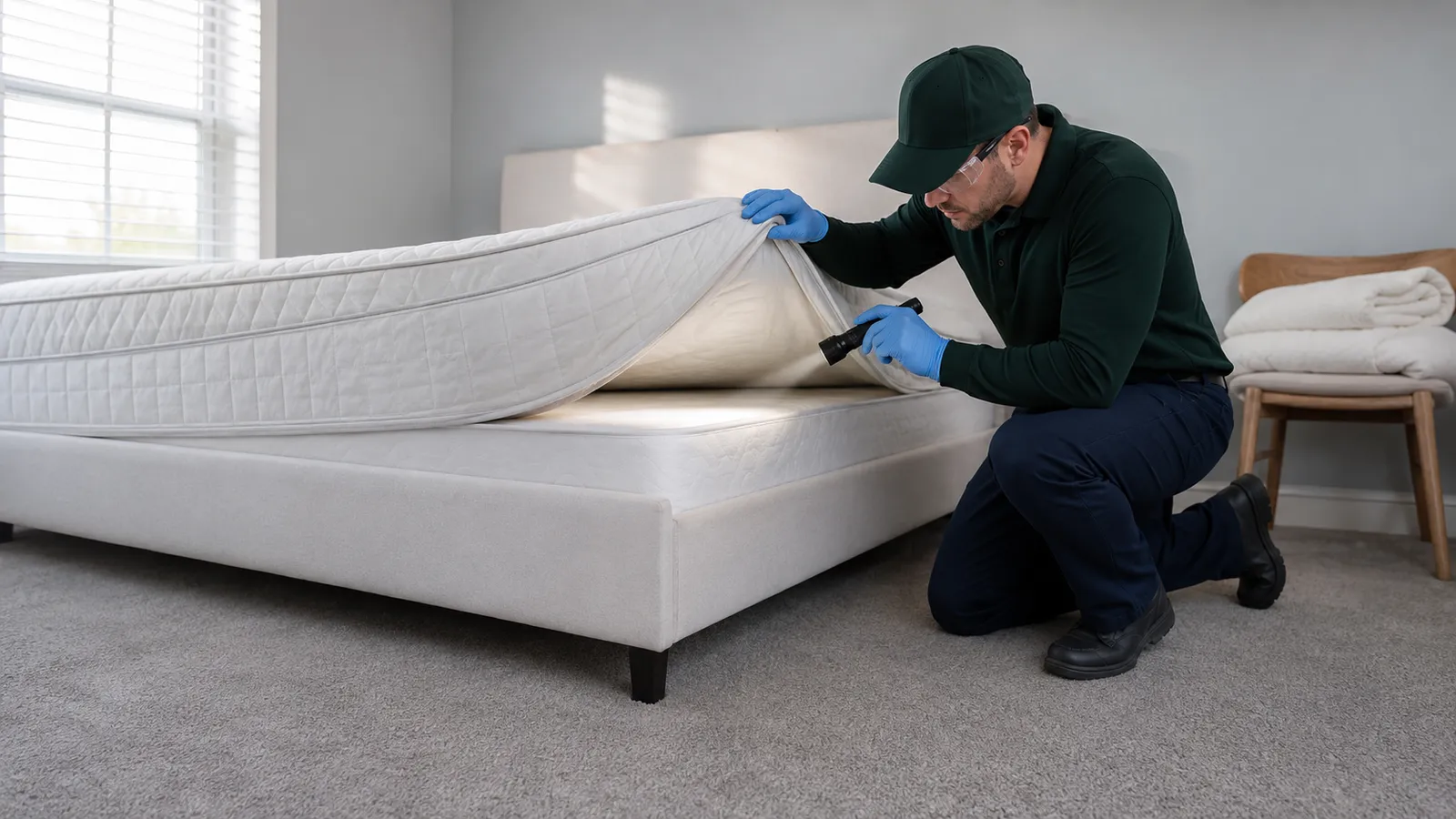
Can you get rid of bed bugs without a professional?
Realistically, no. Bed bugs harbor inside mattress seams, bed frame joints, furniture voids, and baseboard gaps that over-the-counter products do not reach, and their eggs are protected from most treatments. Worse, most retail sprays are repellent, so they drive bed bugs out of known harborage and into wall voids and adjacent rooms — turning a one-room problem into a whole-home one. Effective treatment means confirming the pest first, preparing the home properly, and then applying treatment across several visits timed to the life cycle so that eggs hatching after the first visit are still addressed.
Service Overview
Bed bugs can happen to anyone. They are hitchhikers, not a sign of a dirty home, and they are also one of the few pests where do-it-yourself efforts reliably make things worse. They hide in places you cannot reach, their eggs are shielded from most products, and store-bought sprays are largely repellent — which scatters an infestation from one room into several. This is a pest that needs professional treatment to actually be removed, and it needs it in stages, because no single application reaches eggs, nymphs, and adults at once.
Key Takeaways
- Bed bugs are a genuinely difficult pest and need professional treatment to be eliminated — this is not a DIY problem.
- Step one is confirming it is actually a bed bug. Carpet beetles and other insects are routinely mistaken for them, and the wrong identification means the wrong treatment.
- You will get a preparation checklist — mostly laundering — and doing it properly is what makes the treatment work.
- Each treatment visit covers furniture, mattresses, and perimeters, because bed bugs are never in only one of the three.
- Multiple visits are required. Eggs are shielded from product, so treatment is staged to catch each life stage as it emerges.
- We provide chemical treatment only — no heat treatment. See the FAQ below for why.
- Store-bought sprays are largely repellent and tend to spread an infestation rather than reduce it.
Key Benefits
- ✓Confirmed identification before any treatment is applied
- ✓A clear preparation checklist so the treatment is not undermined
- ✓Treatment across furniture, mattresses, and perimeters at every visit
- ✓Staged visits that account for eggs and every life stage
Identification First
We confirm the pest before treating. Carpet beetles, bat bugs, and other insects get mistaken for bed bugs often enough that skipping this step means a real risk of treating the wrong thing.
Growth Regulators
We use products that prevent young bed bugs from reaching reproductive age, so the population cannot rebuild between visits.
Furniture, Mattresses, and Perimeters
Every visit covers all three. Treating only the mattress leaves the frame and baseboards untouched, and the population simply shifts.
Our Decisive Process
Inspection & Confirmation
We verify the pest is genuinely a bed bug and not a look-alike such as a carpet beetle, then locate the harborage points. Getting this wrong means treating the wrong problem.
Your Preparation Checklist
You receive specific homework — principally what to launder and how — because product cannot reach what is buried in fabric and clutter. This step decides how well the treatment works.
Three-Part Treatment
Each visit treats furniture, mattresses, and the room perimeters. Bed bugs are never confined to just one of those, so all three are covered every time.
Repeat Visits Across the Life Cycle
Eggs are shielded from product, so a single visit cannot finish the job. Treatment is repeated on a schedule that catches nymphs as they hatch and reach the treated surfaces.
Why this takes more than one visit
Bed bug eggs are cemented into cracks and seams and are protected from the products that kill adults and nymphs. That single biological fact drives the whole treatment structure: whatever is applied on the first visit, a fresh wave hatches afterward. Staging the treatment means those newly hatched bed bugs emerge onto surfaces that are still working. Anyone offering a one-and-done bed bug treatment is describing a best case, not a plan.
- ✓Visit one addresses the adults and nymphs present at that moment
- ✓Eggs already laid continue hatching over the following weeks
- ✓Later visits catch each emerging generation before it can breed
- ✓Your laundering and preparation between visits removes what product cannot reach
It is not a cleanliness problem
We say this plainly on every bed bug call, because embarrassment is the main reason people wait — and waiting is the only thing that genuinely makes an infestation harder and more expensive to resolve. Bed bugs arrive in luggage, on second-hand furniture, in delivery boxes, from a hotel stay, or through a shared wall in an apartment building. None of that reflects on how a home is kept.
Service FAQs
"Do you provide heat treatment?"
We do not — we provide chemical treatment only. To be effective, heat treatment has to hold a structure between roughly 120 and 140 degrees Fahrenheit for several hours. At those temperatures you risk melting electronics and wiring in the home, which trades a pest problem for a different and often more expensive kind of damage.
"How do I know it is actually bed bugs?"
You often cannot tell from bites alone, and that is exactly why the first visit is an inspection. Carpet beetles in particular get mistaken for bed bugs regularly. What confirms it is physical evidence — live insects in mattress seams or bed frame joints, rust-colored spotting on the sheets, dark specks, and translucent shed skins. If you have caught something, keep it; one specimen ends the guesswork.
"Why do I have to do laundry before you treat?"
Because no product reaches bed bugs buried in fabric. Laundering on a hot wash and, more importantly, a full high-heat dryer cycle handles every life stage including eggs in the items you can put through a machine. It is the part of the job only you can do, and skipping it is the most common reason a treatment underperforms.
"Do I have to throw away my mattress?"
Usually no. In most cases we can treat the mattress, and a professional-grade encasement rescues it afterwards. We will tell you honestly if something is genuinely beyond saving, but that is the exception — and dragging an infested mattress through the house carries its own risk of seeding new rooms.
"Where do bed bugs come from?"
Travel and second-hand items, mostly. Hotel stays, luggage, public transport, used furniture, and delivery packaging are all common routes, and in apartment buildings they move through shared walls and plumbing chases. They do not discriminate by how clean a home is.
"Do bed bugs spread disease?"
They are not known to transmit disease to people. The real problems are the bites themselves, the sleep disruption, secondary infection from scratching, and the stress of the infestation — which are reason enough to deal with it promptly.
"How long can bed bugs survive without feeding?"
Months, in the right conditions — which is why an empty apartment or an unused guest room is not self-clearing, and why an infestation can reappear when a rarely used bedroom is occupied again. Time alone does not solve this one.
"How much does bed bug treatment cost?"
It depends on how many rooms are involved and how established the infestation is, which is why we quote after the inspection rather than over the phone. What we can tell you is that the cost climbs with delay, because a population that has spread to more rooms takes more visits.
"How will I know when they are gone?"
By the absence of new evidence over time rather than by a single clear night. Because eggs keep hatching after the first visit, some activity between treatments is expected. What matters is the trend across visits, and the final visit is where we verify no new activity has emerged.
"Should I throw out my furniture or move to another room?"
Please do neither without talking to us first. Moving to a different bed or the couch relocates the problem, because bed bugs follow carbon dioxide. And carrying furniture through the house to discard it is a reliable way to seed new rooms on the way out.
Identify What You're Dealing With
Treatment starts with correct identification. These pest library entries cover the species we target with this service.
Specialists you
can count on.
Xtermicon was founded in 2015 with one focus: protect Southern California homes and businesses from the pests that threaten them. The name says it all — eXterminate TERmites & pest CONtrol — and that's exactly what we do. We're a family-owned team specializing in termite control, pest control, and rodent exclusion. From West LA and East LA to the beach cities and Orange County, we're local neighbors who treat your property like our own.